





CPI(M) MP John Brittas has once again taken to social media to indulge in political theatrics, this time accusing the government of “deliberately elevating V D Savarkar over Mahatma Gandhi.” In his X post, Brittas alleged that the move undermines India’s “secular constitution,” invoking Mahatma Gandhi’s assassination, Savarkar’s acquittal, and the Kapur Commission’s circumstantial observations.
The deliberate elevation of V.D. Savarkar over Mahatma Gandhi is not a coincidence but a calculated act. The government’s actions undermine the nation’s commitment to its secular constitution. It is pertinent to note that Savarkar was an accused in Gandhi’s assassination, though… pic.twitter.com/hSZ6mpkW4G
— John Brittas (@JohnBrittas) August 15, 2025
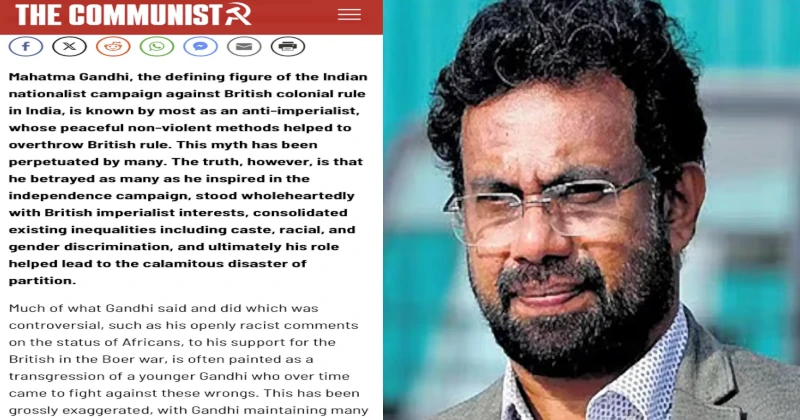
But Brittas’s grandstanding collapses under the weight of his own party’s history. The Communist Party of India, to which Brittas owes his ideological loyalty, has never regarded Gandhi as a saintly figure. In fact, the CPI’s April 13 1943 resolution painted Mahatma Gandhi as a collaborator, casteist, and imperialist stooge. The party openly declared Gandhi’s “myth” of non-violence as a carefully constructed façade, accusing him of betraying India’s masses and siding with British interests.
Could you show me where Mohandas is mentioned in the constitution? Btw here’s what communists think of Gandhi … your 13th April 1943 resolution had this exact view of Gandhi. https://t.co/9UST7TVzL8 pic.twitter.com/WrkXnMbYkg
— Abhijit Iyer-Mitra (@Iyervval) August 15, 2025
The CPI(M)-affiliated website still carries a damning portrayal of Mahatma Gandhi, stating:
“Mahatma Gandhi… betrayed as many as he inspired in the independence campaign, stood wholeheartedly with British imperialist interests, consolidated existing inequalities including caste, racial, and gender discrimination, and ultimately his role helped lead to the calamitous disaster of partition.”
It even cites Mahatma Gandhi’s racist comments against Africans, his support for the British in the Boer War, and his continued defense of social hierarchies as evidence that Gandhi was no liberator, but rather a moralist who safeguarded entrenched privileges.
This is the same Mahatma Gandhi whom Brittas and his comrades now claim to defend against the legacy of Savarkar.
Brittas’s reference to the “secular constitution” is equally misleading. The Constitution of India, drafted by Dr. B.R. Ambedkar and his colleagues, does not mention Gandhi by name. This was intentional. The Constitution was meant to enshrine universal values of justice, liberty, and equality—not to elevate any individual as above the republic.
Thus, when Brittas weaponises the Constitution to posture as Mahatma Gandhi’s saviour, he is simply indulging in political deception. Neither Gandhi’s image nor his ideology was built into the foundational legal text of India.
On Savarkar, Brittas parrots the tired claim that he was “an accused in Mahatma Gandhi’s assassination.” Yes, Savarkar was tried—but he was acquitted due to lack of evidence. Decades later, the Kapur Commission noted circumstantial links, but even those never formed a legal basis for conviction. Savarkar’s imprisonment in the Andamans, his early revolutionary activities, and his articulation of a Hindu cultural identity remain inconvenient truths for those who thrive on demonising him.
If association with Mahatma Gandhi’s killing is Brittas’s only card, then he conveniently forgets that his own party’s intellectual forebears denigrated Gandhi when he was alive, labeling him a reactionary who derailed genuine anti-imperialist struggle.















Comments