





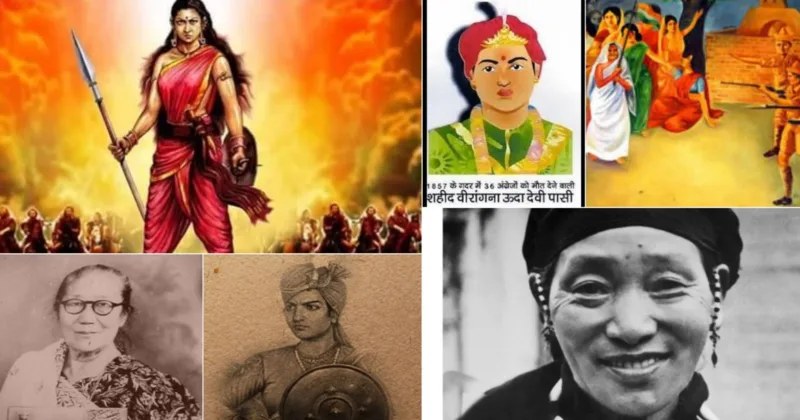
Bharat celebrated its 79th Independence Day on August 15, 2025. Tribal women played an invaluable and often overlooked role in India’s independence movement. From leading armed rebellions to protecting their cultural heritage, these courageous women demonstrated immense bravery and strategic leadership. They fought not only for political freedom from British rule but also to defend their way of life, land, and identity against colonial exploitation.
Tribal women warriors like Rani Durgavati, descendants of Tilka Manjhi, and Sushila Samad have demonstrated unparalleled courage, sacrifice, and leadership in Bharat’s freedom struggle. These valiant women not only took up arms but also fought to protect their culture, language, and identity, offering unprecedented sacrifices for the nation.
This report is based on the bravery of 12 tribal women freedom fighters who made unique contributions to the Indian independence struggle through their courage, leadership, and sacrifice from 1824 to 1947.This report is based on the bravery of 12 tribal women freedom fighters who made unique contributions to the Indian independence struggle through their courage, leadership, and sacrifice from 1824 to 1947.
Rani Gaidinliu: The Naga freedom fighter
Rani Gaidinliu, also known as the “Rani Lakshmibai of Nagaland,” joined the freedom struggle in 1930 at the young age of 13. A native of Zeliangrong, Manipur, she fought alongside her brother Cousian and Haipou Jadonang in the Heraka movement, which aimed to re-establish Naga rule and drive out the British. For her service to the nation, she was honoured with the Padma Bhushan in 1982. She passed away on February 17, 1993. In her memory, the Government of Bharat issued a postage stamp in 1996 and a commemorative coin in 2015.
Ka Phan Nonglait: The warrior of the Khasi Hills
Ka Phan Nonglait, the first woman freedom fighter from the Khasi Hills, Meghalaya, was celebrated for her bravery and cleverness during the rebellion against British colonialism. She was part of the revolt against the British army led by the brave Khasi warrior U Tirot Sing Syiem. In one instance, she cleverly offered a snack to British soldiers who were resting near a waterfall. When they put down their weapons, she seized them and threw them into a rocky gorge. The loss of these weapons is said to have led to the British army’s defeat, with 32 of their soldiers being killed. The waterfall is now known as the ‘Ka Phan Nonglait Fall’. Her contribution is remembered as a testament to the courage and strategic thinking of a woman warrior in the history of the Indian independence struggle.
Helen Lepcha: The tribal freedom fighter of the Swadeshi Movement
Helen Lepcha, a tribal freedom fighter from Sangmoo village in Sikkim, actively participated in the Swadeshi Movement. Helen was deeply moved by the Charkha and Khadi movements propagated in the hills. She traveled to Calcutta in 1918 and trained in spinning at a center run by the granddaughter of Ishwar Chandra Vidyasagar. She traveled to various places, inspiring people to adopt Swadeshi goods and fostering a sense of patriotism. She was also deeply involved in social service. During the 1920 floods in Bihar, she worked tirelessly to help the victims in Muzaffarpur. Mahatma Gandhi, impressed by her dedication, renamed her “Savitri Devi.” In 1921, she attended the Ahmedabad Congress Session with Sarojini Naidu. She led a procession of over ten thousand workers in the coal fields of Jharia, fearlessly protesting the exploitation of tribal laborers. The Bengal government honoured her with the mountain tribe chief title for tribal eminence in 1958. Later, the Government of Bharat honoured her with the “Tamra Patra Samman” and the “Swatantrata Senani Pension” in 1972.
Sushila Samad: The first tribal woman to become a ‘Vidushi’
Sushila Samad was a freedom fighter from the Munda tribal community in Singhbhum, Jharkhand. She was the first tribal woman in the country to earn the title of ‘Vidushi’ (scholar). A Hindi poetess, journalist, editor, and publisher, she was a fierce freedom fighter. She earned her Hindi education from the Prayag Mahila Vidyapeeth and dedicated her life to organising and politically awakening women. When Mahatma Gandhi started the Dandi March in 1930, she led the tribal women’s participation in the movement in Jharkhand. Her contribution remains an inspiration not only in the literary world but also in the freedom struggle.
Tileshwari Barua: A child martyr of the Quit India Movement
At just 12 years old, Tileshwari Barua, a young girl from Dhekiajuli, Assam, joined the Quit India Movement in 1942. She became a member of the “Mrityu Bahini” (suicide squad), a group of women who had vowed to hoist the national flag at police stations, even if it meant sacrificing their lives. On September 20, 1942, Tileshwari was martyred during the freedom struggle. Her sacrifice became a source of pride for Assam and the entire nation. September 20 is celebrated as ‘Martyr’s Day’ in Assam in her honour. During his visit to Dhekiajuli, Prime Minister Narendra Modi paid tribute to her. Under the ‘Har Ghar Tiranga’ campaign, the Government of Bharat honoured her as a brave young martyr.
Kanaklata Barua: The youngest martyr of the Quit India Movement
Kanaklata Barua, hailed as the “Rani Lakshmibai and Birangana of Assam,” was just 17 years old when she sacrificed her life during the Quit India Movement. She was a member of the ‘Mrityu Bahini’ (suicide squad). On September 20, 1942, she led a procession with the aim of hoisting the national flag at the local police station in Tezpur. Holding the tricolor flag, she fearlessly marched forward, even after the station in-charge warned her that she would be shot if she proceeded. Kanaklata did not stop. As soon as she crossed the barricade, the police opened fire, and she was martyred for the country. Her bravery remains a source of inspiration for Assam and the entire nation. Her sacrifice stands as a shining example of the role women played in the freedom struggle.
Parvati Giri: The ‘Mother Teresa of western Odisha’
Parvati Giri, hailed as the “Mother Teresa of Western Odisha,” quit school at the age of 11 to join the Quit India Movement. At just 16, she openly challenged the British government, for which she was imprisoned. However, due to her being a minor, she was released shortly after. Following her release, she led a public awareness campaign in support of the Quit India Movement in Odisha and other parts of the country.
After independence, Parvati Giri dedicated her life to social service. She played a vital role in raising and educating orphaned children in her village, and she made significant contributions in the fields of education, healthcare, and humanitarian work. In 1950, she completed her formal education from Prayag Mahila Vidyapeeth, Allahabad. In honour of her contributions, the Odisha government named a mega lift irrigation project after her as the “Parvati Giri Yojana” in 2016. In 1998, she was awarded an honorary doctorate by Sambalpur University.
Kuntala Kumari Sabat: The Nightingale of Utkal
Kuntala Kumari Sabat was a female freedom fighter from Odisha who dedicated her life to serving the nation through literature and medicine. She earned the esteemed titles of “Nightingale of Odisha” and “Bulbul of Utkal.” After receiving her education from Ravenshaw Girls’ School and completing her medical studies from Orissa Medical School, Cuttack, she began her career as a doctor.
During the freedom struggle, she used her powerful poems to awaken people’s patriotism. Her poem ‘Anjali’ received special praise. She was also actively involved in social organisations like ‘Nava Vidhan’, the ‘Brahmo Society’. A prominent women’s cultural organisation honored her with the title “Utkal Bharati.” Her life became a symbol of women’s empowerment and nationalism in Odisha.
Kalibai: The goddess of education
Kalibai, a brave girl from the Bhil tribal community, is honoured as the “Goddess of Education.” At just 12 years old, she showed extraordinary courage by protesting the British and the Dungarpur princely state’s ban on education. On June 19, 1947, when British soldiers tied her teacher, Nanabhai Khant, to their jeep and started dragging him, Kalibai used her sickle to cut the rope and tried to save her guru. For this heroic act, the British shot her, and she was martyred on the spot.
Kalibai’s sacrifice became a symbol of lighting the torch of education in the tribal regions. Today, schools, colleges, intersections, and panoramas are named after her, which continue to inspire future generations with a message of education and courage.
Rani Ropuiliani: The brave freedom fighter of Mizoram
Rani Ropuiliani was a freedom fighter with unparalleled courage and strong determination. In 1890, when the British attacked several areas of Mizoram, she fearlessly organized the Mizo people and led their fight against the British. After the death of her husband, she took over the reins of self-governance and played a leading role in the Mizo struggle. Rani Ropuiliani famously said, “The land of Mizoram is my life.” This statement reflects her profound love and devotion for her motherland.
Lipa: The unparalleled sacrifice for the motherland
Lipa, a courageous and unique warrior from the Jarawa tribe of the Andaman and Nicobar Islands, made the ultimate sacrifice for Bharat’s freedom struggle. In the Battle of Aberdeen on May 17, 1859, a fierce conflict broke out between the British forces and the Jarawa warriors. Lipa, who was pregnant, sacrificed her life to protect her motherland. Her husband, an English soldier named Dudhnath Tiwari, betrayed the Jarawa warriors, which led to their defeat. Despite the loss, Lipa’s sacrifice remains a unique and immortal tale of motherhood and patriotism.
Phulo and Jhano Murmu: The twin sisters of the Santhal Rebellion
The twin sisters of the Santhal tribe in Jharkhand, Phulo and Jhano Murmu, played a significant role in the Santhal Rebellion (1855–1856) against British rule. They were the sisters of Sido and Kanhu, the leaders of the Santhal Rebellion. Their bravery and leadership inspired many Santhal warriors. They organised women and trained them to use swords, spears, and bows and arrows. In 1856, a fierce battle broke out in which both sisters were martyred.
The Jharkhand government has started the ‘Phulo-Jhano Dairy Technical College,’ the ‘Phulo-Jhano Medical College,’ and the ‘Phulo-Jhano Ashirwad Yojana’ in their memory. The sacrifice of Phulo and Jhano is a symbol of women’s power, tribal pride, and a glorious chapter in the freedom struggle.
The narratives of these brave individuals offer a powerful and inspiring look into the diverse heroes of the freedom struggle. Their stories highlight that the fight for independence was not limited to major leaders or well-known figures; it was a collective effort carried out by people from all walks of life, including young women and members of tribal communities.
Their sacrifices – whether resisting colonial authority, promoting social reform, or dedicating their lives to humanitarian service – were driven by an unwavering love for their country. Each person’s journey reflects remarkable courage and a deep commitment to freedom and justice. These accounts remind us of the immense and often overlooked contributions that shaped a nation, leaving a legacy of bravery and selflessness for future generations.














Comments