





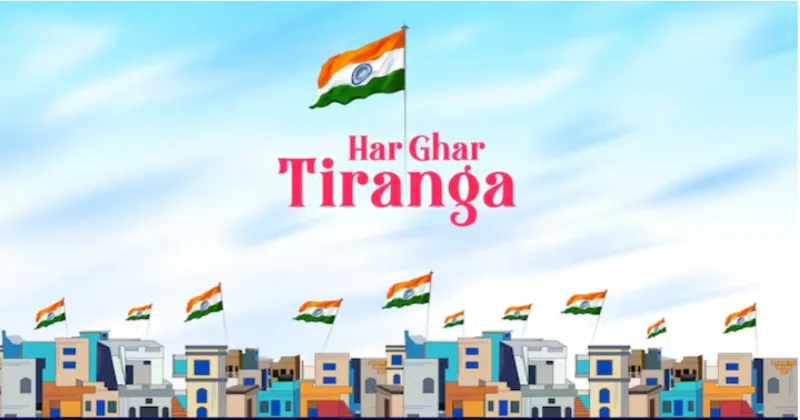
The nation is poised to celebrate her 79th Independence Day and the “Har Ghar Tiranga” campaign is witnessing an overwhelming response, to the extent that it has motivated Prime Minister Narendra Modi to tweet, “Glad to see #HarGharTiranga receiving phenomenal participation across India. This shows the deep patriotic spirit that unites our people and their unwavering pride in the Tricolour. Do keep sharing photos and selfies on http://harghartiranga.com.
The Har Ghar Tiranga campaign was launched as a part of the Azadi Ka Amrit Mahotsav by the BJP led Union Government. The initiative is spearheaded by the Ministry of Culture with support from state governments, volunteers, and local bodies. It encourages and inspires the citizens of the country to hoist the national flag (Tiranga) in their houses, offices etc. as a part of the independence day celebrations, pledge allegiance, and bask in the collective pride of the country. The practice has been going on since the last few years with each year witnessing a new zeal and vigour that surpasses the previous year.
The Significance of the National Flag
A flag is the most motivating entity of all. “Our relationship with the flag has always been more formal and institutional than personal. Bringing the flag home collectively as a nation becomes symbolic of not only a personal connection to the Tiranga but also an embodiment of our commitment to nation-building,” says Lt. General Satish Dua, a military veteran.
In India, a flag has been a symbol of power, authority and tradition since ancient times. Commonly called the “Dhwaj” it initially indicated the position of the King or the general in a war. The falling of a Dhwaj indicated the falling of its owner. With time, the Dhwaj found its way from the battlefield into the palaces of the rulers and gained a sacred position.
In the modern world, all nations have a national flag. The colours of the flag personify the character and the ideology of the nation. World leaders display their National flags in the background when they hold meetings with other leaders. The national flag flies atop the residence of the national leaders like the president and prime minister.
Sports teams carry their National flags at the head of the contingents in opening and closing parades of the events. The flag also adorns the sports podium when a sportsperson of the country attains international laurels. Mountaineering expeditions carry and plant their team flags and their national flags at the summit. Expeditions to Antarctica or the moon plant their national flag.
Military Flags
Flags have a special significance in the military domain. Most militaries have distinct flags from army level to the fighting regiment. The regimental flags are termed as Ensigns, Standards and Colours and are presented by the supreme commander in recognition of the good military performance of the unit. These are distinct from the national flag which of course, holds the highest level of precedence.
Flags in the Indian Armed Forces personify the concept of “Naam, Namak, Nishaan.” Naam relates to the good name of your country, your army and most of all your regiment. Namak involves being true to the salt of the country. Most important is the Nishaan that denotes the Ensign, Flag, Standard or colour of the unit.
If a unit is defeated in battle, the victor takes possession of its standard and places it upside down in his own unit. It is the ultimate and enduring shame for the defeated enemy. Armies plant their flags on the fort or the objective after victory. The regimental standard and the Tiranga, therefore, motivates the soldier to lay down his life of preserving its honour.
Such is the romanticism of the flag that they have become an identity symbol for multiple organisations ranging from political parties to even corporate houses.
The Evolution of the Tiranga
The need for a distinct flag was felt by the Indian National Congress in the beginning of the twentieth century. In 1908 the first tricolour flag was instituted. It included eight white lotuses on the upper green band representing the eight provinces, a sun and a crescent on the bottom red band, and the Vande Mataram slogan in Hindi on the central yellow band. It was called the Calcutta Flag and also the Vande Mataram flag.
The hunt for a perfect flag, however, continued. Many options were suggested by senior iconic leaders like Madam Bhikaiji Rustom Cama and Sister Nivedita, a disciple of Swami Vivekananda. Sister Nivedita had earlier designed what was known as the Vajra Flag.
In 1916, Mahatma Gandhi, with the assistance of Pingali Venkayya, designed a flag that was to be called the Swaraj Flag. It had the colours White, Grey and Red with a Charkha (spinning wheel) in the centre.
The Advent of the Kesari Colour
In the early 1920’s, the freedom movement was gaining great momentum in the Punjab. Institutions like the Shiromani Gurdwara Prabandhak Committee and the Shiromani Akali Dal had come into existence and the fight for freedom was in full swing. Sikhs were being persecuted by the British and sent to Kaala Pani (prison in the Andaman and Nicobar Islands) in great numbers.
The Indian National Congress wanted the Sikhs to join it in the freedom struggle. The Sikhs said that they were in agreement conceptually but would not fight under the flag of the INC. It was at this time that Baba Kharak Singh, a tall leader of the Sikhs, strongly advocated that saffron (Kesari), the colour of the Sikh flag (Nishaan Sahib), be incorporated in the Congress flag to depict unity of purpose.
While being close to the heart of the Sikhs, the Kesari colour also represented Hindu thought from ancient times. It was the representative colour of several martial segments like the Rajputs and the Marathas. The proposal was put up to Mahatma Gandhi who suggested that the matter be considered by the flag committee.
Thus, the Indian National Congress flag, therefore adopted three colours – Kesari on top to depict strength and renunciation; white in the middle to denote peace and green to denote mother earth with the Charkha in the centre and named it the Swaraj flag.
The adoption of the National Flag
The flag for democratic India was, once again, designed by Pingali Venkayya. He based it on the Swaraj flag after replacing the Charkha in the centre with the Ashok Chakra.
The Indian National flag, also called the Tiranga, is a horizontal rectangular tricolour flag, the colours being saffron, white and India green; with the Ashoka Chakra, a 24-spoke wheel, in navy blue at its centre. It was adopted in its present form during a meeting of the Constituent Assembly held on 22 July 1947, and it became the official flag of the Union of India on 15 August 1947. The flag was subsequently retained as that of the Republic of India.
The Har Ghar Tiranga Campaign
The campaign involves the following steps
· Hoist the Flag: From 2 August to 15 August – Hoist the Tiranga in your home, office, institution, or at any convenient place.
· Share Your Tiranga Selfie: Capture a selfie or photo with the flag and upload it to the official portal: https://harghartiranga.com/selfie.
· Register for Joining: Enter name, mobile number when requested. Fill up the form and photograph.
· Take the Har Ghar Tiranga Pledge: Go to the online pledge platform (pledge.mygov.in) to take the authentic pledge and download a special, downloadable certificate.
· Download Your Certificate: After getting registered and uploading a photo/selfie, download your digital certificate from the site. Instructions for doing the same are provided in the subsequent section.
There is something about a flag that motivates even the weakest to rise to phenomenal levels. It raises the spirit (exemplified by Josh in military jargon) to unimaginable heights and gives an unprecedented drive for achievement in the name of the country or any organisation that a person has an affiliation with. It symbolises courage, beyond the call of duty and an enduring desire to win.












Comments