





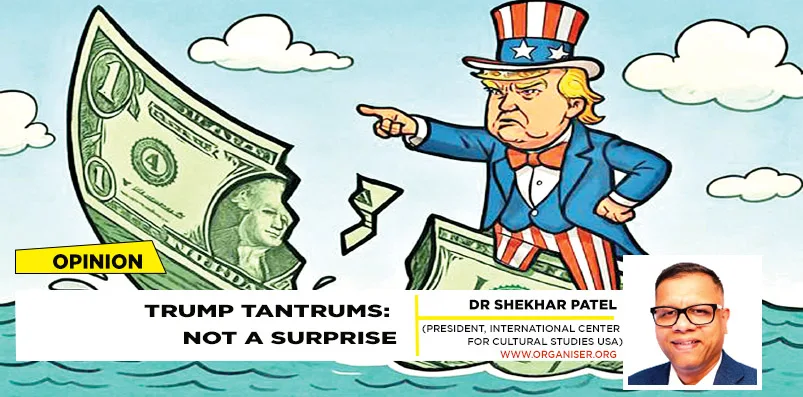
The United States has reached a crucial turning point in its history, facing a range of foundational challenges that are jeopardising its economic, social, and political stability.
Economically, the nation’s debt has skyrocketed to historic levels, with forecasts predicting the accumulation of additional trillions of dollars over the next decade. Currently, the interest on this debt is greater than the defense budget. If inflation continues, America may soon struggle to cover its basic needs. This situation is exacerbated by significant trade deficits stemming from a materialistic society that relies on the Dollar’s status as the global reserve currency. Under the impulsive leadership of the Trump administration, tariffs have been implemented as a catch-all “solution,” disregarding historical context, factual evidence, and future repercussions. Consequently, these actions are likely to cause inflation and risk long-term global and U.S. GDP contraction, with the financial burden falling not only on exporting countries and American businesses but eventually on the citizens of the U.S. who are already burdened by economic disparity.
Socially, the White segment of the American population is not replacing itself at sustainable levels. There is a growing fear that non-White populations will eventually become politically dominant, which has made immigration a contentious issue in the U.S. Once a source of economic growth, immigration is now nearly halted, with efforts focused on deportation and stricter border enforcement. Racial tensions, increasing political divisions, deteriorating healthcare, and widening disparities are further complicated by corporations that are struggling with tariff burdens that erode profits.
At the centre of these problems is decades of unchecked consumerism. Even Trump remarked that “I don’t think that a beautiful baby girl needs – that’s 11 years old – to have 30 dolls; I think they can have three dolls or four dolls…” What is striking is that none of the divisive political debates in America address waste as a major issue. The amount of useful but discarded products generated by Americans is staggering. This rampant consumerism has led to environmental degradation, resource depletion, and greenhouse gas emissions. Although America comprises only four per cent of the world’s population, it consumes 16 per cent of global primary energy, significantly contributing to environmental impact. There is a lack of public discourse acknowledging that there are limits to growth.
The post-World War II era was a time when the United States rose to unparalleled power, with the Dollar established as the global reserve currency through the 1944 Bretton Woods agreement. This position allowed the U.S. to engage in unchecked monetary expansion to finance imports and foster consumerism. Over generations, America’s dominance attracted capital from across the world, fuelling military, technological, and market advancements. Its geographical advantages supported freedom from wars for its population, which was free to enjoy and spend on the pleasures of the world while the world assumed debt. Ultimately, corporate greed led to the erosion of domestic industry, with factories relocated to countries with lower labour costs, such as China. This further amplified economic imbalances, while the Dollar’s status masked American weaknesses until the nation’s indebtedness became critical.
As a result, the U.S. has become a service-oriented society that is detached from physical resources and lacks the means of production, now facing an uncomfortable reality of dependency on the world. New geopolitical alliances like BRICS are perceived as threats, contributing to a sense of fear and panic in America. In response to these alarming realities, American voters exercised their democratic rights by ousting the Democrats, hoping that Donald Trump, the quintessential “Disruptor in Chief,” would instigate significant changes.
Now, Trump is acting on what he perceives as a mandate from the American populace. His transactional approach treats everyone—whether friend or foe—capriciously, disregarding both the past and the future with the intent to exploit and extract. This has made the world aware of what the United States truly is: an opportunistic nation prioritising its own interests above all else, with little regard for international laws or norms. The world now faces a challenging situation with America; collaborating with it presents one set of problems, while confronting it presents another.
For example, in 1985, when the US trade deficit expanded, the country gathered its allies. It compelled them to devalue the Dollar collectively and forced Japan and West Germany to lower their interest rates. This effort culminated in the Plaza Accord, an agreement between the US, France, the UK, Japan, and West Germany. In this agreement, the US engineered a significant devaluation of the dollar to support its deficits, which elevated the value of the Yen and the Deutsche Mark. Japan suffered significantly as its export-oriented model, heavily reliant on the US market, struggled with a doubling of the Yen, lowered interest rates that created an asset bubble, and ultimately led to an economic crisis known as the “lost decade.” West Germany, on the other hand, managed to avoid negative consequences due to its smaller exposure to the US economy and its fiscally prudent policies.
Countries can mitigate the adverse effects of America’s decline by drawing lessons from West Germany’s experience. They must diversify their markets to reduce reliance on the US, implement stringent monetary policies to prevent exposure to greedy FDI investors, and form local or regional coalitions to withstand political shocks from the US administration.
Bharat is already pursuing self-reliance and building resilience by empowering allied Nations through bilateral trade agreements. Clearly, President Trump is aware of this strategy. Recently, he targeted Brazil, Bharat, Russia, and China in an attempt to divide them and preempt any challenge to the dominance of the Dollar. He has also issued explicit threats against BRICS nations. Countries like Bharat will not allow any other country to repeat the historical exploitation that Imperial Britain imposed on them. Trump’s mercantilist policies bear resemblance to Britain’s 19th-century exploitation of Bharat, where British forces compelled Bharatiya farmers to export raw cotton at depressed prices while flooding Bharatiya markets with duty-free textiles. This led to a drastic decline in Bharat’s industrial share of the global economy, dropping from 25 per cent in 1750 to below 3 per cent by 1900.
Countries like Bharat will not allow any other country to repeat the historical exploitation that Imperial Britain imposed on them. Trump’s mercantilist policies bear resemblance to Britain’s 19th-century exploitation of Bharat
Through trade reorientation, accelerated efforts for de-dollarisation, and participation in groupings similar to BRICS, Bharat can leverage its intrinsic strengths to assert its independence from Trump’s influence. This could position Bharat as a rival should the US continue to falter, which is likely. Furthermore, the actions Bharat takes will enhance its prominence on the global stage, potentially attracting other countries to recognize the benefits of its initiatives. Historically, punitive actions from the West have spurred innovation and independence in Bharat. Ultimately, a new equilibrium will be achieved where the US will have to redefine its role in the global hierarchy.
Trump should understand that while Bharat is capable of making friends and is often forgiving, it does not tolerate injustice and bullying. Given Trump’s temperament, it is not far-fetched to envision Bharat assuming a role similar to that of Rama if pushed too far by Ravana. The silver lining to Trump’s agenda is its potential to promote sustainability by reducing consumerism. In addition, Trump’s short-sighted agenda could drive the rest of the world to seek solutions for global welfare that exclude American involvement. Ironically, despite the short-term challenges faced by businesses and America’s current trade partners, the long-term outcome will likely be beneficial as the US’s global influence is gradually recalibrated, a change that Trump appears to be desperately trying to maintain.
Those who have followed my articles know that I wrote in Organiser Weekly on January 17, 2023, that America is greedy and serves as a modern-day Ravana. The question was whether Bharat would play the role of one of Ravana’s heads, like greedy America, or if it would take on the role of Vibhishana or Rama? Looks like President Trump wants Bharat to play the role of Rama.














Comments