





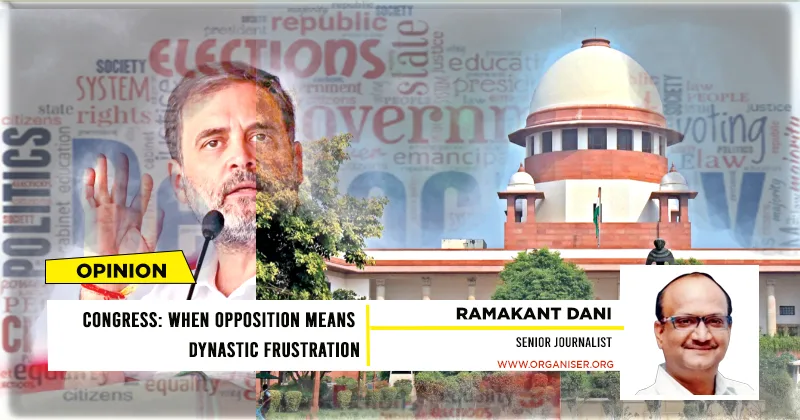
In a democratic polity, the Leader of the Opposition (LoP) is expected to question, critique, and hold the Government accountable — always within the bounds of national interest. But when criticism morphs into international denunciation, unverified claims, or repeated attacks on institutions, it invites not just political debate but also legal and moral scrutiny.
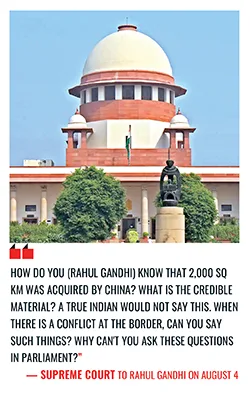
In a dramatic moment, the Supreme Court recently issued a stinging rebuke to Congress leader Rahul Gandhi over his remarks about the Bharatiya Army and territorial integrity. The Court’s observation — “A true Indian will not say all this” — was not just a legal comment but a moral censure that echoed widely across political lines.
The BJP responded strongly, calling Gandhi a “certified anti-national” and “China Guru.” Congress and its INDI bloc allies termed the Court’s remarks “extraordinary and unwarranted.” Rahul’s sister and MP, Priyanka Gandhi Vadra, countered: “With due respect to the honourable judges, it is not for them to decide who a true Indian is.”
But this was not an isolated incident — rather, the latest in a sequence of statements raising doubts about Gandhi’s political maturity and national sense of responsibility.
Loose Claims and Judicial Questions
The controversy stemmed from Gandhi’s statements during the Bharat Jodo Yatra in December 2022. He alleged that China had “captured 2,000 square km of Indian territory” and had “thrashed our jawans in Arunachal Pradesh.” These claims prompted a criminal defamation complaint, which the Supreme Court has currently stayed.
During the hearing, Justices Dipankar Datta and Augustine George Masih questioned the credibility and impact of these assertions. “Were you there? How did you get to know? Do you have credible material?” the bench asked. They emphasised that such remarks — especially amid tensions — should be voiced in Parliament, not aired through the media.
This wasn’t merely a legal issue; it was a reminder that a national leader’s words carry weight and consequences.
Domestic Alarmism and Institutional Distrust
On January 15, 2024, Gandhi declared: “The BJP and RSS have captured every single institution. We are now fighting the BJP, the RSS, and the Indian State itself.”
This led to an FIR in Guwahati, with the complainant alleging that these remarks endangered public order and national unity. Critics viewed it as a move to delegitimise the constitutional framework by projecting the State as adversarial.
During his U.S. visit, Gandhi claimed Bharatiya Sikhs feared they might lose the right to wear turbans or visit gurdwaras. This triggered a petition in an Bharatiya court citing the comments as inflammatory. Sikh organizations distanced themselves, calling the claims alarmist and inaccurate.
A visibly frustrated Congress appears to have undergone a reshaping of its ideological stance. This coincides with increased influence from left-liberal intellectual circles, often critical of nationalist narratives
Such repeated invocation of fear and victimhood, without credible substantiation, reflects a tendency toward political dramatisation over constructive engagement.
Global Criticism and Its Diplomatic Fallout
Gandhi’s repeated use of global platforms to criticise Bharat has raised concerns even among neutral observers. At a Cambridge seminar in 2023, he described Indian democracy as “under brutal attack,” sparking diplomatic unease. While democratic critique is essential, airing unverified or exaggerated claims on foreign soil often plays into adversarial narratives.
Critics argue that such remarks erode Bhart’s global image and provide fodder for anti-Bharat lobbies, especially at multilateral forums where national unity is paramount.
These international remarks don’t just travel — they reverberate. They find space in hostile media, official reports, and UN briefings, influencing how Bharat is perceived, especially in the Global South where the country has long fought for credibility.
Moreover, Gandhi’s comments are increasingly being used by foreign think tanks and hostile governments to build narratives of democratic decline in Bharat. These views impact bilateral relations and give rise to scepticism about Bharat’s internal cohesion and political stability.
Ideological Drift and Congress’s Identity Crisis
Adding to the series of controversies, a very senior Congress leader and close aide to the Gandhi family, Sam Pitroda, caused an uproar in 2024 with comments on Bharat’s diversity. His remarks, made while discussing the country’s varied population, were widely perceived as insensitive and drew sharp criticism from across the political spectrum. The comments were seen by many as a significant misstep, reinforcing a public perception of a disconnect between the party’s leadership and the diverse social fabric of Bharat. Though the Congress party quickly distanced itself from the statement, a political firestorm had already been ignited.
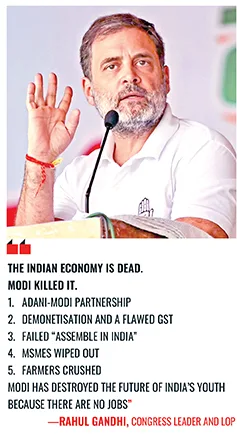
Such insensitive statements not only alienate communities but also damage Bharat’s standing as a diverse and inclusive democracy. Just recently, Rahul Gandhi publicly supported U.S. President Donald Trump’s remark calling the Bharat`s economy “dead,” asserting that “everybody knows this fact.” Gandhi also questioned Prime Minister Modi’s silence on the U.S.’s imposition of a tariff on Indian goods.
The endorsement triggered internal discord within the Congress — even as Gandhi embraced the remark, senior party figures like Shashi Tharoor and Rajeev Shukla pushed back, defending Bharat’s economic resilience. Party insiders admitted that echoing Trump’s dismissive comment was diplomatically unwise and politically damaging.
Gandhi’s tendency to validate such sweeping statements from global populists while undermining national achievements has earned him criticism across ideological lines. While Gandhi’s remarks dominate headlines, they reflect a deeper ideological shift within Congress. During moments of national urgency, the party has often chosen opposition over consensus. For example, after Operation Sindoor — a counter-terror strike by the Indian Army — the government invited bipartisan delegations abroad to expose Pakistan’s duplicity. Congress opted to criticise rather than support.
In recent years, a visibly frustrated Congress appears to have undergone a reshaping of its ideological stance. This coincides with increased influence from left-liberal intellectual circles, often critical of nationalist narratives. These leanings, rooted in the Nehruvian era’s flirtation with internationalist socialism, have re-emerged, emboldened by global discourses that valorise dissent against Governments with popular mandates.
This drift also reflects a deeper identity crisis within the Congress. Once the custodian of nationalist fervour during the freedom struggle, it now struggles to reconcile its legacy with a new-age positioning that often appears reactive and externally influenced. This ideological imbalance has left the party vulnerable — caught between appeasing global liberal opinion and addressing domestic aspirations for security, stability, and pride.
The Bigger Question
The consequence: a party increasingly seen as willing to compromise unity for intellectual validation or global endorsement. Gandhi and his supporters insist he is merely exercising democratic dissent. But his statements often appear untimely, poorly framed, and harmful to national morale. When a constitutional office bearer repeatedly makes questionable or inflammatory remarks — especially abroad — it raises more than political concerns. It calls into question his judgment, maturity, and alignment with national priorities.
The Supreme Court’s line — “A true Indian will not say this” — may not carry legal consequences, but it serves as a moral rebuke. It challenges not just Gandhi’s politics but the larger culture of entitlement and recklessness that seems to characterise the modern Congress.
In an era when India is asserting itself confidently on the world stage — diplomatically, economically, and militarily — it becomes crucial for national leaders to speak with coherence, commitment, and clarity. Words spoken out of political frustration cannot become weapons that undermine the very unity they claim to protect.











Comments