





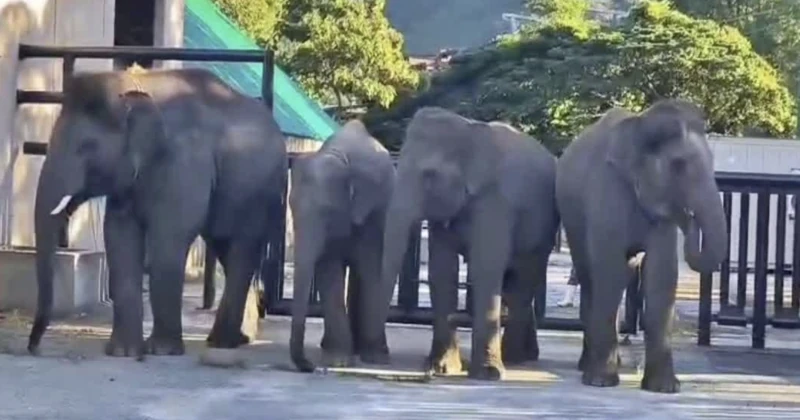
After more than two years of meticulous planning, coordination, and care, Bannerghatta Biological Park has achieved a landmark in wildlife diplomacy, completing its first-ever overseas animal exchange. Four Asian elephants, eight-year-old Suresh, nine-year-old Gauri, seven-year-old Shruti, and five-year-old Tulsi, have now made Japan’s prestigious Himeji Central Park their new home.
This achievement is not only a significant chapter for Bannerghatta but also a moment of pride for India’s conservation community. The exchange represents a rare and carefully managed opportunity for animal lovers and researchers to introduce new species to different environments while ensuring high standards of animal welfare.
The four elephants began their long journey on July 24 from their familiar surroundings in Bannerghatta. After an intensive 20–25-hour trip, they arrived safely in Japan, having flown aboard a Qatar Airways B777-200F cargo aircraft from Bengaluru’s Kempegowda International Airport to Kansai International Airport in Osaka.
Six Months of Preparation
Before embarking on their journey, the elephants underwent six months of special “flight training” to help them adjust to confinement and travel conditions. Only after veterinarians confirmed their good health and fitness to travel was the final approval for the cargo flight granted.
The exchange is part of a growing Indo-Japanese conservation partnership. It follows a 2021 exchange in which Mysore Zoo sent three elephants to Japan’s Toyohashi Zoo. This latest transfer saw two veterinarians from Himeji Central Park, two veterinary officers from Bannerghatta, four elephant keepers, a supervisor, and a biologist accompanying the animals to ensure their safety and comfort.
Cross-Cultural Elephant Care
The collaboration has led to a fascinating exchange of animal-handling techniques. In Japan, mahouts (elephant handlers) rely on gentle, reward-based methods rather than the more directive style common in India. Instead of using sticks to guide elephants, Japanese keepers offer fruits as positive reinforcement. If an elephant follows instructions, it earns a treat; if not, the absence of the treat communicates the need for different behaviour. Over time, elephants learn to respond to subtle human cues, adapting their behaviour without stress.
Another striking difference is Japan’s use of whistles to direct elephants, instead of riding or using loud vocal commands. This whistle-based communication, introduced to the Bannerghatta elephants during their time in India, is helping them adapt quickly in their new home.
Adapting to a New Home
The elephants’ integration into Himeji Central Park has been carefully managed. For the initial months, their diet will mirror the Indian menu — millet, rice, and familiar produce — before gradually shifting to Japanese feeding practices. The transition is designed not only for the elephants’ comfort but also to align with local biodiversity.
Japan’s summer heat has prompted additional care measures. The elephants now enjoy a large, well-equipped shelter with giant fans, overhead water misting systems, and even a dedicated elephant swimming pool for cooling off. These facilities have quickly become favourites, with the elephants frequently engaging in water play.
A Broader Conservation Vision
This exchange is more than a one-way journey. Bannerghatta Biological Park is preparing to welcome rare and endangered species from Japan in return. In the first phase, Capuchin monkeys will arrive within weeks, followed later by chimpanzees and other animals.
The Japanese zoos’ commitment to non-punitive, trust-based training has impressed Indian keepers. Such exchanges foster not only genetic diversity among animal populations but also the sharing of humane and innovative care practices.










Comments