





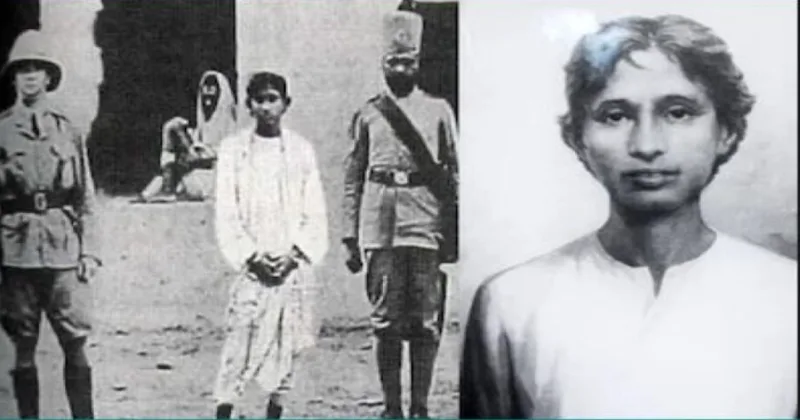
On August 11, 1908, as the morning mist lifted over Muzaffarpur jail, an 18-year-old Bengali boy walked to the gallows with a smile that would haunt the British Empire for decades. Khudiram Bose, India’s youngest martyr, represented something far more dangerous to colonial rule than his bomb-making skills or revolutionary activities. He embodied the emergence of a fearless new generation that refused to accept British supremacy as natural or permanent. The colonial state feared him not merely for what he had done, but for what he symbolized – the birth of an awakening that would ultimately consume the Empire itself.
The story of why the British feared this teenager begins with understanding that Khudiram was not simply another revolutionary. He was the living manifestation of a generational shift that transformed the character of Indian resistance from petitioning to direct action, from deference to defiance. When news of his execution spread across Bengal, it triggered student protests, inspired folk songs, and created a template for youth-led militancy that would eventually produce the Hindustan Socialist Republican Association and countless other revolutionary organizations.
The Muzaffarpur Conspiracy and Its Reverberations
The path to Khudiram’s martyrdom began with the Bengal Partition of 1905, Lord Curzon’s attempt to divide and weaken Bengali nationalism by separating the Hindu-majority western regions from the Muslim-majority eastern areas. This administrative reorganization of the 78.5 million-strong Bengal Presidency was officially justified on grounds of administrative efficiency, but Indians immediately recognized it as a calculated blow against the nerve center of nationalist sentiment.
For Khudiram, born in Habibpur village in Midnapore district in 1889, the partition represented a personal affront to his emerging political consciousness. Orphaned at age six and raised by his elder sister Aparupa Devi, he had been exposed to revolutionary ideas through the public lectures of Sri Aurobindo and Sister Nivedita during 1902-1903. These encounters transformed a school-going boy into a committed revolutionary who, at age 15, was first arrested for distributing anti-British pamphlets.
The targeting of Douglas Kingsford, the Chief Presidency Magistrate of Calcutta, arose from his notorious reputation for harsh sentences against young political activists. Kingsford had become particularly hated after ordering 15 lashes for a 15-year-old boy named Sushil Sen, who had protested police brutality against revolutionaries. With each lash, Sen had shouted “Vande Mataram,” and this news spread throughout Bengal, making Kingsford a prime target for revolutionary vengeance.
When the British transferred Kingsford to Muzaffarpur hoping to defuse tensions, the revolutionaries decided to pursue him there. Khudiram Bose and Prafulla Chaki were selected for this mission, arriving in Muzaffarpur on April 18, 1908, disguised as Haren Sarkar and Dinesh Roy respectively. For over three weeks, they carefully studied Kingsford’s routine, noting his court timings and evening visits to the European Station Club.
On the fateful evening of April 30, 1908, around 8:30 PM, the two revolutionaries waited outside the European Club as Kingsford’s carriage departed. In the darkness, they mistook an identical carriage for their target and hurled a bomb at it, killing Mrs. Kennedy and her daughter instead of their intended victim. This tragic error would prove to be a tactical failure but a strategic victory for the revolutionary cause, as it demonstrated that young Indians were willing to risk everything to challenge British authority.
British Panic: The Fear of Youth-Led Militancy
The British reaction to the Muzaffarpur bombing revealed the depth of colonial anxiety about youth radicalization in Bengal. The immediate response was not merely punitive but betrayed a fundamental fear that the traditional mechanisms of colonial control were breaking down. Contemporary British officials understood that they were witnessing something unprecedented – the emergence of what one academic described as “wayward youth” who could no longer be managed through conventional educational or administrative channels.
The colonial state’s greatest fear was not the bomb itself, but what it represented: the transformation of Bengali youth from supposedly docile “babus” into armed revolutionaries willing to kill and die for independence. For decades, British propaganda had promoted the stereotype of the effeminate Bengali clerk, content with minor administrative roles and ritual observance. Khudiram’s actions shattered this racist caricature, proving that Bengalis could be as militant and fearless as any other community in India.
More troubling for the authorities was the realization that revolutionary sentiment was spreading beyond isolated individuals to encompass entire networks of educated youth. The Anushilan Samiti, which Khudiram had joined in 1906, represented a systematic attempt to prepare young men for armed resistance through physical training, ideological education, and practical skills like bomb-making. Under the guidance of figures like Sri Aurobindo and his brother Barindra Ghose, these organizations were creating what the British termed “a generation of terrorists”.
The symbolic power of Khudiram’s youth made him infinitely more dangerous than older revolutionaries. While mature political leaders could be dismissed as misguided or opportunistic, an 18-year-old martyr represented the future itself in rebellion against colonial rule. British intelligence reports from this period reveal deep concern about the “contagion” of revolutionary ideas spreading through schools and colleges, with teachers themselves suspected of indoctrinating students.
The speed with which news of Khudiram’s arrest and trial spread across Bengal demonstrated the existence of communication networks that the colonial state could not fully control or comprehend. When he was brought handcuffed to Muzaffarpur on May 1, 1908, crowds gathered at the railway station and police station to catch a glimpse of the teenage revolutionary. The Statesman newspaper reported that he appeared “quite determined” and “cheerfully cried ‘Vandemataram'” when taking his seat in the carriage.
Trial, Defiance, and the Making of a Legend
Khudiram’s conduct during his trial elevated him from a failed assassin to an iconic figure of resistance whose influence would outlast the British Empire itself. The proceedings began on May 21, 1908, with a team of defense lawyers led by Kalidas Basu working without fees to save the young revolutionary. Despite their efforts to argue for clemency based on his age and the possibility of other conspirators, the British judge was determined to make an example of him.
On June 13, 1908, when Judge Corndoff pronounced the death sentence, Khudiram’s response became the stuff of legend. Instead of pleading for mercy or showing fear, he smiled broadly and, when asked if he had anything to say, offered to teach the judge how to make bombs if given sufficient time. This extraordinary display of defiance in the face of death stunned the courtroom and was immediately reported in newspapers across India.
The British had hoped that swift punishment would deter other potential revolutionaries, but Khudiram’s cheerful acceptance of martyrdom had precisely the opposite effect. His appeal to the Calcutta High Court was dismissed on July 13, 1908, and when a final appeal to the Governor General was rejected, his execution was scheduled for August 11. Throughout this period, he maintained his composure, spending his time reading the Bhagavad Gita and works by Swami Vivekananda.
The manner of Khudiram’s death on August 11, 1908, at exactly 6 AM, became a masterpiece of revolutionary theater that the British could neither suppress nor control. Newspapers reported that he “walked to the gallows firmly and cheerfully and even smiled when the cap was drawn over his head”. The Amrita Bazar Patrika’s headline “Khudiram’s End: Dies cheerful and smiling” captured the essence of a martyrdom that transformed defeat into moral victory.
Even more troubling for the authorities was the massive public response to his funeral. Thousands of people lined the streets of Muzaffarpur as his body was taken in procession, throwing flowers and garlands despite heavy police presence. The fact that an ordinary village boy could command such reverence indicated the depth of anti-British sentiment and the power of his symbolic sacrifice.
Nationalist Reverberations: Songs, Literature, and Revolutionary Inspiration
The cultural impact of Khudiram’s sacrifice proved far more enduring and influential than his actual revolutionary activities. Within months of his execution, the Bengali poet Pitambar Das had composed “Ekbar Biday De Ma Ghure Ashi” (Grant me farewell, Mother, let me go once), a haunting song that imagined Khudiram’s final conversation with both his biological mother and Mother India. The song’s lyrics, “Hashi hashi porbo phansi dekhbe bharatbasi” (Smiling, smiling, I’ll wear the noose, all Indians will witness), became a rallying cry for future revolutionaries.
This song achieved remarkable cultural penetration, spreading far beyond Bengali-speaking regions and becoming part of India’s revolutionary folklore. Its popularity demonstrated how Khudiram’s story had transcended regional boundaries to become a national symbol of youth sacrifice for independence. The song was later featured in the 1966 film “Subhas Chandra,” sung by Lata Mangeshkar, ensuring its transmission to new generations.
The broader literary and cultural response to Khudiram’s martyrdom revealed the emergence of what scholars have termed “revolutionary nationalism” as distinct from the moderate politics of petition and prayer that had previously characterized the Indian National Congress. Writers, poets, and dramatists throughout Bengal began producing works that celebrated armed resistance and martyrdom, creating a cultural ecosystem that sustained revolutionary sentiment even when organizations were suppressed.
More significantly, Khudiram’s example directly inspired the formation of the Hindustan Socialist Republican Association (HSRA) in 1928, twenty years after his death. Leaders like Bhagat Singh, Chandrashekhar Azad, and Sukhdev explicitly acknowledged their debt to early martyrs like Khudiram, whose willingness to die for independence had established the moral framework for revolutionary action. The HSRA’s manifesto and activities showed clear continuity with the ideological foundations laid by the Bengali revolutionaries of 1908.
The impact on student communities was particularly pronounced and persistent. Educational institutions across Bengal became centers of revolutionary recruitment, with teachers suspected of using their positions to spread seditious ideas. The British response included increased surveillance of schools and colleges, but this only reinforced the perception that education itself was becoming a battleground between colonial authority and nationalist aspirations.
Contemporary British reports noted with alarm that Khudiram’s story was being incorporated into oral traditions and popular culture in ways that made it nearly impossible to suppress. Unlike political manifestos or newspaper articles that could be banned, folk songs and stories passed through informal networks that the colonial state could not effectively monitor or control.
The Enduring Symbol of Youth Power
The lasting significance of Khudiram Bose lies not in his military effectiveness – the Muzaffarpur bombing was, after all, a tactical failure – but in his demonstration that age was no barrier to ultimate sacrifice for national freedom. At 18 years, 8 months, and 8 days, he became India’s youngest martyr, but more importantly, he established youth as a legitimate and powerful force in anti-colonial resistance.
His influence can be traced through subsequent generations of Indian revolutionaries who explicitly modeled themselves on his example. The revolutionary movements of the 1920s and 1930s were dominated by young men and women who had grown up hearing stories of Khudiram’s fearless defiance. Even moderate leaders like Mahatma Gandhi, despite his philosophical opposition to violence, recognized the moral authority that martyrs like Khudiram possessed in the nationalist imagination.
The British ultimately understood that their fear of Khudiram was well-founded. His execution did not end revolutionary terrorism in Bengal but rather inaugurated a new phase of more sophisticated and widespread resistance. The Alipore Bomb Case of 1908-1910, which followed immediately after the Muzaffarpur incident, revealed the existence of extensive revolutionary networks that had been inspired partly by Khudiram’s example.
Modern assessments of Khudiram’s significance must acknowledge both his limitations and his achievements. He was not a military strategist or political theorist, and his actual operations were amateurish by later standards. However, his psychological impact on both Indian and British public opinion was profound and lasting. He proved that ordinary Indians could challenge the mightiest empire in history and die with dignity rather than submit to foreign rule.
The institutional legacy of his sacrifice can be seen in the numerous schools, colleges, hospitals, and railway stations named in his honor. The Muzaffarpur jail where he was executed was renamed Khudiram Bose Memorial Central Jail, and the railway station where he was captured became Khudiram Bose Pusa Station.
These commemorations ensure that his story remains part of India’s collective memory even as the specific historical context of his actions recedes.
Perhaps most significantly, Khudiram’s example established youth activism as a permanent feature of Indian political culture. From the student movements of the 1960s and 1970s to contemporary protests, young Indians have consistently invoked the moral authority of those willing to sacrifice everything for their beliefs. The image of the smiling martyr walking cheerfully to the gallows remains a powerful symbol of principled resistance to injustice.
The British feared Khudiram Bose because he represented the emergence of a new India that would no longer accept colonial rule as inevitable or permanent. His youth made him dangerous not because of his technical skills or strategic acumen, but because he embodied the future in revolt against the present. In choosing death over submission, he demonstrated that the moral foundations of empire could be challenged by ordinary individuals armed with nothing more than unshakeable conviction and extraordinary courage. The colonial state understood, perhaps better than many of his contemporaries, that such examples could not be contained by executions or repression.














Comments