





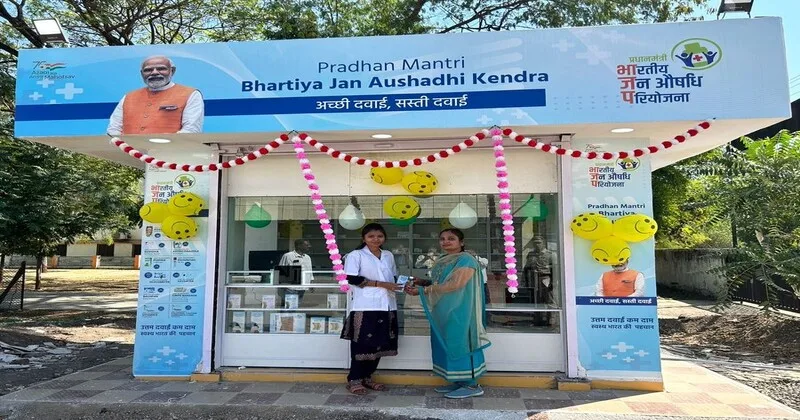
Indian Railways is considered as the country lifeline. At railway stations, where millions of individuals come together daily, travelling through different regions, languages and socio-economic groups. In this vibrant environment, something is happening quietly and it’s revolutionizing the way railway passenger’s travels and now they are able to get affordable health care along the way. The launch of Pradhan Mantri Jan Aushadhi Kendras (PMJAKs) on railway stations all over the nation is proving to be a landmark in Indian public healthcare infrastructure.
106 Jan Aushadhi Kendras have been established in different railway stations under the Pradhan Mantri Bhartiya Janaushadhi Pariyojana (PMBJP) as of June 30, 2025. These Kendras provide quality generic drugs at very affordable prices, thus making healthcare more affordable to India’s traveling population.
Railway Stations as a Health Access Points
Railway stations have traditionally served as something greater than transit points. For most, particularly those who travel from distant or rural places, stations are the sole familiar public space that they regularly encounter. Looking this as opportunity Government of India, under the Ministry of Chemicals and Fertilizers in partnership with the Ministry of Railways, set out to model a system by which healthcare is brought to the passenger. The setting up of Jan Aushadhi Kendras in station premises is also inspired by this very philosophy of converting high-footfall, public utility spaces into locations for the delivery of healthcare.
The Aushadhi Kendras inventory has more than 2,000 medicines and surgical items, all at 50 to 90 per cent lower prices than market-branded substitutes. For a family commuting for a medical consultation in town, or an employee who is on his/her way back home, these kendras will support the required treatment and increased financial stability by cheaper medicines.
Passenger Welfare with Healthcare Affordability
Travelers on Indian Railways usually find it hard to access medicines on prolonged journeys. Branded medicine shops near or inside stations tend to charge over-the-counter rates and public health facilities are generally lacking in the immediate area surrounding stations. Jan Aushadhi Kendras within station premise will fill an important void.
Accessibility: Medicines are now within the circulating area or concourse of the railway complex.
Affordability: A wide range of chronic disease and essential medicines are provided at government-fixed prices.
Trust: Medicines are sourced from WHO-GMP approved vendors and subjected to NABL-accredited testing facilities for ensuring safety and efficacy.
These Kendras serve not only passengers but also the station staff, railway personnel, vendors, coolies and local residents in the vicinity. As a result, a Jan Aushadhi Kendra in a station becomes the sole affordable medical shop in the locality.
Technology-Supported Logistics
One of the strongest aspects of Jan Aushadhi Kendras at railway stations is the healthy and centrally managed supply chain. To ensure uninterrupted supply of medicines, particularly the high-speed and high-demand ones, the government has implemented a robust IT-supported logistics system with 1 central warehouse (for national consolidation), 4 regional warehouses (for geographic proximity) and 39 distributors (connected with individual Kendras)
A Real-time inventory monitoring mechanism tracks 400 high-speed products across Kendras, so they never go out of stock. There is also a stocking requirement that mandates every Kendra to have 200 priority products, including the 100 best-selling Janaushadhi drugs under the scheme and 100 high-selling items in the market. Conformity with this stocking requirement not only guarantees medicine availability but also enables Kendra operators to be eligible for performance incentives, further enhancing the model’s viability.
Daily Impact at the Platform In these 106-functioning railway station Aushadhi Kemra, passenger traffic is increasing gradually. With each new day, more travellers are discovering that vital medicines whether for blood pressure, diabetes, fever, painkiller or acidity are available at reasonable prices without any compromise in quality.
On an average each of these railway station Aushadhi Kendras is experiencing a daily customer base of between 150 and 300 people, depending on the station size. For working-class passengers, these Kendras are the sole means of access to essential medication while traveling. For others, they are a cost-saving alternative to branded chemists in city areas or close to hospitals. This convergence has also been found to be vital in times of crisis when a passenger becomes sick halfway through a journey or when train delays for hours stretch out journey schedules. Availability of generic painkillers, oral rehydration salts, antiseptics and minimal antibiotics at the station has made Jan Aushadhi Kendras a godsend at critical intersections.
Public Savings and Policy Convergence
Though the Jan Aushadhi Kendras at railway stations are largely about passenger convenience, they are also an integral part of the overall affordable healthcare vision of the government. Official estimates put the citizen savings through the Jan Aushadhi scheme in the last 11 years at Rs 38,000 crore, a large part of which involves passengers and low-income travelers who can now access generic medicines route.
Additionally, the railway-station model fits perfectly into the national agenda under Universal Health Coverage (UHC) and Ayushman Bharat, where the mission is not just to treat but to maintain continuity of care even while on the move.
This is especially useful for chronic disease patients who have to follow rigid medicines schedules. Previously, a missed medicine used to mean missing a dose or purchasing an costly alternative on the way. Now, Jan Aushadhi Kendras provide a reliable solution.
The inclusion of Jan Aushadhi Kendras within railway stations indicates a model of governance that is multi-sectoral, holistic, and citizen-centric. It takes advantage of already existing public infrastructure without undertaking huge additional investments.
This model also creates employment opportunities to pharmacists, store managers, logistics staff all earn their livelihoods connected to a mission based on public well-being. By situating Kendras here, the government ensures that both urban and rural travellers benefit from a scheme that was previously limited to hospitals and designated storefronts.
Future of Moving Healthcare Service
Though the present figure of 106 Jan Aushadhi Kendras at railway stations is a good at beginning, the potential for scaling up will make healthier India. With more than 7,000 railway stations in India, the scope for scaling up the model will be helpful.
With more Kendras being created at key junctions, metro stations and railway hubs in different regions, passengers will come to enjoy a new level of travel-based healthcare accessibility. With it being coupled with awareness campaigns, electronic display at platforms and integration into IRCTC’s digital ecosystem, the extent of this initiative can increase manifold. The expansion plan includes streamlined application procedures for entrepreneurs, support for cooperative-led Kendras, and mobile Janaushadhi units for small stations.
In a nation where railways are not merely a means of transport but an artery of economy and culture, the availability of Jan Aushadhi Kendras at railway stations is the beginning of a new era of people-centric governance. It is a model that resonates with the ethos of “Antyodaya” the emergence of the last person in the queue.
By making cheap medicines accessible to the ordinary passenger, the government is not only providing healthcare. It is bringing back dignity, continuity and choice to those who need it most, right where they are. The platform has turned into a pharmacy, with each train that comes and goes, with each medicine at these Kendras, India vision of Swasth Bharat, Viksit Bharat inches closer to reality.














Comments