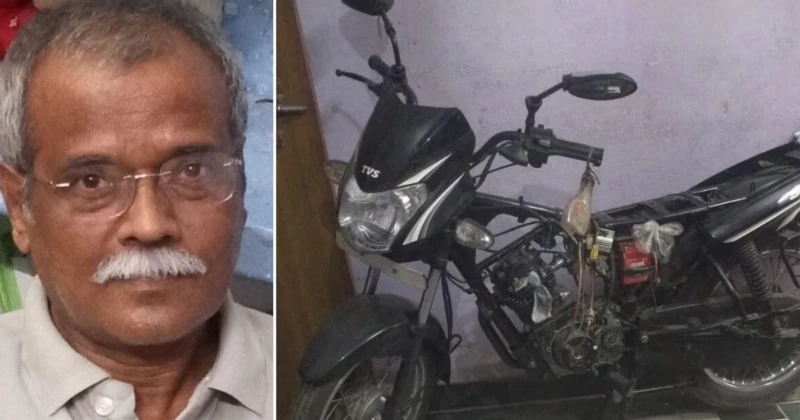
A modest inventor from Uttar Pradesh has emerged with a revolutionary breakthrough that could upend the global automobile industry. Shailendra Singh Gaur, an alumnus of Allahabad University, has reportedly developed a six-stroke internal combustion engine that delivers an unprecedented mileage of 176 kilometres per litre (KMPL) a feat that could redefine vehicular efficiency and drastically reduce emissions.
What makes Gaur’s story more compelling than just technical ingenuity is the sheer personal sacrifice he made in the pursuit of innovation. A native of Kanpur and now residing in Jhunsi near Prayagraj, Gaur earned his B.Sc. in Physics, Chemistry, and Mathematics from Allahabad University in 1983. Though offered a job at Tata Motors in 2007, he turned it down, choosing instead to pursue independent research a decision that would eventually cost him his land, house, and shop.
Gaur transformed his rented home into a makeshift laboratory, determined to prove his concept of a six-stroke engine that drastically outperforms the conventional four-stroke models. Working with precision and perseverance, he conducted early-stage research under Professor Anuj Jain at the Mechanical Engineering Lab of Motilal Nehru National Institute of Technology (MNNIT) and later at the laboratories of IIT-BHU.
The breakthrough came when Gaur successfully modified a 2017-model 100cc TVS motorcycle, equipping it with his six-stroke engine prototype. In testing, the vehicle ran 35 minutes on just 50 millilitres of petrol translating to a fuel efficiency of 176 KMPL. For comparison, standard 100cc bikes typically deliver between 60–75 KMPL under optimal conditions.
In a televised demonstration, Gaur’s innovation was on full display as the bike ran 120 kilometres on one litre of petrol. Prior to the modification, the same bike could only idle-run for 12.4 minutes on 50 ml of fuel. The difference was staggering.
According to Gaur, the core principle of the six-stroke engine lies in enhanced thermal efficiency. “While conventional engines typically utilize only about 30 per cent of the fuel’s energy, my design pushes that number to nearly 70 per cent,” he claims.
This increase is achieved through additional expansion and exhaust strokes, which reduce heat build-up and improve fuel atomization. As a result, the engine not only boosts mileage but also significantly cuts down on carbon emissions, including carbon monoxide and other pollutants, which are emitted in negligible quantities.
India imported $158 billion worth of crude oil in 2024 alone, primarily to feed the transport and energy sectors. The global petroleum industry, worth trillions, thrives on sustained fuel consumption. A low-consumption, high-efficiency engine like Gaur’s would decimate fuel demand across two-wheeler, four-wheeler, and commercial transport sectors.
Simultaneously, automobile manufacturers have built their R&D and production cycles around standard four-stroke combustion engines and are already investing billions into electric vehicle transitions. An alternative petrol-based solution that uses minimal fuel disrupts not only their engine production lines but also their supply chain, after-sales service models, and planned obsolescence strategies.
Furthermore, the engine is modular and adaptable, meaning it can be integrated into two-wheelers, cars, buses, trucks, and even marine vessels. Gaur asserts that this technology, once mass produced, could drastically reduce India’s oil import bills and urban air pollution.
In recognition of his innovation, the Government of India has granted two patents for the six-stroke engine, while several more are reportedly in process. The patented design is touted to be durable, low-maintenance, and eco-friendly, with an operational efficiency that surpasses current commercial standards.
However, despite this monumental achievement, Gaur stands at a crossroads. Without institutional or private sector support, his engine remains confined to the realm of prototypes and lab experiments.
Gaur has issued a clarion call to the government, investors, and the Indian automobile industry to step forward and help commercialise this transformative innovation. “This technology belongs to Bharat,” he says. “But unless it’s supported and scaled, it risks being buried under the weight of apathy, or worse — sabotaged by vested interests.”