





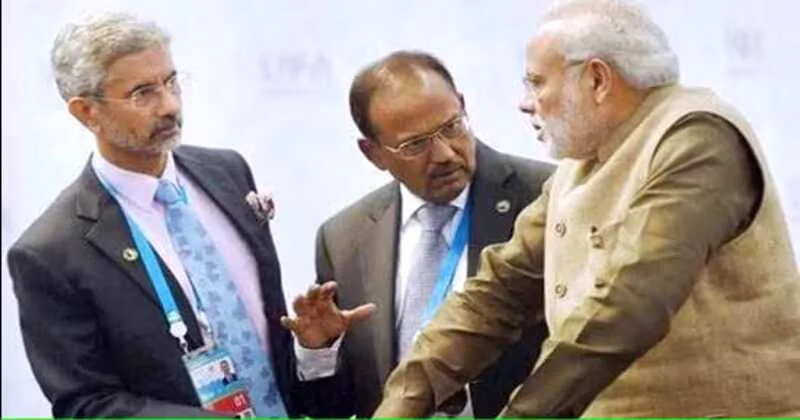
In a bold and unwavering move, India’s National Security Advisor Ajit Doval has arrived in Moscow at a time when the United States, under President Donald Trump, has issued threats of steep import tariffs on India for continuing its oil trade with Russia. Though the visit had been pre-planned, the timing and optics now carry great significance. In an era where global powers often bend to US pressure, India’s firm refusal to comply marks a pivotal moment in post-independence foreign policy history, one where India asserts its sovereignty, strategic independence, and growing global leadership.
The visit is aimed at deepening the already strong India-Russia relationship across defence and energy sectors, even as Washington attempts to pressure New Delhi to cut ties with Moscow. External Affairs Minister S. Jaishankar is also scheduled to visit Russia later this month, signalling continuity in India’s diplomatic engagement with one of its oldest partners.
President Trump, in a recent interview with CNBC, once again warned that the US would “significantly raise tariffs” if India continues to purchase oil from Russia. He also claimed, without nuance, that India “doesn’t care how many people are killed in Ukraine”, a statement many interpret as an attempt to isolate India diplomatically. However, far from being rattled, India has remained calm, mature, and firm in its response.
Indian NSA Mr. Ajit Doval Sahab
Is in Moscow. Indo Russian ties to surge after diplomatic tensions with the USA.New Delhi and Moscow to strengthen Defence cooperation with Su-57E,S-500 being of top priority
India is expected to increase oil, coal import from Russia pic.twitter.com/NVDdbK52qg
— GeoStrat Bharat (@GeostratB) August 5, 2025
India’s Strategic Autonomy Stands Tall
What appears to frustrate the US most is India’s steadfast commitment to strategic autonomy. India does not subscribe to bloc politics. It imports oil from Russia, arms from the US, France, and Israel, and is simultaneously a member of both the Quad, which includes the US, and BRICS, which includes Russia and other emerging powers. India’s role in these groupings, combined with its proactive leadership in forums such as the G-20, reflects its unique balancing act in an increasingly polarised world.
However, the US is attempting to corner India because of its independent decisions and its refusal to fall in line with Western expectations. However, India has made it abundantly clear, through its actions, not just words, that its choices will be governed by national interest and not external pressure.
Doval’s visit to Moscow is symbolic of this policy posture. In Moscow, he is expected to meet Russian President Vladimir Putin and hold key discussions with senior Russian defence officials. One of the main agenda points is the crucial S-400 missile defence system. India had signed a Rs 40,000 crore deal with Russia in 2018 for five S-400 systems, three of which have been delivered. The remaining deliveries were delayed due to the Ukraine conflict, and Doval is now expected to push for their expedited handover. The S-400s have proven their strategic worth during Operation Sindoor, where they were instrumental in countering Pakistani missiles and drone threats.
Energy Partnership: Unshaken, Unmoved
India’s oil trade with Russia continues unabated, with discussions also expected to focus on securing further reductions in crude oil prices. Recently, there were false assumptions that Indian public sector units had halted Russian oil purchases due to tariff fears. Doval’s presence in Moscow firmly dispels such rumours and reinforces India’s long-term vision of energy security through diversified sources.
Even as President Trump threatens punitive action, he has now backtracked slightly, saying no immediate decision would be taken and that discussions with Russia would precede any further steps. This shift came after Russia clarified that any trade deal is a matter of bilateral choice between sovereign nations. The message is loud and clear, India will not be coerced.
Trump’s recent comments reflect an inconsistent approach. “India has never been a good trading partner. They do a lot of trade with us. But we don’t do trade with them,” he remarked, while accusing India of harming US interests. Yet, facts on the ground paint a different picture.
Economic Impact: Minimal for India, Maximum for US
India’s economy is expected to grow between 6.5 to 7 percent this year. While tariffs may reduce demand for Indian goods in the US temporarily, India’s diversified export portfolio, spanning the European Union, Middle East, and Southeast Asia, ensures resilience. A Rs 20,000 crore scheme is reportedly being prepared to shield Indian exporters, reinforcing domestic industry and nurturing a culture of economic self-reliance.
Moreover, leading Indian financial institutions have debunked the idea that such tariffs would seriously hurt India. A report by SBI, the country’s largest bank, argues that the proposed measures would backfire on the US itself. Higher tariffs would shrink US GDP, fuel inflation, weaken the dollar, and increase the cost of living for American families. The report also highlights that India supplies 47% of the pharmaceuticals consumed in the US. Any disruption in this supply chain could trigger medicine shortages and price surges in the American market.
Many see this confrontation not as a setback but as a historic moment where India, for the first time in the post-independence era, is asserting itself so confidently against a major global power. The country’s stand is being closely observed and quietly admired by many developing nations. Countries like Nigeria, South Africa, Brazil, Mexico, Vietnam, and Indonesia are already studying India’s oil diversification strategy as a model to emulate.
Nikki Haley: A Voice of Reason Within the US
Amid the chaos of Trump’s tariff threats, former US Ambassador to the United Nations and Indian-origin Republican leader Nikki Haley has spoken out strongly in support of India. Her remarks have resonated widely, especially among Indian and global observers who see her statements as a rare voice of clarity and balance.
Haley emphasised that alienating a “strong ally” like India would be a mistake. She questioned the selective morality being applied, pointing out that while India is being penalised, China, the largest importer of Russian and Iranian oil, has been granted a 90-day temporary tariff pause.
“India should not buy oil from Russia. But China, the number one user of Russian and Iranian oil, has received a 90-day temporary tariff pause,” she wrote in a message posted on social media. “We should not sever ties with a strong ally like India,” she added. Many consider her comments as a reflection of the growing realisation in Washington that punishing India could strategically backfire and benefit China.
India: A Rising Power Charting Its Own Path
India’s approach is not driven by defiance for its own sake, but by a principled vision of sovereignty, resilience, and responsibility. By continuing its engagements with Russia in defence and energy, despite aggressive external posturing, India has demonstrated maturity, strength, and strategic clarity.
Doval’s visit is not just a diplomatic meeting. It is a statement of intent. India is willing to talk, but it will not compromise on its core interests. Whether it is defence cooperation through the S-400s or favourable oil deals, India’s partnerships are forged through mutual respect, not coercion.
This moment could well go down in history as a turning point, when India stopped being seen as a soft power and emerged instead as a decisive, confident voice on the global stage. It is this very posture that is inspiring other nations to look to India not only as a trade partner or a regional actor but as a global leader for the times to come.











Comments