






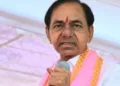
Hyderabad, Aug 5 : In a damning report tabled before the Telangana government, the Judicial Commission headed by former Supreme Court judge Justice Pinaki Chandra Ghose has squarely blamed former Chief Minister K. Chandrasekhar Rao (KCR), his cabinet colleagues, and top officials for the “rampant and brazen procedural and financial irregularities” in the Kaleshwaram Lift Irrigation Project, particularly in the construction and collapse of the Medigadda, Annaram, and Sundilla barrages.
The report, submitted on July 31, 2025, follows a 16-month-long inquiry into corruption, negligence, and embezzlement of public funds in one of India’s largest irrigation ventures. The Commission has “fixed responsibility” on political executives, IAS officers, engineers, and contractors, calling for action on charges ranging from criminal breach of trust to financial misconduct and perjury.
Following a review, Telangana Chief Minister Revanth Reddy announced that the State Cabinet has accepted the report submitted by the Justice Pinaki Chandra Ghose Commission, which conducted a judicial inquiry into the Kaleshwaram project, “as it is.” He added that the report would be tabled in the Legislative Assembly and assured that “further course of action will be taken based on the opinions of all members.”
కాళేశ్వరం ప్రాజెక్టు వ్యవహారంలో న్యాయ విచారణ జరిపిన జస్టిస్ పినాకి చంద్ర ఘోష్ కమిషన్ ప్రభుత్వానికి సమర్పించిన నివేదికను శాసనసభలో ప్రవేశపెట్టి అందరి అభిప్రాయాల మేరకు తదుపరి కార్యాచరణ ఉంటుందని ముఖ్యమంత్రి శ్రీ @revanth_anumula గారు ప్రకటించారు. జస్టిస్ ఘోష్ కమిషన్ ఇచ్చిన నివేదికను… pic.twitter.com/g5O9u0qm6I
— Telangana CMO (@TelanganaCMO) August 4, 2025
Key Findings: ‘Sole and Individual Decisions’ Caused the Collapse
“The decision to construct the barrages at Medigadda, Annaram, and Sundilla was the sole and individual decision of the then Chief Minister and Minister for Irrigation,” the report states, dismissing claims of collective government approval.
The Commission concluded that “K. Chandrasekhar Rao functioned not as the head of the Government but as the administrative executive himself” and that his “direct and vicarious accountability” was established in the entire affair, from conceptualisation to collapse.
Suppression of Expert Warnings
A 2015 expert committee had clearly warned that a barrage at Medigadda was “not advisable and not economical” and had recommended Vemanapally as a better alternative. “The Government has not considered the report… this omission is not inadvertent or accidental,” the Commission declared.
Notably, the report highlights that “S.K. Joshi, Spl Chief Secretary (I&CAD), then Chief Secretary; Chairman, KIPCL, C. Muralidhar, Engineer-in-Chief (Irrigation) and B. Hari Ram, Chief Engineer (Kaleswaram) & Superintending Engineers suppressed the report with malicious intention to enable the Chief Minister and the Minister for Irrigation to go ahead with their plans.”
Administrative Approvals Were Illegal
Administrative approvals totalling Rs 2,591 crore were issued through G.O. Rt Nos. 231, 232 & 233 on 1 March 2016. “These were not placed before the Cabinet. The Commission sees no compelling urgency to bypass the Cabinet and terms this a violation of Government Business Rules.”
Contract Irregularities & Financial Misconduct
The project was illegally awarded on a lump-sum basis, bypassing the CWC’s recommendation for a turnkey contract. Revised Administrative Approvals (RAA-I and RAA-II) sanctioned massive cost escalations on flimsy grounds.
In one instance, Rs 369 crore worth of works were added without any basis in the Detailed Project Report. “This is clinching evidence of an intent to siphon public funds to unduly favour the agency,” the Commission found.
Operation & Maintenance Negligence
The Commission noted “absolutely no operation and maintenance of whatsoever nature” after construction. Water was continuously impounded at full capacity, converting the barrages into storage structures and hastening their failure.
“This was done on direct orders of the then Chief Minister,” the Commission held, calling the act “against the interests of the state” and a “major cause for distress.”
Quality Control Lapses & Fabricated Certificates
In Medigadda, the report found that only 7,498 concrete samples were tested versus the required 37,288. Secant pile integrity was never verified. In Annaram, plinth slab thickness was halved, and key safety components like water stops were discontinuous.
Completion certificates were issued fraudulently. “The issuance of Substantial Construction Completion Certificate (9.9.2019) and Final Certificate (15.3.2021) was tainted with malice and falsehood,” the report said.
Political and Bureaucratic Accountability
Among those found liable:
K. Chandrasekhar Rao (then CM): “Directly and vicariously accountable… acted with malicious intent… caused financial loss and structural distress.”
T. Harish Rao (then Irrigation Minister): “Acted in complicity… suppressed expert reports… allowed CM to take over administrative roles.”
Etela Rajender (then Finance Minister): “Demonstrated lack of commitment and integrity… pleaded ignorance on crucial financial decisions.”
S.K. Joshi, Smita Sabharwal, and other IAS officers: Violated Business Rules, processed illegal orders, and failed in oversight.
Senior Engineers and CDO Officials: Found guilty of malice, suppression of facts, and perjury before the Commission.
Contractors Held Liable
Larsen & Toubro, Afcons, and Navayuga were held responsible for the shoddy wo
“If the agency fails, the Government shall recover the costs incurred,” the report ordered.
Massive Financial Impact
Cost Overruns: Project cost rose from Rs 38,500 crore (PCSS) to Rs 1,10,248 crore (Kaleshwaram), excluding interest.
Loan Burden: Rs 87,449 crore borrowed via Kaleshwaram Corporation; Rs 29,737 crore repaid as of Sept 2024.
Fraudulent Payments: Rs 1,342 crore lost in avoidable price escalations; Rs 612 crore in inflated contractor bills.
Infructuous Expenditure: Rs 6,000 crore lost due to change in site from Tummidi Hatti to Medigadda, plus Rs 1,500 crore in tunnel and land costs.
Conclusion
Calling the Kaleshwaram fiasco a “colossal waste of public money,” the Commission held that “the involvement and directions of the then Chief Minister… is the cause and result of irregularities.” It recommended immediate financial recovery, enforcement of bank guarantees, and criminal action against several officials and agencies.
The State Cabinet lead by CM Revant Reddy is reviewing the report for further action.
“Rampant procedural and financial violations have not only drained public money but have also put the state’s irrigation future at risk.” — Judicial Commission Report, 2025
On August 4, Irrigation, Food & Civil Supplies Minister N. Uttam Kumar Reddy unveiled these findings of the Judicial Commission, and directly blamed former CM KCR for bypassing rules, ignoring expert warnings, and plunging the State into Rs 84,000 crore of high-interest debt.
The , once projected as the flagship achievement of the , has now been exposed as a massive betrayal of public trust.
The Kaleshwaram project, promoted as a transformative initiative by the BRS under KCR to solve Telangana’s water crisis, is now viewed as a stark example of how the BRS leadership, led by KCR, misused the historic mandate given by the people. Rather than honouring public faith, the project was driven by personal ambition and political optics.
The Judicial Commission’s report highlights how KCR and the BRS regime sidelined institutional checks, ignored expert recommendations, and operated outside established procedures. Critical decisions were taken unilaterally, administrative rules were violated, and massive public funds were spent without due diligence.











Comments