





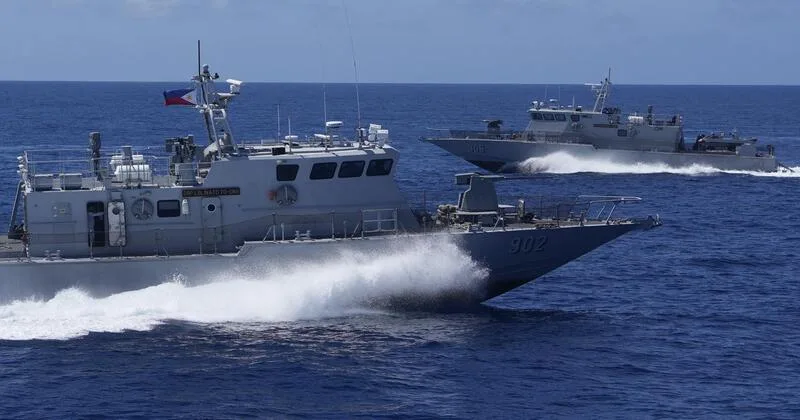
On August 2, India and Philippines commenced the ‘bilateral maritime cooperative activity’, a first-ever joint naval drill in the much disputed South China Sea. The exercise scripts a new chapter in the maritime diplomacy of both India and Philippines and in its efforts to ensure free, open, inclusive and transparent Indo-Pacific domain.
The joint naval drill also coincides with the 4-day state-visit of the Philippines President Ferdinand Romualdz Marcos Jr. to India. Both the events thus, give a major boost to the India-Philippines bilateral relations. The strategic and advanced Indian warships have been docked in the South China Sea and strategic military exercises are underway.
The Indian diplomats and naval officials along with their counterparts from Philippines aboard INS Shakti reiterated, “The coordinated patrols are a powerful testament to the enduring friendship and growing maritime cooperation between the two countries. It sets a positive tone for the bilateral relations”.
A Strong Message from the South China Sea
The ongoing ‘bilateral maritime cooperative activity’ between India and Philippines is conducted in the waters close to the Scarborough Shoal, a historically disputed island between China and Philippines in the South China Sea. The maritime exercise between New Delhi and Manila, thus asserts a strong message to the maritime aggressors regarding sovereignty, inclusivity, freedom of navigation and strategic autonomy in the maritime domain.
“The joint naval exercise projects a united front in the face of regional challenges. It is a clear demonstration of our mutual resolve to safeguard freedom of navigation and uphold the law of sea’, said Gen. Romeo Brawner Jr., Chief of Philippines Armed Forces. “We do not do such exercises in isolation, but in partnership with nations who share our values”, he added.
India’s Pivotal Warships Docked in Philippines
As a part of the joint naval drills, most advanced and strategically vital warships of India have been docked in Manila.
- INS Delhi(D61)-a guided missile destroyer
- INS Shakti- a fleet tanker
- INS Kiltan(P-30)-anti-submarine warfare corvette
- INS Sandhayak(Yard-3025)-a new generation surveillance ship
These warships participating in the naval exercise is capable of long-range deployment and has highest operational efficiency. These warships thus reflect the stellar military manouvering potential and advanced naval technological capabilities of India in its resolve to ensure maritime security and freedom of navigation.
The Strategic Significance of the Exercise for India
The maiden naval drill with Manila has high strategic significance for New Delhi. Philippines is among the key pillars for India in its ‘Act East’ and ASEAN policy. Philippines is also the first country to purchase BrahMos supersonic missile from India in 2022 and in this regard, Manila has signed a deal worth of US $374.9 million with New Delhi. The latest naval exercise also enhances the scope of India’s strategic maritime partnerships beyond traditional partners such as US, Japan, Australia or Srilanka. Further, the naval exercise enhances the momentum for stronger defence relations for both the countries and Philippines has the potential to emerge as a key defence export destination for India.
Beyond this bilateral bonhomie, the naval drill also helps both India and Philippines to champion collective maritime security, regional stability and balance of power in the Indo-Pacific or in the Indian Ocean Region(IOR) against any aggression and helps to send a strong message of maritime security. The exercise also enhances the diplomatic and strategic stature of India as a credible and resilient maritime partner.
Why South China Sea is a Contested Maritime Zone?
South China Sea is one of the most disputed maritime zones of the world. The sea is home to numerous uninhibited islands that are rich in critical and strategic minerals such as oil, natural gas reefs and atolls. The various littoral nations thus keep claiming and contesting over the sovereignty of these islands. China being the bulwark and dragon in the room asserts aggressively its sovereignty over majority of the South China Sea, through its wolf-warrior diplomacy and the concept of 9-dash line(9-dash line is the imaginary line erected by China in the South China Sea and it claims all the region falling within the line as the sovereignty of China).
China, Philippines, Vietnam, Taiwan, Malaysia, Brunei and other littoral nations have contesting claims over the South China Sea. China and Philippines have contesting claims over the Spratly Islands and Scarborough Shoal. The historical tension sparks periodic disputes between China and Philippines in terms of illegal intrusion and collision of vessels in each other’s territory. In a latest row, Chinese Coast guard ship put a huge rope to block the Philippines vessel from reaching the Second Thomas Shoal a disputed island, that falls under the Exclusive Economic Zone(EEZ) of Philippines.















Comments