





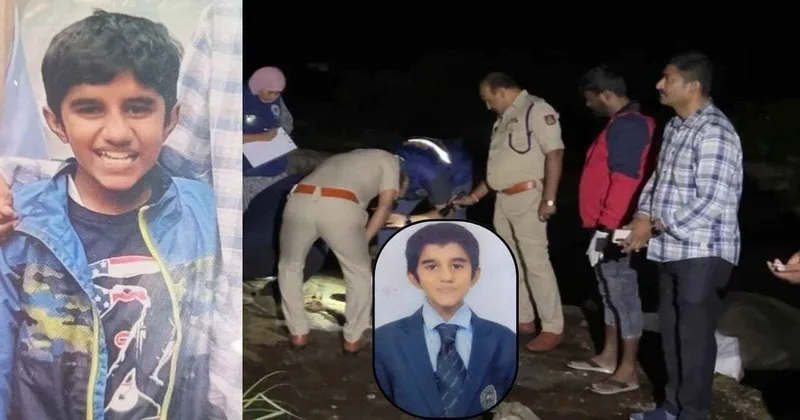
Bengaluru: In a chilling incident that has shaken the conscience of Karnataka, a 13-year-old schoolboy named Nishchit was abducted and brutally murdered near Bannerghatta. The crime, which involved ransom, torture, and the eventual burning of the victim’s body, highlights a disturbing pattern of rising violent crime and deepening law and order failure under the Congress-led Siddaramaiah government.
According to police, the two accused identified as Gurumurthy and Gopalakrishna were arrested following a swift operation, during which they attempted to attack the police and were subsequently shot in the leg in self-defense. The two were arrested from Kaggalipur Road under Bannerghatta police limits. The gravity of the case, the barbarity of the act, and the psychotic nature of the accused reflect an environment where criminals no longer fear the law.
Nishchit, a Class 7 student from a professor’s family residing in Shantiniketan Layout, Arakere, was abducted while returning from tuition on July 30. Shortly after the kidnapping, his parents received a ransom call demanding Rs 5 lakh. The father, refusing to bow to pressure, informed Hulimavu police immediately. In a shocking escalation, the kidnappers murdered the boy, tied his hands, beat him, and then set his body on fire using petrol near a roadside boulder before fleeing.
Despite the swift action by the police, the tragedy unfolded too quickly. “The accused tortured and killed the child out of fear of being caught. We are investigating if the motive was limited to ransom or something more sinister,” an officer revealed.
Initial findings suggest that the mastermind, Gurumurthy, had been a driver for Nishchit’s family and had a prior record under the POCSO Act. His familiarity with the household and its routines indicates premeditated planning. That he could return as a predator to the very home he once served raises serious questions about how such individuals slip through background checks and security protocols.
Political inaction fuelling criminal boldness
This ghastly case is not an isolated incident. Over the past few months, Karnataka has seen a disturbing surge in violent crimes—ranging from gang wars to drug hauls, kidnappings, and even terror-linked arrests. Just days ago, the Gujarat ATS arrested an Al-Qaeda affiliate from Bengaluru. Meanwhile, drugs worth ₹394 crore were seized by Maharashtra police in Mysuru, prompting public ridicule of Karnataka’s intelligence failure.
Former Chief Minister Basavaraj Bommai has slammed the Congress-led government, accusing it of losing its moral compass and failing to protect citizens. “What is our police intelligence doing? Outsiders are coming in and arresting criminals while our police are unaware. This is a complete collapse of the Home Department,” he said in New Delhi on Friday.
A pattern of criminal impunity
This tragedy also underscores the dangerous environment for children and families in Karnataka’s urban spaces. That a child could be kidnapped and murdered within hours, by a known acquaintance, speaks volumes about the erosion of public safety. Adding to the concern is the psychotic background of the accused and the fact that one was previously booked under a sexual offense. Yet, he remained free and employed in a household.
Experts warn that the state’s police forces are under-resourced, demoralized, and operating in a politically compromised environment. Instead of proactive surveillance, the administration is constantly on the backfoot, responding only after national embarrassment. The Congress government’s inability to implement institutional reforms, ensure effective intelligence gathering, or crack down on repeat offenders is proving costly—not just for governance, but for innocent lives.
















Comments