





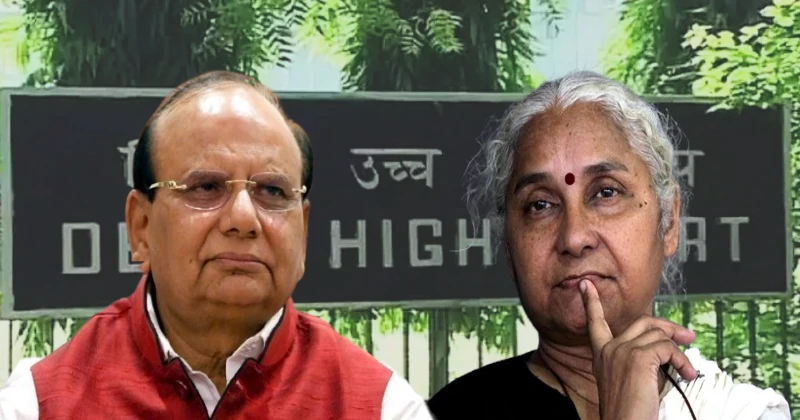
The Delhi High Court has upheld the conviction of activist Medha Patkar for maligning Delhi Lieutenant Governor Vinai Kumar Saxena. The case, rooted in a 2000 press release in which Patkar accused Saxena of hypocrisy, political collusion, and financial irregularities, has now conclusively ended with the Court branding her statements as “deliberate and calculated” acts of defamation.
The judgment, delivered by Justice Shalinder Kaur, refused to interfere with the findings of both the trial court and the sessions court, which had already found Patkar guilty. The High Court further affirmed the punishment awarded, while slightly modifying a procedural condition requiring her physical court appearance every three months — now allowing her to appear virtually or through her counsel. But the sting of conviction, jail term, and compensation remains.
“It is evident that the accused harbored a clear intention to defame the complainant through her press note, given the deliberate and calculated nature of her statements,” the High Court reiterated, standing by the strong language used by the lower courts.
In 2000, Vinai Kumar Saxena, then President of the National Council of Civil Liberties (NCCL), took out a bold advertisement titled “True Face of Ms. Medha Patkar and her Narmada Bachao Andolan”. The ad directly criticized Patkar and her controversial movement which had long opposed the Sardar Sarovar Dam and related infrastructure projects in Gujarat and Madhya Pradesh. Saxena’s stand — widely considered pro-development challenged the ideological orthodoxy Patkar had come to represent.
Patkar retaliated not with evidence-based counterarguments, but with a press note titled “True Facts of a Patriot – Response to an Advertisement.” The press release painted Saxena as a deceitful operator: accusing him of once praising the Narmada movement in Malegaon, donating Rs 40,000 via cheque (which allegedly bounced), and receiving backing from the industrial Lalbhai Group. She insinuated an unholy nexus between corporates and Saxena, mocking his patriotism and calling into question his motivations.
One of the most damaging lines from her press note read, “The cheque, please note, came from Lalbhai Group. What is the connection between Lalbhai Group and VK Saxena? Who among them is more ‘Patriot’?” She went further, accusing Saxena of “mortgaging the people of Gujarat and their resources before Bill Gates and Wolfensohn [then World Bank President],” implying he was a sellout and a state stooge.
Saxena filed a criminal defamation case in an Ahmedabad court in 2001, citing personal and reputational harm. In 2003, the Supreme Court, considering the sensitive nature of the case, transferred it to Delhi to ensure a neutral trial. The legal process dragged on for more than two decades. However, in 2024, a Delhi magistrate court finally delivered its verdict: Patkar was found guilty and sentenced to five months in jail. She was also directed to pay Rs 10 lakh as compensation to Saxena.
The court found that her allegations were not only factually unsupported but crafted with the explicit intention to defame, rather than engage in fair public debate. The trial court stated, “The statements made by the accused were not fair criticism, nor borne out of ignorance. They were made with full knowledge and intent to tarnish the reputation of the complainant.”
In April 2025, Additional Sessions Judge Vishal Singh upheld the conviction but showed leniency on punishment. On April 8, the Court released Patkar on probation for one year, against a personal bond of Rs 25,000 and a reduced compensation of Rs 1 lakh.
However, Saxena’s lawyers Gajinder Kumar, Kiran Jai, and Chandra Shekhar continued to defend the verdict before the High Court, arguing that Patkar had attempted to misuse her platform as an activist to engage in personal, defamatory attacks under the guise of dissent.
Patkar, represented by advocates Abhimanue Shrestha and Sridevi Panikkar, challenged both her conviction and the sentence, arguing that her statements were made in the spirit of free speech and public interest. The High Court, however, drew a clear line between criticism and slander.
The judgment is more than a personal victory. It delivers a wider message that activism cannot be a shield for defamation, and that public figures who level grave allegations must be ready to face legal accountability.
Medha Patkar has, for decades, been a lightning rod of ideological battles opposing large dams, questioning government infrastructure projects, and frequently taking positions seen by critics as obstructive and hostile to national interests. Her detractors have often accused her of cloaking anti-development propaganda in moral righteousness, while shielding herself from scrutiny using her NGO networks and political allies.
















Comments