





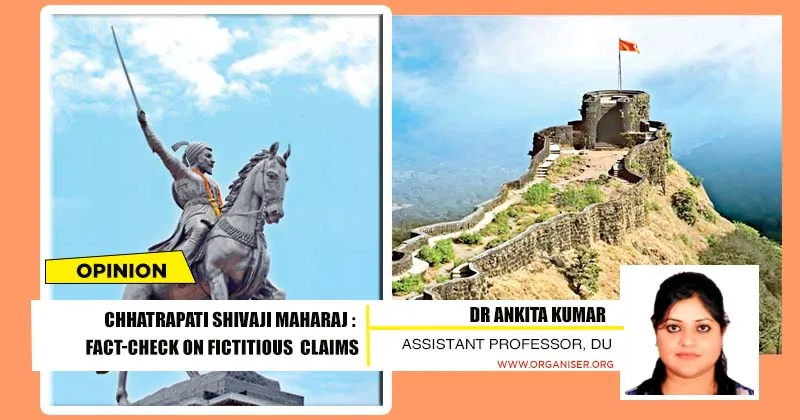
In recent times, the legacy of Chhatrapati Shivaji Maharaj, Bharat’s legendary warrior-king and architect of Hindavi Swarajya, has been dragged into the realm of misinformation and ideological conflict. Disregarding the fact that Shivaji has been a revered figure in Bharatiya history for his unmatched military strategy, administrative genius, and moral code of conduct. Chhatrapati Shivaji Maharaj is increasingly misrepresented by certain voices in media and academia who ignore historical evidence and instead apply a biased lens to interpret the past.
The recent controversy erupted following the revision of NCERT school textbooks, which rightfully integrated more comprehensive and balanced portrayals of Bharatiya civilisational icons, including Chhatrapati Shivaji Maharaj.
Irresponsible and Incorrect Versions
In response, self-styled historian Ruchika Sharma made a provocative and historically unfounded claim that Shivaji had “looted Srirangapatna” and attacked the Wodeyars. Journalist Rajdeep Sardesai echoed this sentiment by alleging that Shivaji “looted Bengal” and cautioned against the “glorification” of Shivaji, all without citing any credible historical evidence. Though it was followed by apology by the celebrity anchor after realising that Shivaji Maharaj never went to Bengal, the original narrative did not change. These remarks, disconnected from both facts and context, sparked widespread outrage across social media and among scholars of Indian history.
These assertions are not only factually baseless but represent a larger trend: the distortion of Bharat’s civilisational heroes to fit narrow ideological agendas. It is high time we return to primary sources and historically verified facts to confront these narratives head-on.
Course Correction Through NCERT Textbooks
At the heart of this media-fuelled controversy is a deeper discomfort with the revival of indigenous narratives. The revised NCERT textbooks seek to decolonise historical discourse by offering an inclusive picture of Bharat’s past, one not exclusively centred around colonial rulers or Islamic dynasties but inclusive of native resistance movements and regional sovereignty. Figures like Shivaji Maharaj, Maharana Pratap, Rani Durgavati, and others are being restored to their rightful place in history.
Propagating Falsehood
Ruchika Sharma’s claim about Srirangapatna collapses when we refer to Surendra Nath Sen’s work, Foreign Biographies of Shivaji (1927), based on the French Factory records from Pondicherry. These primary sources clearly indicate that Shivaji’s campaign in Srirangapatna was not an act of plunder but a calculated strategic move aimed at incorporating the region into his territory. His objective was to protect larger interests and prevent Bijapuri rule from persisting dangerously close to his southern frontier.
During his Karnataka expedition, Shivaji Maharaj captured key forts like Vellore, Kopal, Belwadi, and Gingee. Factory records from Fort St. George highlight his systematic efforts to strengthen these fortifications. In a letter to the English Governor of Madras, he outlined his strategic plan to consolidate Maratha power and establish a secure base to support and reinforce the foundations of Hindavi Swarajya.
One of the most outrageous claims made recently is that Shivaji looted Bengal. This statement is factually incorrect and historically absurd. There is no record of Shivaji ever launching a campaign in Bengal, nor any mention of his forces looting that region. His military campaigns were focused on the Deccan, Konkan, Karnataka, and parts of Gujarat. He was primarily engaged in resisting the Mughal Empire and various sultanates that had oppressed the native population. No historian, whether Jadunath Sarkar, G.S. Sardesai, or M.G. Ranade has claimed that Shivaji invaded Bengal. Such accusations are rooted in historical ignorance or deliberate distortion.
Contrary to attempts to portray him as a plunderer, Shivaji Maharaj is widely remembered as a ruler of great moral integrity, whose conduct in war was guided by the principles of Dharma. He held a deep aversion to injustice and maintained a strict code of honour that forbade the harming of civilians, the desecration of places of worship, and the mistreatment of women. Shivaji and His Times (1919), written by the renowned historian Jadunath Sarkar, says, “Shivaji had a horror of injustice and a chivalrous regard for women. He never permitted the slaughter of the defenceless or the desecration of temples.”
One of the most significant of these is the Sabhasad Bakhar written in 1679 by Krishnaji Anant Sabhasad, a courtier in Shivaji’s service. It recounts an incident where a Maratha commander brought a noblewoman from Kalyan as a prisoner. Shivaji was furious upon hearing this. He not only arranged for her safe return to her family but also honoured her with gifts, ensuring her dignity and safety. This was not an exceptional act—it reflected a consistent policy of respecting non-combatants, especially women. Additional support for this comes from the Shivcharitra Sahitya, Vol. 9, no. 55, published by the Bharat Itihas Sanshodhak Mandal, which documents several such instances where Shivaji’s regard for women was evident and unwavering.
Khafi Khan, a Mughal chronicler who was overtly critical of Shivaji, acknowledged in his Muntakhab-al Lubab that Shivaji treated Islamic religious texts with respect. He noted, “Whenever a Quran came into his possession, he treated it with the same respect as if it had been one of the sacred works of his own faith.” This recognition from an adversarial source speaks volumes about the Maratha king’s ethical code.
British administrator and historian D. Kincaid, in The Grand Rebel, also highlighted Shivaji’s extraordinary respect for women and religious figures of other faiths. He observed: “Even his enemies remarked on his extreme respect for Mussulman priests, for mosques and for the Koran… Whenever his men captured Mussulman ladies, they were brought to Shivaji, who looked after them as if they were his wards.” Such accounts make it abundantly clear that Shivaji Maharaj was not a vindictive figure but a visionary who upheld pluralism and justice, even in the chaos of warfare.
Court historian Malhar Ram Rao Chitnis, in the Chitnis Bakhar, also affirms Shivaji Maharaj’s firm stance against religious intolerance. He records explicit orders issued by Shivaji instructing his commanders not to desecrate places of worship, regardless of the faith they belonged to. Shivaji the Great, Volume II, written by G.S. Sardesai (1946), illustrates the Maratha king’s consistent policy of respecting all religions. Shivaji believed that a ruler’s dharma was to protect, not persecute his subjects, including those of different faiths.
Contemporary foreign observer François Bernier, a French physician and traveller who visited Bharat during the reign of Aurangzeb, also offers valuable insight into Shivaji’s character. In his seminal work Travels in the Mughal Empire (1656–1668), Bernier writes about Shivaji as “wise and moderate in religion.” This observation, coming from a neutral European eyewitness to the political affairs of the subcontinent, further dispels the myth of Shivaji being a sectarian figure. Thus, the portrayal of Shivaji as a looter or a sectarian bigot is not only historically inaccurate but fundamentally dishonest. The legacy he left behind is one of ethical governance and unwavering adherence to righteous conduct.
A recurring slur, often implied rather than stated outright, is that Chhatrapati Shivaji Maharaj was a “rebel” or a “traitor” to the established Mughal order. This accusation is rooted in a colonial mindset that delegitimises any form of native resistance as unlawful insubordination. But the real question is: Was Aurangzeb’s authority in the Deccan truly just or legitimate? Shivaji did not rise against a fair and lawful regime; he resisted an expansionist empire bent on religious persecution, heavy taxation, and centralised exploitation of the Deccan’s resources.
Shivaji’s coronation in 1674 was not merely a symbolic gesture. It was a profound political act that asserted sovereign identity and self-rule. The ideal of Swarajya, represented decentralised, just governance rooted in indigenous civilisational values. As historian Setu Madhavrao Pagdi rightly stated in Shivaji, published by National Book Trust in 1974, “Shivaji was the first true maker of modern India.” This view is echoed by Jadunath Sarkar in his book, Shivaji and His Times, 1919, who observed that Shivaji was not a mere dissenter in the Mughal order but the founder of a sovereign state rooted in native political principles. Even from a leftist standpoint, the late Govind Pansare, in his Marathi book Shivaji Kon Hota?, defends Shivaji’s secularism and far-sighted statesmanship. Pansare, though a Communist, recognised the progressive and inclusive nature of Shivaji’s rule, distinguishing him from the bigotry of his contemporaries.
Further evidence of Shivaji’s administrative genius is found in his Rajyavyavahara Kosha, an early administrative manual as compiled in V.K. Rajwade’s monumental work Marathyanchya Itihasachi Sadhane (Volumes I–VII), published by Bharat Itihas Sanshodhak Mandal that reveals a structured, decentralised, and professional model of governance. Mountstuart Elphinstone, one of the earliest British historians of Bharat, in his work, The History of India, Vol. II, London: John Murray, 1841 has admired Shivaji’s governance.
The answer lies in a deeper ideological struggle between competing visions of Indian history. On one hand is a narrative that honours indigenous heroes, promotes decolonisation, and celebrates civilisational continuity and offers as it was. On the other is a narrative shaped by Marxist, postcolonial, and Eurocentric lenses, which often treats native assertions of sovereignty with suspicion and offers facts with their own biased interpretations to suit their and their master’s interests. These schools of thought find comfort in binaries, colonial vs. anti-colonial, feudal vs. revolutionary, and have difficulty accommodating figures like Shivaji, who defy easy classification.
Shivaji was not a Mughal courtier or British collaborator; he was a Hindu king, a defender of his land and people, whose legitimacy arose from native traditions, not foreign approval. Attempts to portray him as a looter or sectarian aim to undermine his national legacy. That makes him inconvenient to ideologues who demand validation through foreign paradigms.
The updated NCERT textbooks are not “saffronisation” but long-overdue corrections, giving due space to icons like Shivaji and Rani Durgavati. Critics fear the collapse of colonial narratives. Even Tagore envisioned Shivaji uniting broken Bharat. From Tilak to Bose, leaders drew inspiration from him. Restoring his place in history is reclaiming Bharat’s story on its own terms.














Comments