





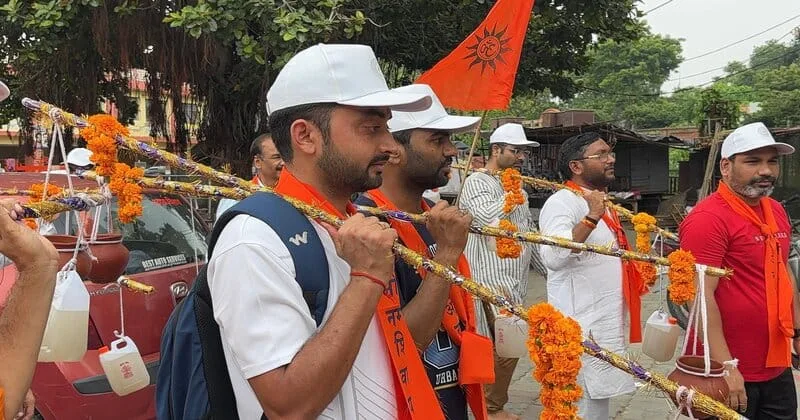
In a profound expression of cultural pride and spiritual devotion, students of the Indian Institute of Technology-Kanpur (IIT-K), one of India’s premier engineering institutions, undertook a 2.5-kilometre Kanwar Yatra on July 27, carrying holy water from the Ganga to perform jalabhishek at the revered Anandeshwar Mandir in Parmat. This symbolic journey, echoing centuries-old Sanatan traditions, is being seen as more than a spiritual act — it reflects a cultural reclamation unfolding within India’s top academic spaces.
Yesterday, IIT Kanpur students walked a 2.5 km Kānwad Yatra to Anandeshwar Temple, joined by faculty & community leaders. India’s top institutes are no longer just echo chambers of the West. They’re becoming sites of decolonisation. Reclaiming what it means to be truly Indian &… pic.twitter.com/BRwv88wF63
— Rashmi Samant (@RashmiDVS) July 28, 2025
Around 50 students, including alumni, faculty, and community leaders, participated in the yatra. Dressed in saffron, barefoot, and chanting “Har Har Mahadev” and “Bam Bam Bhole,” the students began their day early at Sarsaiya Ghat, where they performed a ritual dip in the Ganga, collected Gangajal, and set out on foot towards the Anandeshwar Mandir, bearing traditional kanwars on their shoulders.
The yatra was flagged off with blessings by Arun Puri Maharaj, Mahant of the Siddhanath Mandir, who commended the initiative. “This is the Bharat we wish to see — where our youth lead not only in science and innovation but also in upholding and living our dharma,” he said.
The scene was one of solemn devotion combined with youthful energy. As the students walked through the streets of Kanpur, locals joined in to cheer and support the procession. Onlookers offered water, sweets, and encouragement, moved by the sight of some of India’s brightest minds embracing ancient rituals with sincerity and pride.
Upon reaching the Anandeshwar Mandir, participants stood in queue like all devotees, waited patiently, and performed the jalabhishek of Bhagwan Shiv, pouring the sacred Gangajal on the Shivling as per Vedic tradition. The entire ritual was conducted with discipline and devotion, as chants echoed through the Mandir premises.
This yatra marks a growing trend among students and scholars across India’s elite institutions — a turn toward decolonisation, not only in theory and curriculum but also in personal identity and cultural expression. For decades, top institutes like IITs were perceived as bastions of westernised thought, often distanced from India’s spiritual and civilisational heritage. That perception is now being challenged from within.
Faculty members who joined the walk expressed similar sentiments. “As educators, we’re seeing a shift,” said one professor from the Humanities Department. “Students are no longer ashamed of being openly Hindu or Indian in thought and practice. They’re asking deeper questions — not just about the world, but about themselves and their place in a civilisational continuum.”
The entire event was student-organised, reflecting both spontaneity and structure. Arrangements for safety, hydration, and crowd management were handled efficiently. Alumni and faculty offered support, and local authorities facilitated the smooth movement of the procession.
This Kanwar Yatra was not just a ritual walk — it was a declaration. That India’s future scientists, engineers, and thinkers are no longer content with borrowed narratives. They are seeking meaning in the timeless traditions of their land, and proudly so.
















Comments