





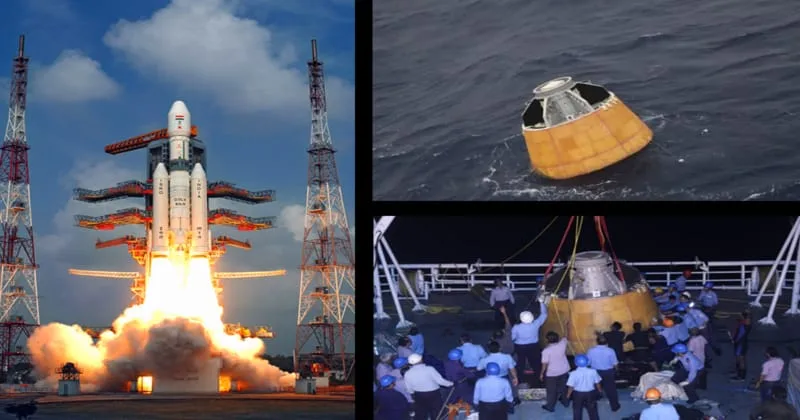
The Indian Space Program is over six decades old. It has seen many great chapters in its history. The one chapter it wants to add soon to its glorious history is a chapter on India’s first human spaceflight mission. The chapter is currently being written with a lot of preparation and hope.
The talks about this mission started a decade ago, it gained strength by the year 2017-18 and it got announced to the world by Prime Minister Narendra Modi on India’s Independence Day on August 15, 2018 when he declared in his prime ministerial address to the nation from the ramparts of the Red Fort that India would send its own human spaceflight mission exactly 4 years later. He told the audience present there and viewers across the globe that when India celebrated its 75th Independence Day in 2022, that day would also mark the launch of Mission Gaganyaan.
This announcement made quite an impact in the technology circles, policy circles, media and among the public as well. Critics argued against the need for such a mission when a mission like this had already been conceived five decades ago by the superpowers, like the Soviet Union and the United States, during the height of the Cold War. The Soviet Union was the first nation to send a human to outer space way back in 1961, and the United States was the first nation to make a human land on the moon in 1969 when Neil Armstrong became the first human to set foot on the lunar surface. Critics also argued about the need to invest in a human spaceflight program, which would put a lot of burden on the public exchequer, considering the fact that the mission costs would be paid directly by the taxpayers’ money. Their third argument was that instead of investing in a human spaceflight program, why don’t the policymakers think about investing in developmental projects like sanitation, schools, healthcare, education, etc.
The answer to these critics is very plain and simple. On the first point regarding the superpowers having achieved this feat half a century back, the counter question is that if some other nation has achieved something five decades back, should India not accomplish the same feat at all. This would mean not having a human spaceflight program and future missions at all because, as per the critics’ argument, the developed nations have already done it. Yes, they have done it for their own self-interest as much as any other nation, including India, will do it for its own national interests. Yes, outer space is considered to be a global commons, but that doesn’t mean that the success of one or a few nations in outer space can be claimed by every other nation on the planet. Metaphorically, yes, one can claim it, but that doesn’t change the world of realpolitik, where every nation needs to stand on its own and work independently.
The second argument presented by critics regarding the costs of a human spaceflight mission is that it will burden the public exchequer. Agreed, that it will have a huge cost since outer space is an expensive business, but one has to look at this scenario rationally and weigh in whether the gains of sending the human spaceflight mission would out-cost the costs of sending the mission in the first place. To anyone who agrees with the first counter-argument, they would also then agree with this argument too. The reason being that if one agrees with the premise of India having an indigenous human spaceflight mission, one would also agree that it would require a certain cost.
To the third argument, where the critics argued for investing in development sectors like sanitation, healthcare, education, etc- the counterargument is that this same line of argument was there in the late 1950s and early 1960s as well, when India, as a newly independent young nation was trying to sow the seeds of an indigenous space program. That time too, India was suffering from poverty, hunger, undernutrition, illiteracy, etc. Additionally, natural disasters such as floods and droughts used to plague the country on a continual basis. At that time, the policy makers and shapers like Dr. Vikram Sarabhai, who is considered to be the father of the Indian Space Program, didn’t bow down to the then pressures of the then critics. Had he not ploughed under the pressure, India would probably not even have a space program to begin with.
This shows that there are always going to be critics who would try to steer the discourse entirely towards the pressing needs of the day, even at the cost of overlooking the emerging technologies whose benefits in future might outweigh the pressing needs of today. India has always walked on the philosophy of taking the middle path- the ‘Madhyam Marg’. Mission Gaganyaan is also a step in the same direction, reaching for the skies, without overlooking the ground realities.















Comments