






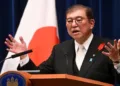
An idea Japanese Prime Minister Ishiba Shigeru has long been floating around relates to the creation of an “Asian NATO.” One wonders why his idea has not yet received the attention it deserves.
Observers say Prime Minister Ishiba is hardly in a comfortable position in Japan’s domestic politics today. Recently, Japan’s ruling Liberal Democratic Party, currently led by him, has received a drubbing in the country’s Upper House of Parliament elections. Last year, his party fared badly in the elections to the more important Lower House of Parliament. There is, however, little threat to his prime ministership.
As the head of his government, Prime Minister Ishiba is likely to continue asserting his favourite idea of “Asian NATO.” Prior to his election as LDP president last year, Ishiba contributed a piece on this theme, advocating for the development of greater deterrence against China in the Indo-Pacific region.
The observers lament that there are few takers of the Ishiba idea in the world today. At ASEAN’s last summit in Laos, its ten member states were sceptical of this proposal. The United States, India, and Australia, all important members of the Indo-Pacific region, have been hardly receptive to this idea. US President Donald J Trump has been making a lot of noise about pulling the United States out of NATO. India’s External Affairs Minister S Jaishankar said in a speech: “We have never been a treaty ally of any country. We don’t have that kind of strategic architecture in mind.” Australian Prime Minister Anthony Albanese has termed the idea of an Asian NATO “contentious.”
However, the observers assert, the Ishiba idea needs to be analysed in a nonpartisan manner and endorsed. They say it has the potential to promote a rules-based order in the Indo-Pacific. The norms to be complied with under this framework would prevent any other countries from unilaterally changing the status quo in the region. It would deter China’s well-documented territorial designs in the Indo-Pacific.
The observers say New Delhi would do well to back the Ishida proposition. The creation of an Asian NATO is likely to prove an asset to its time-tested doctrine of strategic autonomy. New Delhi should not be indifferent to it, the way it initially was in the case of the Quadrilateral Security Dialogue. Regrettably, India came to participate in the QUAD only in 2018.
Once South Block was non-committal to the QUAD. In his famous “Confluence of the Two Seas” speech to the Indian Parliament in August 2007, then-Japanese Prime Minister Shinzo Abe stressed the idea of connecting the Pacific and Indian Oceans through an “Arc of Freedom and Prosperity.” The Abe speech envisioned a strategic partnership between India, Japan, Australia and the United States. It was only with Abe’s “Democratic Security Diamond” (DSD) proposal, published by Project Syndicate in December 2012, that the initiative gained traction in India.
The observers’ counsel that India and Japan may coordinate to translate the idea of the Asian NATO into reality. They would do well to forge stronger ties with the United States, but at the same time, they may better delink themselves from any military dependence on the only superpower for the security of the Indo-Pacific region today.













Comments