





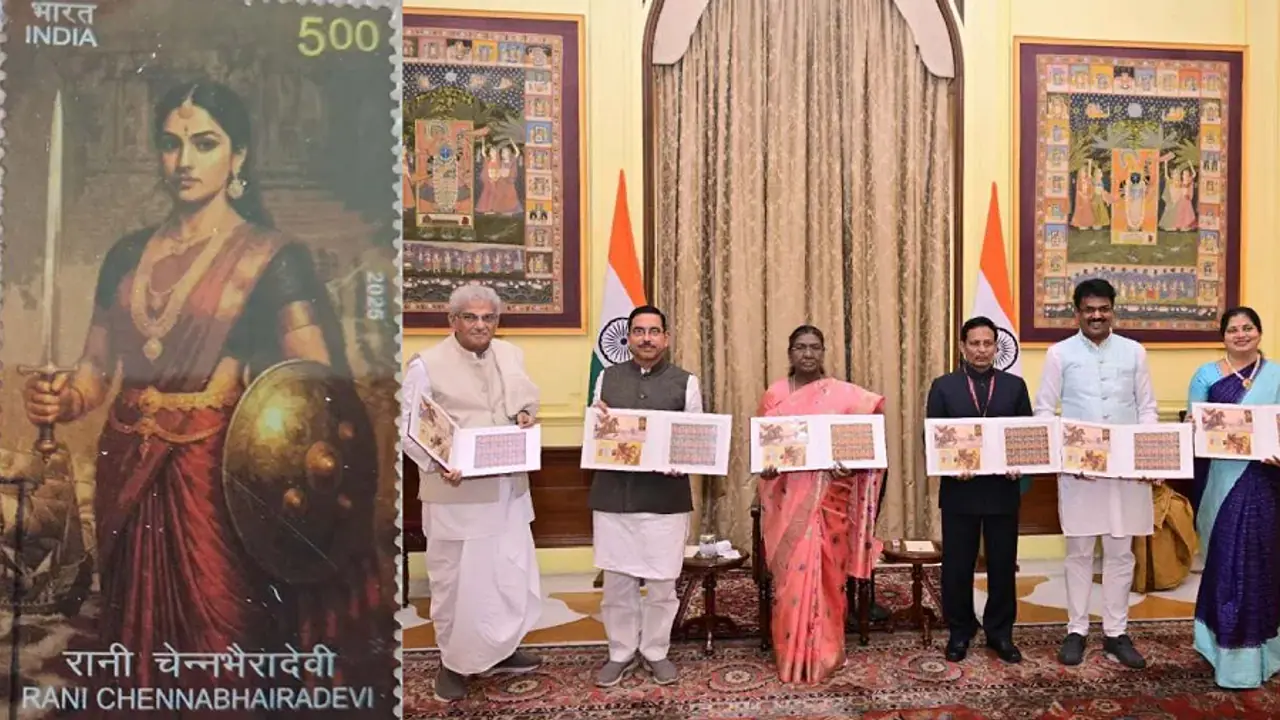
On July 24, Thursday, President Droupadi Murmu unveiled the postage stamp in commemoration of the 16th-century queen Rani Chennabhairadevi, in a ceremony held at Rashtrapati Bhavan. During the occasion, the President highlighted the Queen’s courage and fortitude. Queens achievements has to be inscribed “not just in golden letters, but in diamonds”, said the President while expressing her admiration for the irreplaceable saga of the queen.
The president was joined by Union Minister Pralhad Joshi, Rajya Sabha MP Veerendra Heggade, Postmaster General Yuvaraj, and others. Minister Pralhad Joshi exclaimed that Rani Chennabhairadevi is the pride of Karnataka and she is the role model for the women of today. “She empowered women by creating opportunities for self-reliance and self-defence. She exemplified leadership marked by courage, compassion and integrity”, he added. “She is a remarkable personality buried in the depths of forgotten history”, said Dharmadikari and Rajya Sabha MP Dr. Veerendra Heggade.
The ceremony held at Rashtrapati Bhavan also paid homage to many other forgotten historical women figures, who made an exceptional contribution to the country and sacrificed their life for the sake of the motherland. Reviving the saga of such historical women personalities and acknowledging their contribution is pivotal to uphold the nation’s civilizational legacy in the 21st century.
Chennabhairadevi and her Unequivocal Legacy
Rani Chennabhairadevi, hailed as the longest-serving queen of India (1556 to 1606), who ruled around coastal Karnataka and parts of the Western Ghats (Sahyadris) during the 16th century, is popularly called ‘Raina-Da-Pimenta’ by the Portuguese, which means ‘The Queen of Pepper’. The Portuguese gave her the title as they were amazed by her exceptional trading and business skills. As the region was rich in the cultivation of spices, she exported large quantities of pepper, cinnamon, and Sandalwood to Europe and the Arab countries via the ports of Honnavara and Bhatkala in coastal Karnataka, thus making the region a key commercial and trade hub of the era.
Not just trade, she was also popular for her stellar statecraft, diplomacy, and military capabilities. She fought two wars against the Portuguese in 1559 and 1570 and won both wars. Interestingly, she commanded an army that included the kings such as the Sultans of Gujarat, the Sultans of Bidar and the Adil Shahis of Bijapur. She also gave refuge to the Konkans who were seeking to escape the forced conversions perceived by the Portuguese. Thereby, she thwarted the Portuguese expansion towards the south of Konkan and upheld the native cultural spirit.
Remembering and honouring the legacy of the brave hearts, such as Chennabhairadevi adds much more vibrancy and valour to Indian history. The unveiling of the queen’s postal stamp by the President is a hallmark step in the direction of revisiting and reviving the rich forgotten history of India, its unsung heroes and their remarkable sagas.















Comments