China destroys 300 Buddhist stupas in Tibet
July 11, 2026
  • Read Ecopy
  • Circulation
  • Advertise
  • Careers
  • About Us
  • Contact Us
Android AppiPhone AppArattai
Organiser
  • ‌
  • Bharat
    • Assam
    • Bihar
    • Chhattisgarh
    • Jharkhand
    • Maharashtra
    • View All States
  • World
    • Asia
    • Europe
    • North America
    • South America
    • Africa
    • Australia
  • Editorial
  • International
  • Opinion
  • RSS @ 100
  • More
    • Op Sindoor
    • Analysis
    • Sports
    • Defence
    • Politics
    • Business
    • Economy
    • Culture
    • Special Report
    • Sci & Tech
    • Entertainment
    • G20
    • Azadi Ka Amrit Mahotsav
    • Vocal4Local
    • Web Stories
    • Education
    • Employment
    • Books
    • Interviews
    • Travel
    • Law
    • Health
    • Obituary
  • Subscribe
    • Subscribe Print Edition
    • Subscribe Ecopy
    • Read Ecopy
  • ‌
  • Bharat
    • Assam
    • Bihar
    • Chhattisgarh
    • Jharkhand
    • Maharashtra
    • View All States
  • World
    • Asia
    • Europe
    • North America
    • South America
    • Africa
    • Australia
  • Editorial
  • International
  • Opinion
  • RSS @ 100
  • More
    • Op Sindoor
    • Analysis
    • Sports
    • Defence
    • Politics
    • Business
    • Economy
    • Culture
    • Special Report
    • Sci & Tech
    • Entertainment
    • G20
    • Azadi Ka Amrit Mahotsav
    • Vocal4Local
    • Web Stories
    • Education
    • Employment
    • Books
    • Interviews
    • Travel
    • Law
    • Health
    • Obituary
  • Subscribe
    • Subscribe Print Edition
    • Subscribe Ecopy
    • Read Ecopy
Organiser
  • Home
  • Bharat
  • World
  • Operation Sindoor
  • Editorial
  • Analysis
  • Opinion
  • Culture
  • Defence
  • International Edition
  • RSS @ 100
  • Magazine
  • Read Ecopy
Home World

China wages war on Tibetan faith: 300 stupas and Guru Padmasambhava Statue bulldosed in Drakgo amid crackdown

Chinese authorities have demolished over 300 Buddhist stupas and sacred statues in Drakgo, Tibet, while imposing a total communications blackout and arresting locals who resist. This state-led assault on Tibetan Buddhism reflects Beijing’s systematic campaign to erase Tibet’s spiritual identity under the guise of law and “Sinicisation”

WEBDESKWEBDESK
Jul 24, 2025, 01:15 pm IST
in World, International Edition
Follow on Google News
Chinese Authorities Raze Hundreds of Buddhist Stupas and Padmasambhava Statue in Karze,Tibet

Chinese Authorities Raze Hundreds of Buddhist Stupas and Padmasambhava Statue in Karze,Tibet

FacebookTwitterWhatsAppTelegramEmail

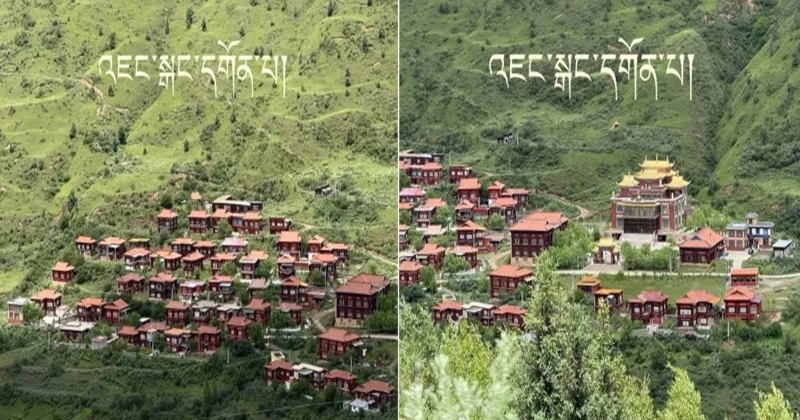
Chinese Communist authorities have bulldosed over 300 Buddhist stupas and demolished sacred statues, including one of Guru Padmasambhava (Guru Rinpoche) and another of the venerated late Khenpo Jigme Phuntsok, at Lungrab Zang-ri near Janggang Monastery in Drakgo County, Karze (Ch: Ganzi) Tibetan Autonomous Prefecture, part of the historic Kham province of Tibet.

The mass demolition, executed in late May or early June 2025, is among the most severe state-sponsored acts of cultural and religious destruction in recent years drawing chilling parallels with the first Cultural Revolution (1966–76) that left thousands of monasteries, scriptures, and statues in ruins across Tibet.

This time, the war is quiet no Red Guards with loud slogans, just a coldly efficient machinery of Communist repression that erases centuries of Tibetan devotion with the silence of bulldosers and the brutality of surveillance.

According to Tibetan sources, dozens of earth-moving machines, security personnel, and party officials arrived at Lungrab Zang-ri without warning. Within hours, they began rasing hundreds of whitewashed stupas, including three large chortens, built by monks and lay devotees over years. These structures, considered representations of the enlightened mind of the Buddha, were lovingly constructed with prayers, relics, and traditional craftsmanship.

Also destroyed were two highly revered statues, A newly built statue of Khenpo Jigme Phuntsok, the legendary abbot and founder of Serthar Buddhist Institute, credited with leading a revival of Tibetan Buddhism in post-Cultural Revolution Tibet.

A sacred statue of Guru Padmasambhava, also known as Guru Rinpoche, the 8th-century tantric master who introduced Buddhism to Tibet and is worshipped by Tibetans as a “Second Buddha.” “These were not just statues,” said a source who managed to speak under conditions of complete anonymity. “They were living symbols of our faith, our history, our very identity. And now they’re dust.”

Once the demolition was complete, all traces were cleared. The ground was flattened. The rubble was carted away. Even mobile phone signals vanished.

Chinese authorities imposed a complete communications blackout in the region. The surrounding areas were sealed. Locals were warned not to speak, photograph, or even whisper about the incident. Attempts to communicate with the outside world have been met with swift arrests under charges of “leaking state secrets.”

“It’s not just a physical destruction of structures; it’s a psychological war against Tibetan resilience,” said a researcher with access to verified information from inside the region.

The government offered a vague and cynical justification, stating that the religious structures were “built illegally on government land” and violated unspecified “land use regulations.” However, no documents, warnings, or legal notices were ever presented to the monasteries or the community. In fact, many of the demolished structures had stood peacefully for decades, some dating back several generations.

This fresh wave of destruction follows Decree No. 22, issued by the National Religious Affairs Bureau on December 1, 2024, which took effect from January 1, 2025. Under this new law, all religious institutions including centuries-old monasteries must function under direct Communist Party supervision, in accordance with Article 43 of the Monastery Management Regulations.

The regulations prohibit:

  • Independent construction or renovation of stupas and statues without written CCP approval
  • Display of images or prayers related to His Holiness the Dalai Lama
  • Congregations of religious leaders without prior surveillance clearance
  • Any religious activity deemed “outside the purview of socialist values”

Effectively, Tibetan Buddhism is no longer allowed to function independently, even in remote corners of Kham.

The religious leadership in Tibet is under siege. Khenpo Tenga (བསྟན་དགའ།), a senior monk of Janggang Monastery who helped construct the destroyed stupas and statues at Lungrab Zang-ri, has been placed under surveillance confinement. He is not allowed to lead prayers, meet with followers, or travel beyond designated zones.

The persecution is nationwide. In Amdo, monks are forbidden to travel in groups larger than five, especially around the 90th birthday celebrations of the Dalai Lama. Religious gatherings, even within monastery premises, are being interpreted as anti-state mobilisations.

The case of Tulku Hungkar Dorje remains one of the most shocking:

Known for resisting the government-imposed Panchen Lama, composing long-life prayers for the Dalai Lama, and promoting authentic Tibetan education, Tulku Hungkar Dorje was forced to flee to Vietnam. On March 28, 2025, he was reportedly arrested in a secret joint operation by Chinese and Vietnamese intelligence. His body was returned lifeless.

The Chinese government claims he “died in custody,” while his followers suspect torture or targeted execution. A secret funeral was conducted under heavy security. International human rights groups demanding transparency have been ignored.

Global Celebrations, Local Bans: The Dalai Lama’s 90th Birthday silenced

While the global Tibetan diaspora and Buddhist communities celebrated the 90th birthday of the 14th Dalai Lama in July 2025, inside Tibet, the occasion was suffocated with fear.

Chinese authorities banned all public gatherings in Karze Prefecture and nearby counties. Anyone attempting to mark the event faced interrogation. Posters or photos of the Dalai Lama were deemed “tools of separatism.” In schools and monasteries, CCP officials conducted “re-education campaigns” branding the exiled leader as a “reactionary.”

Also Read: Indian Passport Gets Global Boost: 77th rank, access to 59 countries without visa

This wasn’t merely censorship; it was an attempt to erase the spiritual heartbeat of a people. This isn’t the first time Drakgo County has seen such brutality. In November 2021, Party Secretary Wang Dongxin ordered the closure of Drakgo Gaden Namgyal Ling Monastery School, followed by:

  • Demolition of two 30-foot Buddha statues
  • Destruction of 45 prayer wheels
  • Mass arrests of monks, including children

The scale and frequency of these acts reveal a coherent strategy not of isolated crackdowns, but a state-sponsored campaign of cultural extermination.
 

Topics: TibetCCPTibetan BuddhismChinese CommunistBuddha statuesDrakgoNational Religious Affairs Bureau
ShareTweetSendShareSend
✮ Subscribe Organiser YouTube Channel. ✮
✮ Join Organiser's WhatsApp channel for Nationalist views beyond the news. ✮
Previous News

2006 Mumbai Blasts Case: Supreme Court stays Bombay HC judgement acquitting the accused, orders fresh notice

Next News

Russian Angara Airlines An-24 with 50 onboard crashes near Tynda after vanishing from radar

Related News

Tibetan man self-immolates outside the UN, protesting the repressive policies of China & Xi Jinping

Tibetan man self-immolates outside UN: Protests against repressive Chinese policies & demands independence from Beijing

The "China Plus One" strategy is reshaping the global manufacturing map

The China Plus One Era: Why global manufacturing is shifting from Beijing to new strategic hubs

Chinese President Xi Jinping

China Back to Mao Era? Xi unveils new doctrine of party supremacy over state and people

As economic pressures mount, Beijing is tightening control over business, investment and society, placing security and stability above growth

Xi, the CCP and China’s New Reality: Why regime survival now matters more than economic growth

China’s economic slowdown pushes migrant workers into homelessness as Beijing reshapes the narrative through new terminology.

China rebrands ‘homelessness’ as ‘dispersed persons’ to hide rising economic distress and urban poverty

Tibet Museum Exhibition showcases 1947 documents claiming Tibet’s sovereign status

Load More

Latest News

INS Mahendragiri commissioned into Indian Navy; Indigenous stealth frigate marks a milestone in maritime security

Bharat Jodo Yatra has faced scrutiny over participation of several individuals later linked to arrests, FIRs & major criminal controversies

From Hate Speech to Crime: How Rahul Gandhi’s Bharat Jodo Yatra became a haven for radical and disreputable elements

Ayodhya Ram Mandir: All construction to conclude by July 30; Storyline for Ram Katha Sangrahalay finalised

Namaste is a timeless Indian greeting that symbolises respect, humility, and harmony

The Art of Namaste: Exploring the ancient Indian greeting that symbolises respect, humility & human connection

Vice-President of India, CP Radhakrishnan

Sardar Patel united not only territories but also hearts of Indians: VP Radhakrishnan in virtual address at IIAS Shimla

Bible-related prosecutions, church raids and mass arrests have become central to a new report on the treatment of Christians in Iran.

Iran’s anti-Christian crackdown escalates with Bible bans, church seizures and mass arrests: Report

UP govt to replace Shop act with OSH Code

Uttar Pradesh to scrap 60-year-old shop act and align the state’s rules with the OSH Code framework

(Left) Rath to be used at Puri Jagannath Yatra (Right) Odisha Chief Minister Shri Mohan Charan Majhi reviews Rath Yatra preparations at Lok Seva Bhawan on July 10, 2026

Puri Rath Yatra: Odisha CM reviews preparations; Govt deploys 12,000 security personnel, 30 evacuation corridors ready

Two held in the killing of Nagaland civilians

Manipur: NIA makes first arrests in sensational killings of 6 Naga civilians

People gather in large numbers during an anti-Pakistan protest, in Pakistan-occupied Jammu and Kashmir (ANI Video Grab)

POJK Unrest: Pakistan Forces kill two during JAAC protest; Umar Nazir Kashmari sets July 14 deadline if demands not met

Load More
  • Privacy
  • Terms
  • Cookie Policy
  • Refund and Cancellation
  • Delivery and Shipping

© Bharat Prakashan (Delhi) Limited.
Tech-enabled by Ananthapuri Technologies

  • Home
  • Search Organiser
  • Bharat
    • Assam
    • Bihar
    • Chhattisgarh
    • Jharkhand
    • Maharashtra
    • View All States
  • World
    • Asia
    • Africa
    • North America
    • South America
    • Europe
    • Australia
  • Editorial
  • Operation Sindoor
  • Opinion
  • Analysis
  • Defence
  • Culture
  • Sports
  • Business
  • RSS @ 100
  • Entertainment
  • More ..
    • Sci & Tech
    • Vocal4Local
    • Special Report
    • Education
    • Employment
    • Books
    • Interviews
    • Travel
    • Health
    • Politics
    • Law
    • Economy
    • Obituary
  • Subscribe Magazine
  • Read Ecopy
  • Advertise
  • Circulation
  • Careers
  • About Us
  • Contact Us
  • Policies & Terms
    • Privacy Policy
    • Cookie Policy
    • Refund and Cancellation
    • Terms of Use

© Bharat Prakashan (Delhi) Limited.
Tech-enabled by Ananthapuri Technologies