





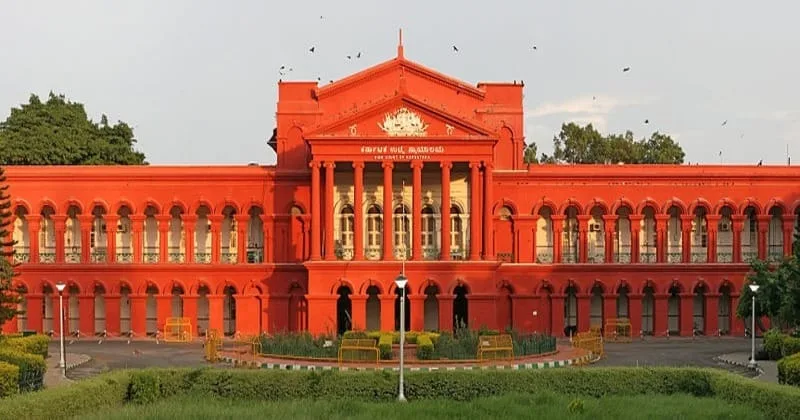
A controversial ruling has sparked nationwide debate. The Karnataka High Court has quashed a First Information Report (FIR) filed against three Muslim men accused of preaching Islam and distributing pamphlets inside a Hindu temple, holding that their actions did not constitute an offence under the state’s anti-conversion law or the Bharatiya Nyaya Sanhita (BNS), 2023.
The case revolves around an incident that occurred on May 4, 2025, at the Ramatheerth Temple in Jamkhandi, where the three accused were seen distributing Islamic literature and explaining Islamic beliefs to devotees within the temple premises.
According to the complainant, not only did the men propagate Islamic teachings inside the temple, but they also made derogatory remarks about Hinduism and allegedly attempted to lure devotees with promises of jobs and vehicles in Dubai, actions that the complainant interpreted as covert attempts at religious conversion.
The local police subsequently registered an FIR under Sections 299 (hurting religious sentiments), 351(2) (promoting enmity between religious groups), and 3(5) (attempt to convert) of the BNS, along with Section 5 of the Karnataka Protection of Right to Freedom of Religion Act (KPRFR Act), 2022.
However, the three accused filed a petition before the High Court seeking to quash the FIR, arguing that they were merely engaging in peaceful religious discourse and had not attempted any forced conversion.
Justice Venkat Naik T, presiding over the case, observed that the allegations in the FIR failed to meet the essential ingredients required to constitute an offence under the cited laws. The court noted that Section 3 of the KPRFR Act specifically criminalises conversion through coercion, misrepresentation, undue influence, or inducement, none of which, the court argued, were conclusively established in the complaint.
Crucially, the court cited Section 4 of the KPRFR Act, which states that only the person who has been converted (or their parents, siblings, or close relatives) may file a complaint under the law. Since the complainant was a third party and not directly affected by the alleged attempt at conversion, the court ruled that he had no legal standing (locus standi) to initiate proceedings.
The bench held that even if all the allegations in the FIR were accepted at face value, they did not meet the legal threshold to be treated as offences under the anti-conversion legislation or the BNS.
While the judgment may be in accordance with a strict interpretation of the law, it raises deeply unsettling questions about the broader implications of such actions inside Hindu religious premises.
Many have expressed concerns that this ruling, while technically sound, may set a dangerous precedent, effectively granting legal impunity to religious preaching within sacred Hindu spaces as long as it does not result in overt conversion.
A Hindu temple is not a public square or a street corner for open discourse; it is a sanctified space, consecrated through rituals and revered as a site of spiritual connection by millions of devotees. It embodies not just religion but civilisational values, traditions, and the collective spiritual identity of the Hindu community.
When individuals from another faith enter such a space and begin preaching their own beliefs, particularly those that challenge or denigrate the host religion, it constitutes not just an intrusion, but a symbolic desecration. Whether or not an actual conversion takes place, such actions disturb the religious sanctity of the space and can provoke strong emotional reactions among devotees.
The idea that distributing Islamic pamphlets and promoting Islamic doctrines inside a Hindu temple is not criminal unless there is evidence of successful conversion risks trivialising the sanctity of sacred spaces. Many argue that this would be akin to delivering Hindu discourses inside a mosque or a church, an act that would likely provoke outrage and be swiftly curtailed.
The court’s judgment, therefore, raises an urgent need for a nuanced approach to religious freedom that includes protecting the integrity of each faith’s worship spaces from external encroachment, irrespective of whether conversion is the explicit goal.
Moreover, the ruling has raised fears about potential communal tensions. If provocative activities like preaching another religion inside temples are deemed legally permissible on technical grounds, and if they escalate into violence or communal riots in the future, the judiciary’s inability to foresee these consequences could come under scrutiny.
Adding to the controversy is the perceived legal and social asymmetry. Hindu religious processions and statements are often criticised for “hurting sentiments” of other communities, while preaching Islam inside a Hindu temple is now being viewed as harmless unless forceful conversion is proven. This selective application of sensitivity standards is not just inconsistent, it is dangerous. It breeds mistrust and resentment, and further deepens the fault lines between communities.
While the Karnataka High Court’s verdict may align with the technicalities of legal provisions, it highlights a glaring void in the safeguarding of Hindu religious spaces.
The judgment has stirred concern about the legal system’s capacity or willingness to protect temples from ideological intrusion. As debate intensifies, one thing is clear: India’s pluralistic harmony cannot survive without mutual respect for the sacred boundaries that each religion holds dear.
Temples are not venues for ideological battles, and unless both law and society uphold this sanctity, the consequences could be grave not just for Hindus, but for the secular fabric of the nation itself.
















Comments