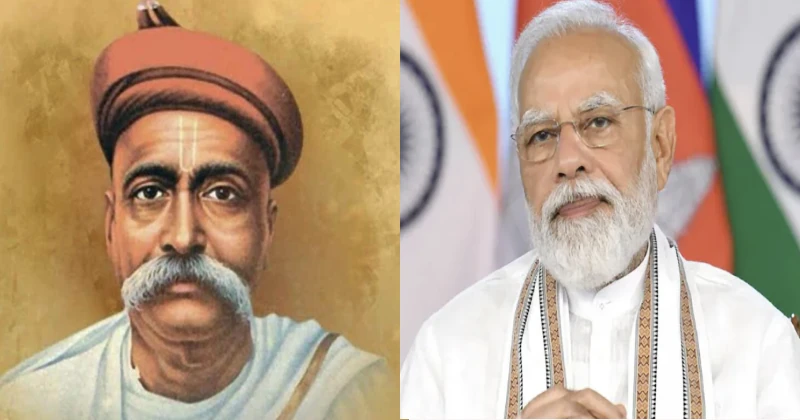
PM Modi honours Lokmanya Tilak on his Birth Anniversary
August 25, 2026
  • Read Ecopy
  • Circulation
  • Advertise
  • Careers
  • About Us
  • Contact Us
Android AppiPhone AppArattai
Organiser
  • ‌
  • Bharat
    • Assam
    • Bihar
    • Chhattisgarh
    • Jharkhand
    • Maharashtra
    • View All States
  • World
    • Asia
    • Europe
    • North America
    • South America
    • Africa
    • Australia
  • Editorial
  • International
  • Opinion
  • RSS @ 100
  • More
    • Op Sindoor
    • Analysis
    • Sports
    • Defence
    • Politics
    • Business
    • Economy
    • Culture
    • Special Report
    • Sci & Tech
    • Entertainment
    • G20
    • Azadi Ka Amrit Mahotsav
    • Vocal4Local
    • Web Stories
    • Education
    • Employment
    • Books
    • Interviews
    • Travel
    • Law
    • Health
    • Obituary
  • Subscribe
    • Subscribe Print Edition
    • Subscribe Ecopy
    • Read Ecopy
  • ‌
  • Bharat
    • Assam
    • Bihar
    • Chhattisgarh
    • Jharkhand
    • Maharashtra
    • View All States
  • World
    • Asia
    • Europe
    • North America
    • South America
    • Africa
    • Australia
  • Editorial
  • International
  • Opinion
  • RSS @ 100
  • More
    • Op Sindoor
    • Analysis
    • Sports
    • Defence
    • Politics
    • Business
    • Economy
    • Culture
    • Special Report
    • Sci & Tech
    • Entertainment
    • G20
    • Azadi Ka Amrit Mahotsav
    • Vocal4Local
    • Web Stories
    • Education
    • Employment
    • Books
    • Interviews
    • Travel
    • Law
    • Health
    • Obituary
  • Subscribe
    • Subscribe Print Edition
    • Subscribe Ecopy
    • Read Ecopy
Organiser
  • Home
  • Bharat
  • World
  • Operation Sindoor
  • Editorial
  • Analysis
  • Opinion
  • Culture
  • Defence
  • International Edition
  • RSS @ 100
  • Magazine
  • Read Ecopy
Home Bharat

PM Modi honours Lokmanya Tilak on his Birth Anniversary, calls him the ‘Torchbearer of Swaraj and Service’

Lokmanya Tilak was a visionary nationalist who rooted India's freedom struggle in dharma, cultural resurgence, and mass awakening. His legacy challenges modern secular paradigms, emphasising that politics must be guided by dharma, not divorced from it

WEBDESKWEBDESK
Jul 23, 2025, 11:00 am IST
inBharat
Follow on Google News
Facebook
Twitter
WhatsAppTelegramEmail

On July 23, Prime Minister Narendra Modi took to X to pay homage to one of the tallest figures of Bharat’s freedom movement Lokmanya Bal Gangadhar Tilak on his birth anniversary. The Prime Minister described Tilak as a “pioneering leader who played a vital role in kindling the spirit of India’s freedom movement with unwavering conviction” and hailed him as an “outstanding thinker who believed in the power of knowledge and serving others.”

Remembering Lokmanya Tilak on his birth anniversary. He was a pioneering leader who played a vital role in kindling the spirit of India’s freedom movement with unwavering conviction. He was also an outstanding thinker who believed in the power of knowledge and serving others.

— Narendra Modi (@narendramodi) July 23, 2025

As India today continues to grapple with the legacy of colonial institutions and the ongoing tension between dharma and modern statecraft, the life of Bal Gangadhar Tilak offers a powerful historical reference point. A fiery nationalist, philosopher, educator, and journalist, Tilak redefined the very essence of political resistance by infusing dharma and cultural resurgence into the political discourse, challenging not just British imperialism but also the spiritual and psychological subjugation of an ancient civilisation.

Born on July 23, 1856, in Ratnagiri, Maharashtra, Tilak emerged from a scholarly Chitpavan Brahmin family steeped in Sanskrit learning. After graduating from Deccan College in Pune with degrees in mathematics and Sanskrit and earning a law degree from the University of Bombay in 1879, Tilak made a decisive shift toward education and mass awakening.

He co-founded the Deccan Education Society in 1884, a bold attempt to liberate Indian minds through liberal English education. But when he discovered deviations from the ideal of selfless service among fellow educators, Tilak resigned—a gesture symbolic of his lifelong commitment to personal integrity and national ethics.

He soon launched two powerful newspapers Kesari (in Marathi) and The Mahratta (in English)which became rallying platforms for an awakened national consciousness. Through scathing editorials, he denounced British tyranny and criticised moderate Congress leaders who advocated gradual reform over full independence.

Tilak’s genius lay in recognising that politics devoid of cultural roots is impotent. At a time when the nationalist movement was largely confined to the English-speaking elite, Tilak used Hindu religious symbolism and popular festivals to democratise the movement.

In 1893, he organised Ganesh Utsav, transforming a private family ritual into a mass celebration of unity and resistance. Two years later, he revived the memory of Chhatrapati Shivaji Maharaj, invoking the Maratha warrior king as a symbol of Hindu resurgence and defiance against oppression.

While critics from the liberal and Marxist camps later accused him of communalising the freedom struggle, it must be remembered that Tilak’s approach was inclusive of all Indians, yet unapologetically rooted in dharma and indigenous traditions. He did not politicise religion; rather, he spiritualised politics.

The British government, threatened by his rising influence, arrested Tilak in 1897 on charges of sedition. His fiery editorials in Kesari were deemed inciteful after the Chapekar brothers assassinated plague commissioner W. C. Rand. His imprisonment made him a national icon, earning him the title “Lokmanya” beloved leader of the people.

Released after 18 months, Tilak plunged into active resistance again, especially during the 1905 Partition of Bengal. He spearheaded the boycott of British goods and laid down the Tenets of the New Party, advocating passive resistance, economic self-reliance, and civic courage. These ideas would later become foundational to Mahatma Gandhi’s satyagraha movement.

At the Surat Congress of 1907, Tilak’s hardline stance led to a split with moderates. The British pounced again, this time deporting him to Mandalay, Burma, for six years. Yet prison only sharpened his intellect. There, he authored his magnum opus—‘Shrimad Bhagavad Gita Rahasya’, rejecting the colonial and renunciate interpretation of the Gita, asserting instead that karma yoga and selfless action were the true messages of the sacred text.

Returning in 1914, Tilak founded the Indian Home Rule League, asserting that “Swarajya is my birthright and I shall have it.” In 1916, he concluded the Lucknow Pact with Mohammed Ali Jinnah, advocating Hindu-Muslim unity against British rule—decades before Partition would sour such alliances. This pact was a rare moment of political alignment that underscored Tilak’s pragmatism in uniting India across community lines.

His 1918 visit to England as the League’s president revealed his deep understanding of geopolitics. Sensing the rise of the Labour Party, he forged relationships that later paid dividends when India finally attained independence in 1947 under a Labour government.

Yet, he maintained a clear moral boundary always disavowing violence, even while advocating mass resistance.

Tilak’s was not a theocracy. It was an Indic civilisational model where knowledge (jnana) and righteousness (dharma) informed power (rajya). He understood the dangers of dharma being used for political gain, insisting that the saint must guide the king, not the reverse. His model preserved the moral authority of spiritual traditions while resisting both colonial and communal distortions.

Tilak passed away on August 1, 1920, just as the freedom movement was entering its Gandhian phase. More than just a revolutionary, Tilak was a civilisational revivalist. He stood as a bridge between the Vedic past and a sovereign future, between cultural assertion and political emancipation.
 

Topics: Ganesh UtsavLokmanya Tilak Birth AnniversaryDeccan Education SocietyPM ModiLokmanya Tilak
Share
Tweet
SendShareSend
✮ Subscribe Organiser YouTube Channel. ✮
✮ Join Organiser's WhatsApp channel for Nationalist views beyond the news. ✮
Previous News

West Africa’s forgotten war claims Indian lives as Niger becomes a Jihadi playground

Next News

“Sadanandan Master in Rajya Sabha is a matter of pride for patriots”, J. Nandakumar at Delhi Malayali reception

Related News

Russian President Vladimir Putin and External Affairs Minister Dr. S. Jaishankar

EAM Jaishankar meets Russian President Putin & briefs bilateral developments; Extends PM Modi’s invite to BRICS Summit

PM Modi interacts with space startup CEOs

National Space Day: PM Modi urge startups to revolutionise India as global space power & solve grassroot challenges

Sapta Dhara: Seven streams of national power with civilisational resonance

PM Modi’s Free Online Coaching Mission: A tool for digital inclusion and social mobility

PM Modi unveils 23-point roadmap for Viksit Bharat

PM Modi’s 23-point Viksit Bharat Blueprint: Sports, skilling, agriculture, governance reforms form key pillars

Japanese Defence Minister Shinjiro Koizumi holds bilateral talks with PM Modi and Defence Minister Rajnath Singh

India-Japan ink pact for Indo-Pacific security; Affirms co-production of advanced military tech under Make-in-India

Load More

Latest News

Russian President Vladimir Putin and External Affairs Minister Dr. S. Jaishankar

EAM Jaishankar meets Russian President Putin & briefs bilateral developments; Extends PM Modi’s invite to BRICS Summit

Tamil Nadu Assembly

Tamil Nadu: TVK govt drops Parandur airport project, announces free bus travel and LPG cylinders

From students voice to political instrument?

PM addressing the Nation on the occasion of 80th Independence Day celebrations at Red Fort, in Delhi on August 15, 2026.

80th Independence Day Address of PM Modi: Walking the difficult path confidently

Representative Image

Beyond ‘Gen Z’: Why Bharat must reclaim its younger generation through ‘Samvad’ and ‘Kutumb Prabodhan’

JeM headquarters rebuilt in Bahawalpur, Pakistan

Pakistan: Destroyed in Operation Sindoor, JeM base rebuilt in 15 months; Exposes Islamabad’s eternal terror nexus

Dimagi Naxals: Decoding the cognitive virus

“A result of a gang war”: Former Envoy to Canada Sanjay Verma on Goldy Brar’s purported claim of hand in Nijjar killing

Tamil Nadu: Tirunelveli POCSO court awards death sentence to church pastor Abraham, for sexually assaulting minor girls

AI Generated Image

West Asia: 20,000+ Pakistanis deported; Gulf countries flag illegal entry, drug trafficking & national security threat

Load More
  • Privacy
  • Terms
  • Cookie Policy
  • Refund and Cancellation
  • Delivery and Shipping

© Bharat Prakashan (Delhi) Limited.
Tech-enabled by Ananthapuri Technologies

  • Home
  • Search Organiser
  • Bharat
    • Assam
    • Bihar
    • Chhattisgarh
    • Jharkhand
    • Maharashtra
    • View All States
  • World
    • Asia
    • Africa
    • North America
    • South America
    • Europe
    • Australia
  • Editorial
  • Operation Sindoor
  • Opinion
  • Analysis
  • Defence
  • Culture
  • Sports
  • Business
  • RSS @ 100
  • Entertainment
  • More ..
    • Sci & Tech
    • Vocal4Local
    • Special Report
    • Education
    • Employment
    • Books
    • Interviews
    • Travel
    • Health
    • Politics
    • Law
    • Economy
    • Obituary
  • Subscribe Magazine
  • Read Ecopy
  • Advertise
  • Circulation
  • Careers
  • About Us
  • Contact Us
  • Policies & Terms
    • Privacy Policy
    • Cookie Policy
    • Refund and Cancellation
    • Terms of Use

© Bharat Prakashan (Delhi) Limited.
Tech-enabled by Ananthapuri Technologies