





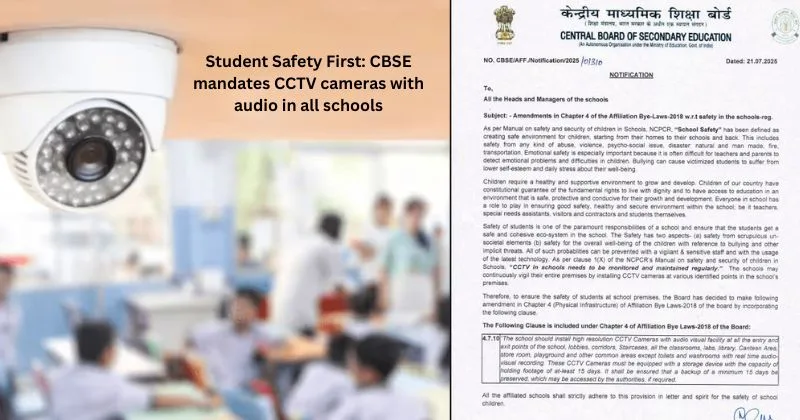
The Central Board of Secondary Education (CBSE) has amended its Affiliation Bye-Laws to make it mandatory for all affiliated schools to install high-resolution CCTV cameras with audio-visual capabilities at critical locations within school premises in order to strengthen school safety across India. The notification was issued on July 21, 2025, and it aims to strengthen the physical infrastructure in schools and focus on comprehensive child safety due to ongoing issues like bullying, accidents, and other dangers.
The newly introduced clause, 4.7.10 under Chapter 4 of the Affiliation Bye-Laws-2018, requires schools to ensure comprehensive surveillance coverage. According to the notification, “The school should install high resolution CCTV Cameras with audio visual facility at all the entry and exit points of the school, lobbies, corridors, staircases, all the classrooms, labs, library, Canteen Area, store room, playground and other common areas except toilets and washrooms with real time audio-visual recording.” A key aspect of the amendment is the requirement that these CCTV cameras must be equipped to generate a secure video archive with a backup period of at least 15 days. The recordings are to be stored in such a way that preserves its integrity and allows prompt access by authorities if required.
CBSE has made amendment in by-law mandating schools to install high resolution CCTV Cameras with audio-visual facility at all the entry and exit points of the school, lobbies, corridors, staircases, all the classrooms, labs, library, Canteen Area, store room, playground and other… pic.twitter.com/H3doF4zHuY
— ANI (@ANI) July 21, 2025
This mandate puts the onus on schools, not just to install surveillance equipment, but also to ensure its continuous functioning, maintenance, and compliance with data retention policy. The inclusion of audio-visual capability, rather than video alone, makes it a significant upgrade in both accountability and transparency.
This measure, previously limited in scope, now mandates surveillance not only in common and access-controlled areas but also in all classrooms and other functional spaces. It expands the net of safety to virtually every corner of a school, except from toilets and washrooms. The explicit exclusion of these latter locations addresses privacy concerns.
Official notification: Amendments in Chapter 4 of the Affiliation Bye-Laws-2018
Safety Rooted in Legal Framework and Best Practices
The CBSE’s move follows recommendations from the National Commission for Protection of Child Rights (NCPCR), which in its manual emphasizes the critical need for safe and supportive environments for children. The notification also echoes clause 1(X) of the NCPCR’s guidelines that require CCTV in schools to be “monitored and maintained regularly.”
This policy change comes at a time when keeping children safe both emotionally and physically is seen as very important during to increasing cases of suicide and related dangers. It is often hard for teachers and parents to notice when a child is facing emotional issues. Bullying, for example, can lower a child’s self-confidence and cause anxiety and lead to affecting overall well-being. The notification from CBSE highlights that regular monitoring and the latest technologies are essential to proactively address issues such as bullying, abuse, and other disciplinary or safety risks.
Implications for School Management, Teachers, and Parents
For school principals and management, this change will necessitate both infrastructural investments and a system overhaul in surveillance management. It includes:
- Procuring high-quality camera systems with audio-visual features
- Extending surveillance coverage to all key areas, with regular maintenance checks
- Establishing protocols for secure storage and authorized access to footage
- Training designated staff in operating and maintaining these systems
Teachers and other staff members, too, will see an increase in accountability, as their interactions with students will now be subject to regular virtual monitoring in classrooms and other supervised spaces.
For parents, the change seeks to provide added assurance that their children’s safety is prioritized.
The announcement has been largely welcomed by parents, educators, and other stakeholders. Many have called it a progressive step in which technology is used to address longstanding safety concerns related to children. However, some school administrators have raised concerns over the cost implications and logistics which are directly involved in implementing the new system. This might affect rural or under-resourced schools.
















Comments