





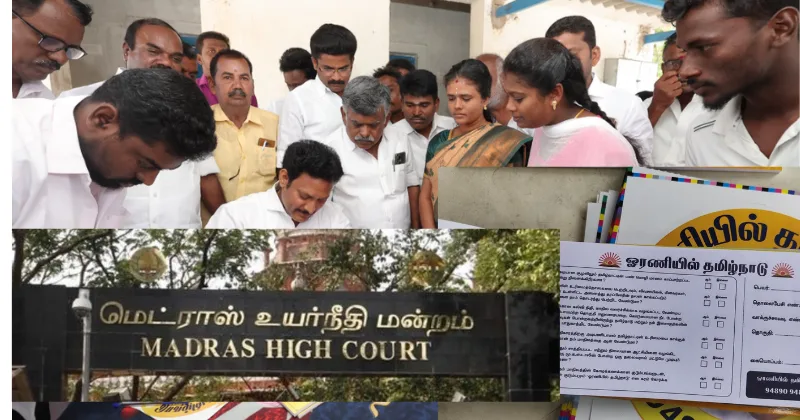
As anticipated, a petition has been filed before the Madurai Bench of the Madras High Court, seeking directions to restrain the unauthorised collection of Aadhaar and other personal data from the public by DMK cadres during the party’s Oraniyil Tamil Nadu (Tamil Nadu in Unison) campaign. The petitioner alleges that the campaign is a covert electoral exercise designed to influence voters and malign the Modi-led Central Government through selectively framed, close-ended questions.
The case is scheduled to be heard on Monday, 21 July, by a Division Bench of the Madurai Bench of the Madras High Court comprising Justices S.M. Subramaniam and Dr A.D. Maria Clete.
The Organiser team had recently published a detailed report on how the 45-day drive, spearheaded by DMK President and Chief Minister M.K. Stalin, amounted to a “blatant misuse of law” in the final phase of the party’s tenure.
‘Oraniyil Tamil Nadu’, DMK’s door-to-door campaign to map voter loyalty ahead of 2026, pushes anti-BJP agenda
Reports: TS Venkatesan#TamilNadu #DMK #BJP https://t.co/mMiayyqzVK
— Organiser Weekly (@eOrganiser) July 18, 2025
According to intelligence sources, the campaign has backfired significantly, facing stiff resistance from educated citizens and members of the opposition, particularly in households visited by survey teams accompanied by DMK IT Wing operatives and local strongmen. There is growing suspicion that the exercise aims to identify or eliminate non-DMK voters from the electoral rolls. They cite instances like Coimbatore, where over 2 lakh voters were allegedly deleted from the rolls — an area where BJP leader Annamalai contested in the April 2024 Lok Sabha elections.
In this context, Rajkumar, a resident of Sivaganga district, has moved the Madurai Bench of the Madras High Court with a petition seeking action against the DMK’s General Secretary over the alleged unauthorised collection of Aadhaar and other personal data under the banner of the party’s Oraniyil Tamil Nadu membership campaign. The petitioner has also sought an immediate directive to halt the collection of Aadhaar numbers, mobile numbers, and OTPs for political purposes.
According to media reports, Rajkumar stated in his petition that DMK functionaries have been visiting homes across Tamil Nadu as part of a 45-day statewide membership drive. On 17 July, Stalin set a fresh target for his party: enrol 2.5 crore members within the next 30 days, covering all 68,000 booths in Tamil Nadu. The campaign’s stated objective is to “highlight the injustices meted out to Tamil Nadu by the BJP-led Union Government and its ally, the AIADMK”.
The petitioner claimed that DMK workers have been demanding sensitive documents such as Aadhaar cards, Voter IDs, bank account copies, and mobile numbers from residents. He further alleged that those who hesitated or refused were subjected to intimidation — specifically, threats that government welfare benefits, including the ₹1,000 monthly scheme for women, would be discontinued if they failed to cooperate. He added that once residents share their mobile numbers, they begin receiving OTPs and SMS notifications, followed by messages confirming their membership in the DMK — often without their consent. Stickers bearing the Chief Minister’s image and the campaign name are also reportedly being affixed to homes without permission.
ஓரணியில் தமிழ்நாடு என்ற பெயரில் பொதுமக்களின் ஆதார் எண்,OTP எண் கேட்பது அடிப்படை உரிமைக்கு எதிரான குற்றம்.
பொதுமக்களிடமிருந்து சட்ட விரோதமாக தனிநபர் விபரங்களை சேகரிக்கும் திமுகவினர் மீது நடவடிக்கை எடுக்க கோரி உயர்நீதிமன்ற மதுரை கிளையில் சிவகங்கை ராஜ்குமார் வழக்கு! திங்கள் விசாரணை! pic.twitter.com/vXysKoRixE— I.S.INBADURAI (@IInbadurai) July 19, 2025
Rajkumar argued that collecting personal data, particularly Aadhaar details, for political recruitment is not only unethical but also a violation of fundamental rights — especially the right to privacy and individual freedom. He has requested the Court to:
Ban the DMK from collecting Aadhaar and other personal data for political purposes.
Order that all data already collected be permanently destroyed.
Direct the Central Government and UIDAI to investigate the matter and take appropriate legal action against those responsible, including the DMK General Secretary.
Reacting to the DMK’s tactics, AIADMK General Secretary Edappadi K. Palaniswami alleged that the party has suffered a drastic decline in membership under MK Stalin’s leadership, necessitating the launch of the Oraniyil Tamil Nadu campaign to reclaim its base. Addressing a public meeting in Nannilam, Tiruvarur district, as part of his “Save the People, Retrieve Tamizhagam” poll rally, he said, “The DMK’s base is crumbling. They are trying to mislead the people through this campaign.”
He claimed that DMK functionaries were collecting contact details, including mobile numbers, under the pretext of expanding the party base. He also accused the party of neglecting the people for over four and a half years, now resorting to data collection to regain lost ground. “Mobile numbers are being taken and passed on to the DMK’s IT Wing,” he charged.
The AIADMK leader warned the public to be cautious: “The DMK is now at your doorstep under the banner of Oraniyil Tamil Nadu, spinning a web of lies. Don’t be deceived by these men.” He termed the Ungaludan Stalin (Stalin with You) scheme — which involves seeking public grievances at people’s doorsteps — as a drama meant to hoodwink voters ahead of the 2026 elections, much like what happened in 2021. Opposition parties have also slammed Stalin’s statewide tours, funded through the public exchequer, as a “pre-poll campaign.” Critics alleged that instead of using party funds, the DMK was misusing government machinery — including the police and publicity departments — for this covert outreach, thereby denying the opposition a level playing field.
Tamil Nadu BJP Vice-President Narayanan Thirupathi, in an interview to a news agency, said, “We have been raising alarm bells for weeks. Many citizens have been complaining. The DMK has no right to collect such personal data from the public — this is dangerous.”
He added, “They could use this data for a variety of purposes. This is not democratic and certainly amounts to a gross violation of privacy. I believe the court will take appropriate action.”
The case is expected to be heard on Monday, 21 July, before a Division Bench of the Madurai Bench of the Madras High Court, comprising Justices S.M. Subramaniam and Dr A.D. Maria Clete.















Comments