





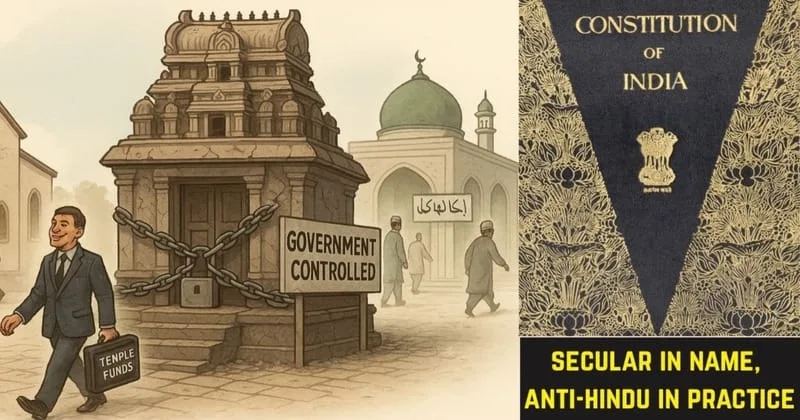
The Preamble of the Constitution of Bharat declared itself to be a secular country by specifically including the word “secular” in 1976. It also resolves to ensure “liberty of thought, expression, belief, faith, and worship” and “equality of status” and of “opportunity”. As the Preamble is the preface to the Constitution and the key to open the minds of its makers, it can be said that Bharat is a country where the State, has nothing to do with religion, treats every religion equally, and provides liberty of belief, faith, worship, and equality of opportunity for every individual.
However, when we examine Article 25 of the Constitution, we find a paradox. While the first part of the Article [i.e. 25(1)] guarantees the fundamental right to freedom of conscience, profess, practice, and propagate religion, the second part [i.e. 25(2)] allows the State to make laws for financial, political, or other secular activity associated with religious practice. By invoking this second part, the States in Bharat often interfere with the religious affairs of Hindus, controlling them under the guise of managing secular activities related to religion.
As Bharat marks just over 50 years since the proclamation of Emergency on June 25, 1975 by the then Indira government – an occasion commemorated by the BJP as Samvidhan Hatya Divas – this article explores how the fundamental right of freedom of religion, particularly the freedom to propagate one’s religion, is being adversely affected for Hindus in “secular” India. It examines the challenges faced by Hindus in propagating their faith, the role of the State in temple administration, and the implications of this interference on the spiritual and cultural practices of Hindus.
Government Control: A hinderance to temple autonomy and right to propagate Hinduism
For the autonomous functioning of an institution, some powers should be vested in it. However, when it comes to Hindu temples, it’s a known fact that most of them are under the government’s control. Their control over temples’ finances has severely limited the ability of temples to allocate resources towards spreading Hinduism, thereby adversely affecting Hindus’ right to propagate their religion through temples. These temples are forced to rely on the government for even their most basic operational needs, leading to a loss of autonomy and independence. State governments spend a very small amount from these funds on temple affairs, such as salaries to pandits-pujaris, officials and workers associated with temple maintenance, like- sanitary workers. The remaining big portion of it is used for “secular activities” like constructing roads, bridges, airports, or even protecting and propagating other religions. The point here is that the funds which should be used in propagating Hindu religion and supporting and maintaining big and small temples all over Bharat (even outside Bharat also), are continuously being diverted to be used in other purposes, due to which many temples are facing shortage of money to such an extent that some of these temples don’t have funds for next-day pooja, or havan, or for offering prasad, because of which most of these small temples are at the verge of closing or has closed. Tamil Nadu government in the year 2020 submitted a report to the Madras High Court stating that in 11,999 temples in the state, there is no pooja or ritual taking place as there is no revenue. In 34,000 temples, there is only one person to manage all the affairs of the space. While 37,000 temples record a revenue less than Rs 10,000 per annum. They estimated that around 12,000 temples will die in the next few years. These situations clearly show how temples’ autonomy has been severely affected by the government’s control over temples and how the fundamental right to freedom of propagation is curtailed or adversely affected in “secular” India.
It is striking to see Hindu temples struggling to survive due to fund shortages, while their resources and wealth are being diverted for secular purposes like infrastructure development and education – responsibilities that should typically fall under state’s purview, especially when it proudly says itself to be a ‘secular’ and ‘welfare’ state and which is funded through public taxes and state revenues. Using temple funds for such purposes not only diverts resources meant for Hindu religious and charitable purposes but also implies that public money/ state exchequer is being misused or potentially siphoned off for other purposes, such as corruption, vote bank politics, or other non-transparent activities. This situation highlights the need for transparency and accountability of states in the management of temple funds and the importance of ensuring that these funds are used for their intended purposes.
Misuse of Temple Funds: A breach of trust
Devotees give donations and offerings to their Almighty or to the temple with the intention that those funds will be used for the proper care and maintenance of idols and temples or used in propagating the Hindu religion and supporting and maintaining big and small temples all over Bharat (even outside Bharat also). However, the government’s use of these funds and donations for “secular purposes” such as building roads and bridges is a breach of trust of thousands or lakhs of Hindu devotees and undermines the purpose of the donations. The government’s actions are a clear example of how the funds meant for the upkeep of temples and the propagation of Hinduism are being diverted for other purposes.
It is also noteworthy to mention here that if the governments were to use temples funds for temples or for propagating Hindu religion or protecting Hindus financially (the intended purpose for which devotees give donations and offerings), then people of India (even Hindus who reflect themselves as “secular”), governments, and even the international community would make hue and cry that India is no longer a secular nation. However, when it comes to managing temples’ funds by governments, nobody (barring a few exceptions like- RSS, Vishva Hindu Parishad) utters anything. Instead, many politicians and political parties used to make adverse remarks publicly. It is the irony of Bharat, where the majority population are Hindus, but their basic fundamental rights to freedom of religion and equal treatment are violated. As the government doesn’t regulate and collect funds from any other religious institutions like mosques, churches, gurudwaras, Baudh, or Jain temples, therefore, equality rights under Articles 14 and 15 are also violated.
This dual meaning of secularism raises questions about the fairness and equality of treatment meted out to different religious communities in Bharat. The government’s actions seem to perpetuate a system where one religious community (Hindus) is subjected to stringent control and financial exploitation, while others enjoy full autonomy and freedom.
Selective Treatment: A violation of secularism and equality before law
Secularism is based on the principle of “Sarv Dharm Sambhav”, which means treating all religions equally and the principle of the State’s non-interference in matters of religion. However, the government’s treatment of Hindu temples is in stark contrast to its treatment of other religious institutions, be they mosques, churches, or gurudwaras. Article 26 of the Indian Constitution guarantees equal freedom to ‘every’ religious denomination to manage its own affairs. But where Hindu temples are subject to strict government control, other religious institutions freely manage their own affairs. Controlling Hindu temples under the garb of managing their “secular affairs” is not even justified under Article 25(2), which allows the government to regulate the secular affairs of temples. This selective-discriminatory-disadvantageous treatment is not only a clear violation of the basic principles of secularism (which demands equal treatment of all religions by the State), but also the fundamental right to equality and equal protection of law and non-discrimination on the ground of religion.
Legal Conundrum: Idol as a minor and juristic personality
In the Indian legal system, an idol is considered to be a ‘minor’ (a living person under eighteen years of age), and the law is that a minor’s property will be managed by his trustee who will work and spend his (minor’s/idol’s) property “only for his beneficial interest”, and all other transactions which are not in the beneficial interest of a minor, can be nullified at the instance of a minor. Applying this principle of law on idols residing in temples, when the properties of idols/temples are being used for constructing roads, bridges, airports, or to fulfil the government exchequer or even for protecting and promoting other religions (instead of using those funds for proper maintenance of temples, spreading Hinduism, supporting other Hindu temples, and Hindus in general and indigent Hindus in particular), then how can the State justify that idols/temples’ funds are being used “only” for their beneficial interest? Idol/Murti is considered a juristic personality in law, capable of holding property and being involved in legal proceedings. In a significant ruling, the Madras High Court has ordered the reopening of Sri Muthalamman and Sri Mariyamman temples in Uthapuram village, Madurai district, which have been closed for over 10 years. Justice G.R. Swaminathan, delivering the verdict on July 30, 2024, emphasised that the closure of temples without conducting customary poojas is akin to imprisoning the deity. He compared this to the treatment of prisoners, who are at least provided with proper food and basic necessities.
Dharm and Arth: An intricate link in Hinduism
In Hinduism, ‘Dharm’ and ‘Arth’ are intricately linked. For the effective practice of Dharm, Artha is required, as it enables to bear the expenses related to rituals like- Havan, Prasad, and various articles used in Pooja. Conversely, for the effective management of Arth, Dharm is essential, as principles like honesty and integrity are crucial for managing wealth and its related activities. This interconnectedness is reflected even in the concept of trinity (Tridev/Trimurti) in Hinduism, where Bhagwan Vishnu’s role is nurturing and sustaining the universe, for which wealth is required, which is why Mata Laxmi, the embodiment of wealth and prosperity, is his ardhangini (better half).
The reliance on government support for funds severely limits temples’ ability to practice their faith and allocate resources towards spreading Hinduism, establishing new math-mandirs, and educational institutions like gurukuls, or supporting other initiatives that promote Hinduism and cater to the cultural and spiritual needs of Hindus. Chanakya’s mantra, “Sukhasya Moolam Dharmah, Dharmasya Moolam Arthah” (Dharm is the root of happiness, and wealth is the root of Dharm) clearly suggests that Dharm cannot be divorced from economics and wealth – highlights the importance of financial autonomy for temples to fulfil their spiritual and social objectives.
Government Interference in Temple Administration
The government’s control over temple administration raises significant concerns about the secular nature of India. When the government has the authority to appoint priests and other officials in temples, it can lead to situations where individuals who may not share the same beliefs or values as the temple’s followers, are placed in key positions. This can be particularly problematic if the appointed individuals do not believe in Hinduism or belong to a different faith, as in such case he will follow the practices, pooja, rituals of the temple (where he is appointed) just as a mere job for earning salary and not because he has great devotion in Hinduism and in the deity of that particular temple. A notable example on this point is the Tirupati temple, where the Tirumala Tirupati Devasthanams (TTD) recently took action against 18 employees for participating in non-Hindu religious activities while being involved in Hindu festivals and rituals. This highlights the need for temples to have autonomy in managing the administration of the temple, which includes appointment of priests and other officials, holding crucial positions in running religious affairs, and for employees to be Hindus only, who have faith in Hinduism.
This is a serious concern, as the government’s authority to appoint even the head priest of a temple not only constitutes interference in the temple’s religious affairs and adversely impacting right to propagate Hinduism but also potentially opens the door to proselytisation, as individuals of other faiths may be appointed to administrative roles, creating opportunities for them to influence or convert Hindus. Appointing priests in temples should not be considered to be a “secular affair” in which the government can intervene.
The Need for Temple Autonomy
Granting autonomy to Hindu temples is essential to ensure that they can manage their own affairs and use their funds for their intended purposes. Temple autonomy would allow temples to practice their faith without interference from the government and would be a step ahead in protecting the fundamental right to freedom of religion of Hindus, especially the right to freely propagate Hinduism like followers of other religion do, and thereby making Bharat a secular nation in the true sense and not be synonym of being anti-Hinduism is what it called ‘secularism’.
Also, if temple funds were managed by the temples themselves, they could potentially take proactive measures to address the socio-economic vulnerabilities that make indigent Hindus susceptible to conversion by Christian missionaries or mosques. These organisations often lure vulnerable individuals with promises of financial assistance, food, or improved living standards. By having control over their own funds, temples could provide support to those in need, thereby reducing the appeal of conversion as a means of securing basic necessities. Additionally, such support would not only alleviate their material needs but also reinforce their faith in Hinduism and strengthen their connection with temples, fostering a sense of community and belonging. This, in turn, could help to boost their confidence in their own tradition and reduce the likelihood of them being swayed by external influences.
A Call to Action
The secular paradox in India highlights the need for the government to re-examine its role in temple management and ensure that it respects the autonomy and integrity of Hindu institutions. By doing so, the government can uphold the basic principle of secularism and ensure that the freedom of religion and equality guaranteed by the Constitution are protected for all citizens, including Hindus.
The erosion of religious freedom for Hindus in India is a pressing issue that requires immediate attention. It’s high time for Hindus to unite and make a lawful demand that both the Centre and the States free temples from their control, allowing them to manage their own affairs like other religious institutions. A clear message should be sent to all political parties that the Hindu vote bank will support those who prioritise temple autonomy and respect the fundamental rights of Hindus.
As the ancient wisdom goes:
“धर्मो रक्षति रक्षितः”
“Dharmo Rakshati Rakshitah”
Meaning: “Dharm protects those who protect it.”
– Let’s protect our Dharm, and our Dharm will protect us. Given that religious endowments and institutions are concurrent list’s subjects, on which both the Centre and the States have the authority to make laws, a collective demand (in a lawful manner) from Hindus can be a game-changer. By joining hands and sending a strong message to all political parties, we can ensure that our voices are heard and our rights are protected at par with others.
In a democracy, it’s the collective demands of the people that have value in the eyes of the government. We must awake to our rights and duties and urge lawfully that our temples be freed from the government’s control. It’s our moral duty to protect our Dharm and Dharmic institutions like temples. By doing so, we can ensure that our religious freedom is protected and our heritages are preserved.
















Comments