





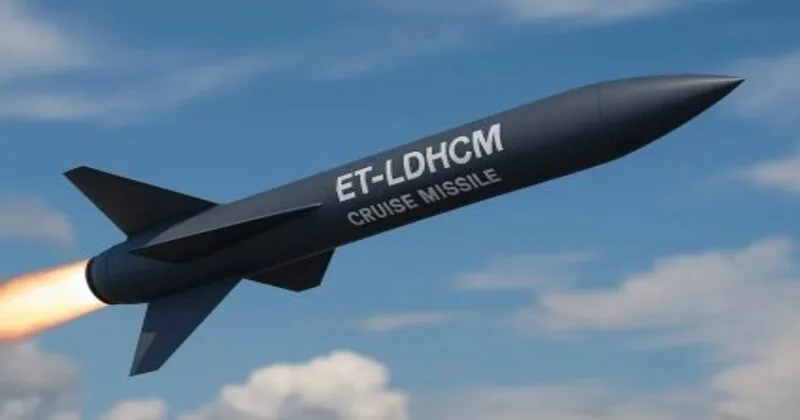
India has successfully test-fired its first indigenously developed hypersonic cruise missile under the codename Project Vishnu, marking a major leap in the country’s strategic defense capabilities. The missile, officially designated as the Vikasippa Extended Trajectory–Long Duration Hypersonic Cruise Missile (ET-LDHCM), was tested though specific details of the trial remain undisclosed.
The ET-LDHCM boasts cutting-edge stealth features capable of evading radar detection and delivers pinpoint accuracy, solidifying India’s entry into an elite group of nations with long-range hypersonic cruise missile technology. Until now, only the United States, Russia, and China possessed such advanced capabilities.
This next-generation missile is equipped with an indigenously developed scramjet engine, allowing it to attain hypersonic speeds, eight times the speed of sound. In comparison, India’s current fastest cruise missile, the BrahMos, travels at three times the speed of sound. The scramjet propulsion system enables the missile to draw oxygen from the atmosphere for fuel combustion once hypersonic velocity is achieved, significantly reducing its weight and enhancing its range and efficiency.
With a strike range of 1,500 kilometers, the ET-LDHCM surpasses BrahMos’ current operational range of 450 kilometers. It is designed for deployment across land, naval, and air platforms, providing India with a robust and versatile deterrence capability.
In addition to its high velocity and long range, the missile features self-healing technology, the ability to carry warheads ranging from 1000 to 2000 kilograms, and nuclear payload compatibility. Its low-altitude trajectory further enhances its stealth, making it more difficult to track and intercept compared to traditional ballistic missiles.
One of the significant technological achievements of this program lies in overcoming the extreme heat generated during hypersonic flight. At such high speeds, the missile’s outer surface can heat up to over 2000 degrees Celsius due to atmospheric friction. India’s Defence Research and Development Organisation (DRDO) has successfully developed indigenous thermal protection systems to withstand this intense heat, a critical requirement for sustained hypersonic flight.
With this successful test, India becomes the fourth nation in the world to independently develop and test a long-range hypersonic cruise missile, marking a monumental milestone in the country’s defence and technological prowess. This achievement underlines India’s growing self-reliance in advanced military technologies and enhances its strategic deterrence in a rapidly evolving global security environment.















Comments