




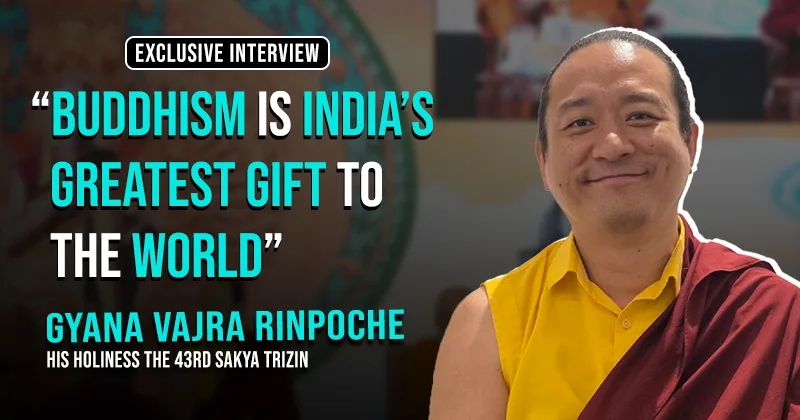
In an era increasingly marked by restlessness and violence, the Dharmic voices remain a grounding force, and among its torchbearers, His Holiness the 43rd Sakya Trizin, Gyana Vajra Rinpoche, stands as a gentle yet powerful reminder of that truth. In a conversation with Organiser Senior Assistant Editor Nishant Kumar Azad, Rinpoche reflects on the significance of the Dalai Lama’s legacy, evolving role of Dharma in today’s fast-paced world, and how young people can bring balance into their lives. Excerpts:
His Holiness the Dalai Lama has completed 90 years. What is its significance?
His Holiness the Dalai Lama has spent 90 years embodying and spreading universal compassion, love, and wisdom. This is not just a celebration of his age, but of his message. His life is a gift to the world, and his continued presence, especially with his assurance that he will live beyond 130 years, is a blessing for all of us. We are fortunate to be living in the same era as such an extraordinary being.
We live in a world increasingly plagued by conflict. In that context, how do you view the significance of celebrating Dalai Lama’s 90th birthday as the ‘Year of Compassion’?
Historically, war has always existed. What is important is having someone to show us the path of righteousness. Celebrating His Holiness’s life is a reminder that compassion is the only sustainable antidote to violence and conflict.
His Holiness often speaks about The Nalanda Tradition. As a torchbearer of Dharma yourself, how do you see the role of Bharat in preserving this tradition?
Bharat has always played a foundational role in Buddhism. As His Holiness often says, India is the teacher and Tibet is the student. Buddha attained enlightenment here, and the Nalanda tradition flourished here. All Tibetan Buddhist traditions — including mine, the Sakya, are rooted in the teachings of Nalanda and Vikramashila.
For our readers unfamiliar with the Sakya tradition, could you briefly explain its uniqueness?
The Sakya tradition has existed for over a thousand years. Tibetan Buddhist traditions are different schools, primarily because of varying masters, timelines, and disciples, but the core teachings remain the same. Sakya uniquely balances philosophical depth and intellectual training with meditative and ritual practice.
You have taught in many parts of the world. How do you ensure the essence of Dharma remains intact while addressing a modern, global audience?
Like His Holiness the Dalai Lama, we try to teach universal human values—compassion, love, and ethical conduct. These transcend religious boundaries. When we speak of universal compassion, we are not speaking to a religion or a country; we are speaking to humanity. This way, Buddhist teachings remain rooted while also becoming accessible globally.
What are the main challenges you see for Buddhism in the 21st century?
Challenges and opportunities are often the two sides of the same coin. Buddhism does not offer you something new—it helps you discover your inner potential. It changes your point of view, which transforms your experience. Where some see difficulty, a Buddhist sees a chance for wisdom and compassion. Our goal is to train the mind, to cultivate inner peace and true happiness.
In today’s world of social media and endless content, everyone claims to have motivational advice. What is your advice for those seeking peace and purpose?
Too much of anything is harmful, even too much love or too much spiritual practice. Balance is the answer. Life, work, family, even spirituality—everything should be in proportion to what your body and mind can handle. You can not copy others. True practice lies in understanding your own needs and limitations.
You mentioned that even too much spiritual practice is not advisable. Could you elaborate?
Once, someone came to me and said they were struggling with his practice due to sleepiness. I asked how long he meditated, and he said 24 hours! I explained: we are human—we need rest, food, movement. Buddhism is not about sitting in a cave. It is about mind training, and mind training must be sustainable. You cannot pour from an empty cup.
How can Buddhism offer a path to peace in a world full of conflict?
Compassion is the core of Buddhist practice. Without compassion, there is no Buddhism. It is compassion that drives us to walk the path, to practice, to attain enlightenment, and to serve others. Compassion neutralises negative emotions like anger, greed, and ignorance. If practised sincerely, it brings inner peace, and that inner peace is the first step to global peace.
“Sanatan Dharma and Buddhism are like two branches of the same tree”
What are your thoughts on relationship between Sanatan and Buddhism?
As His Holiness has said, Sanatan and Buddhism are like two branches of the same tree. At the core, they share values like karuna (compassion), maryaada (righteous conduct), and harmony. Their cultural and philosophical connections are deep, and I see no real contradiction between them.
Prime Minister Narendra Modi has often spoken about Buddhism, even on international platforms. How do you see his engagement with Buddhist values and traditions?
What PM Modi is doing is long overdue. Buddhism is India’s greatest gift to the world. Most of India’s neighbours are Buddhist countries, and they look to India for leadership. Under his leadership, sacred relics have travelled to places like Thailand, Vietnam, and Mongolia. His visits to Bodh Gaya and efforts to develop the Buddhist Circuit are deeply appreciated.
What message would you like to give to the younger generation?
Don’t chase after excess. Keep your life simple and balanced. Peace begins within—and once you find it, you’ll see it in the world around you too.














Comments