





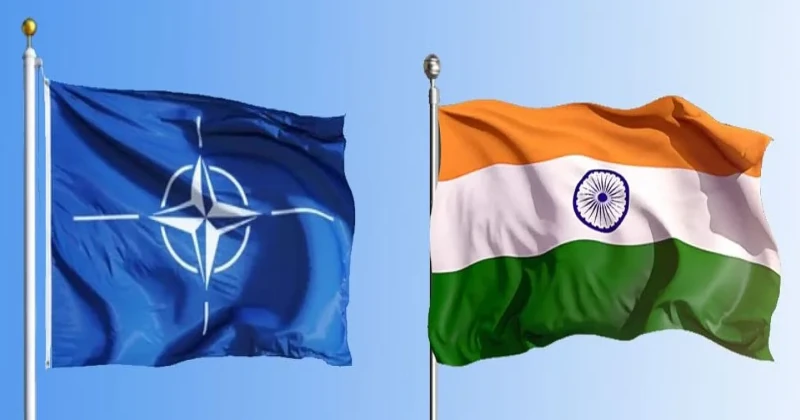
The North Atlantic Treaty Organisation (NATO), primarily a military alliance formed in the aftermath of World War II, has in recent years expanded its geopolitical lens to include matters of economic influence, energy security, and strategic partnerships. In the wake of the Russia-Ukraine war, NATO’s posture toward countries engaging with Russia, especially in terms of energy trade, has hardened. India’s continued purchase of discounted Russian oil amidst sweeping Western sanctions has attracted critical attention, and now there are murmurs from NATO quarters hinting at possible economic sanctions or punitive measures directed at New Delhi. These signals, though not yet formalised, carry significant geopolitical undertones. They reflect a growing tension between India’s assertion of its independent foreign policy and the expectations of the Western alliance system. However, the unfolding drama is not just about oil; it is a broader commentary on India’s emerging clout on the world stage, its strategic balancing act, and its refusal to be coerced by legacy power structures.
At the heart of NATO’s discomfort is the perception that India, as a large democracy and a strategic partner of several Western nations, should align more closely with the West’s punitive stance against Russia. Since the invasion of Ukraine in February 2022, Western nations have imposed comprehensive sanctions on Moscow, aiming to isolate it economically and diplomatically. Energy exports, a critical revenue source for Russia, have been a major target. India, seizing the opportunity, began purchasing Russian crude at heavily discounted rates, thereby ensuring its own energy security while benefiting from market fluctuations. This pragmatic move, though economically sound and diplomatically neutral from India’s perspective, has irked many in the Western bloc who view it as undermining the effectiveness of their sanctions.
What complicates the situation further is India’s nuanced diplomatic posture. New Delhi has repeatedly emphasised that its relationship with Russia is long-standing, predating the current conflict, and rooted in mutual trust and strategic cooperation. Russia remains a key defense partner for India, supplying around 60 per cent of its military hardware. In addition, India has stressed that its oil purchases are aimed at insulating its large and energy-hungry population from global price shocks. From New Delhi’s standpoint, this is not about endorsing Russian actions in Ukraine but about preserving national interest in a volatile global environment. India’s repeated calls for a cessation of violence, respect for international law, and diplomatic dialogue reflect its principled, albeit non-aligned, approach.
The NATO threat of sanctions, even if symbolic at this stage, risks alienating one of the world’s most influential emerging powers. India is no longer the diffident player of the Cold War era. Over the past decade, it has meticulously crafted a foreign policy that is both assertive and pragmatic. Under the leadership of Prime Minister Narendra Modi, India has increasingly projected itself as a civilisational power with global ambitions. It has deepened partnerships with Western powers through platforms like the Quad (with the US, Japan, and Australia), participated actively in G20 deliberations, and even assumed the presidency of the G20 in 2023, during which it championed the Global South’s cause with remarkable effectiveness.
This growing stature has made it clear that India will not be dictated to, even by long-standing partners. New Delhi has resisted Western pressure on a range of issues—be it its procurement of S-400 missile systems from Russia despite the looming threat of US sanctions under CAATSA (Countering America’s Adversaries Through Sanctions Act), or its firm stance on domestic policies like the abrogation of Article 370 in Jammu and Kashmir, which invited criticism from some European quarters. In all these instances, India has emphasised its sovereignty, the primacy of its national interests, and the need for multipolarity in global affairs. This new India is confident, and it expects engagement, not diktats.
Furthermore, the Western expectation that India should conform to NATO’s strategic calculus reflects a persistent misunderstanding of India’s foreign policy ethos. India has never been part of any military alliance. Its adherence to strategic autonomy is rooted in its historical experience of colonialism and its foundational belief in non-alignment. While India is increasingly collaborating with the US and its allies in the Indo-Pacific, especially to counter China’s assertiveness, it has made it clear that such cooperation does not come at the cost of its traditional ties with Russia. It is this balance—between East and West, old allies and new partners—that defines India’s foreign policy today.
Another factor often overlooked in Western discourse is that India’s relationship with Russia is not transactional but deeply strategic. Russia has stood by India during critical moments, notably during the 1971 Bangladesh Liberation War when the Soviet Union provided crucial diplomatic and military support. In the contemporary era, while India diversifies its defense imports, it cannot afford to sever ties with Moscow abruptly. Such a move would not only jeopardise its defense preparedness but also weaken its ability to act as a bridge between conflicting global blocs. In many ways, India’s continued engagement with Russia offers a rare channel of communication between the West and Moscow—a geopolitical asset rather than a liability.
Domestically, the NATO threats are likely to bolster nationalist sentiment and reinforce the Modi government’s narrative of “Vishwaguru Bharat” (India as a world teacher or leader). The Indian public, by and large, supports the government’s independent foreign policy and views Western pressures with skepticism. In a multipolar world, where the US and its allies are no longer the sole arbiters of legitimacy, India’s refusal to buckle under NATO pressure is seen not as defiance, but as dignified assertion. Moreover, it reflects the changing global order where countries like India are no longer content to be rule-takers; they aspire to be rule-makers.
The irony of NATO’s position is also worth noting. Many European countries, despite vocal condemnation of Russia, continued importing Russian gas through much of 2022, citing domestic energy needs. Only when public pressure mounted and alternatives were secured did the imports decline significantly. If such pragmatism is permissible for Europe, why should India be castigated for similar decisions? The selective morality of Western powers, where strategic interests often override professed values, is not lost on Indian policymakers or the public.
In essence, NATO’s threat of sanctions against India—whether rhetorical or actionable—reveals more about the anxieties of a fading unipolar order than about India’s actual policies. It underscores the difficulties Western powers face in reconciling their desire for global consensus with the realities of a world increasingly defined by pluralism, sovereignty, and asymmetrical interests. India is not seeking confrontation with the West; it is merely asserting its right to make decisions based on its unique geopolitical, economic, and security calculus.
In the years ahead, the world will likely see more such moments of friction as emerging powers like India challenge the assumptions of the post-Cold War global order. But these frictions need not lead to rupture. Instead, they can be opportunities for recalibrating relationships based on mutual respect and genuine partnership. For NATO and the broader Western alliance, the real challenge is not to coerce India into alignment but to engage with it as an equal—acknowledging its interests, accommodating its perspectives, and appreciating its contributions to global stability.
As the war in Ukraine drags on and global energy dynamics remain volatile, India’s role as a stable, large democracy with rising economic power becomes even more crucial. Its actions are not just about oil; they are about strategic autonomy, responsible global citizenship, and the assertion of a new geopolitical identity. Sanctions, or the threat thereof, may momentarily grab headlines, but they do little to alter the tectonic shifts underway. India’s rise is not contingent on the approval of any single bloc. It is powered by its civilisational depth, democratic resilience, and strategic clarity. NATO, and indeed the world, would do well to recognise that.













Comments