





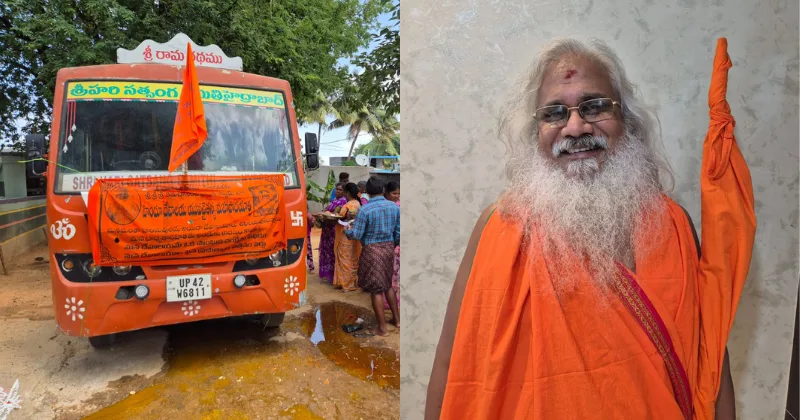
Reflecting the timeless Bharatiya tradition of dharmic leadership and service to society, Sri Kamalananda Bharati Swamiji, the Mathadipati of Sri Bhuvaneshwari Peetham, is scheduled to commence the ‘Hindu Devalaya Yuvachaitanya Mahapadayatra’—a sacred foot pilgrimage across Andhra Pradesh and parts of Telangana—on June 12.
With the theme “Bhagavad Bhakti – Kartavya Deeksha – Samaja Shakti”, the yatra aims to awaken and revitalise dharmic consciousness across the Telugu-speaking states.
The first phase of the yatra will commence from the sacred precincts of Sri Sidheswara Mahashiva Devalayam in Talakona, located 58 km from Tirupati, and will span 13 districts across Andhra Pradesh and Telangana. These include Tirupati, Chittoor, Annamayya, Sri Sathya Sai, Anantapur, Kurnool, Nandyal, Kadapa, Nellore, Narayanpet, Mahabubnagar, Gadwal, and Wanaparthy. The yatra is set to unfold over the next six months and will culminate in Tirupati.
The spiritual leaders scheduled to attend the inaugural ceremony include Sri Sri Sri Sadasivananda Swamiji of Vasishta Ashram, Srinivasa Mangapuram, and Sri Sri Sri Virajanandagiri Swamiji of Achala Ashram, Thotaravalli, Brahmangari Matham. Among the political leaders expected to attend are T.D. Janardhan, MLC; Pullavari Nani, MLA from Chandragiri; and Aarani Srinivasulu, MLA representing Tirupati.
Speaking with Organiser, Raghavendra, who is overseeing the padayatra, explained this monumental padayatra draws inspiration from the timeless Bharatiya tradition of dharmic leadership and service to society. “It is a call for spiritual renaissance,” he said, outlining Swamiji’s vision which rests on four foundational pillars:
- Restoring the dignity and sanctity of Hindu temples;
- Preserving and promoting the Telugu and Sanskrit languages;
- Awakening devotion and dharmic awareness among the youth; and
- Reweaving the spiritual and cultural fabric of society by uniting communities through shared values.
In with Organiser, Kamalananda Bharati Swamiji offered a candid reflection: “These villages are ours—our very roots. Yet in recent times, those with no genuine connection to village life are entering these spaces with vested interests, indulging in anti-social and anti-cultural activities. Their motive is clear: to sever the dharmic roots of our villages, either through coercion or religious conversion, thereby threatening the traditions that define our people and society.”
Swamiji noted a visible increase in awareness among Hindus today compared to thirty years ago, adding, “Society is responding to these threats and beginning to voice its concerns. What we need now is to strengthen and channel this response. The beauty of our society lies in its receptiveness—when it hears the truth, it acts upon it. Never underestimate this society; it is unique in its unbroken spiritual connection with the Divine since birth. That is what makes Hindus distinct. Our bond with our Devalayas (temples) is inseparable. We must remind today’s generation that temples are not just structures—they are the soul of our civilisation.”
He further emphasised, “Temples should not be under the control of government endowment departments. They are community institutions—our collective inheritance. Managing them is not just our right but our sacred duty. The government should refrain from interfering in temple administration.”
Swamiji has also called upon people—particularly those who have migrated to urban areas—to join the padayatra and reconnect with their native villages. One of the yatra’s central objectives is to foster a return to a dharmic lifestyle, rooted in community and cultural continuity.
The padayatra is envisioned to unfold in multiple phases over the next two years. In each village, Swamiji will walk among the people, conduct parikramas, dine with locals at temple premises, listen to their grievances, and facilitate community-led solutions—encouraging self-reliance and social interdependence.
Between 2007 and 2010, swami ji completed three monumental Padayatras, covering over 30,000 kilometers, visiting 35,000 temples, and reaching more than 8,500 villages. In 2012, he led the impactful Ratha Yatra, further strengthening the roots of Dharma across the region.











Comments