





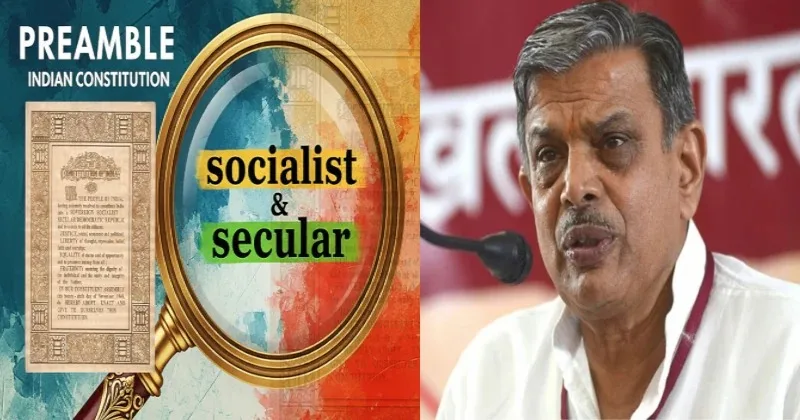
On June 26, 2025, at the Dr Ambedkar International Centre, RSS Sarkaryawah (General Secretary) Shri Dattatreya Hosabale delivered a speech marking fifty years since the declaration of Emergency in India. While reflecting on that authoritarian rupture, he raised a constitutionally grounded concern: the insertion of the words “secular” and “socialist” into the Preamble of the Indian Constitution through the 42nd Amendment Act of 1976. Far from being a routine political statement, Hosabale’s demand for re-examination of these terms signals a long-overdue reckoning with both historical legitimacy and contemporary constitutional morality. These additions, made at a time when democratic processes were suspended, were neither part of the original constitutional text nor a product of public deliberation. Rather, they were inserted at the peak of Emergency rule, when Parliament functioned under duress, political opposition was silenced, and civil liberties were suppressed. It was during this climate of coercion and centralisation that the ideological character of the Constitution was unilaterally altered, subverting both the spirit of federalism and the foundational commitment to democratic choice.
The absence of “secular” and “socialist” in the original Preamble was not an oversight but a deliberate design. The Constituent Assembly had explicitly considered and rejected proposals to incorporate rigid ideological qualifiers into the constitutional text. On November 15, 1948, Professor K.T. Shah moved to include “Secular, Federalist, Socialist” in Article 1, a motion supported by H.V. Kamath and others. However, Dr. B.R. Ambedkar responded firmly, arguing that such ideological commitments were matters of state policy to be decided by the people and their elected governments, not constitutional principles to be frozen in perpetuity. As Ambedkar explained, “What should be the policy of the state… are matters which must be decided by the people themselves… It cannot be laid down in the Constitution itself, because that is destroying democracy altogether” (Constituent Assembly Debates, Vol. VII, 15 Nov 1948). This position reflected a deeper jurisprudential wisdom: a constitution must remain open and flexible, allowing democratic processes to evolve rather than embedding policy preferences that future generations cannot alter. By elevating ideological terms into constitutional doctrine, the 42nd Amendment violated this foundational principle of democratic sovereignty.
The constitutional impropriety of this move is further illuminated by the Supreme Court’s landmark decision in Kesavananda Bharati v. State of Kerala (1973), where the Court introduced the basic structure doctrine. In a narrow 7:6 majority, the bench held that while Parliament could amend the Constitution, it could not alter its essential features, including democracy, the rule of law, and the separation of powers. Importantly, the judgment did not identify either “secularism” or “socialism” as inviolable features of the basic structure. Instead, secularism was understood as a functional outcome of Articles 25–28, which guarantee religious freedom and prohibit state-sponsored religion, not as an ideological doctrine. Similarly, socialism, to the extent it was discussed at all, was confined to the Directive Principles of State Policy, guiding aspirations, not enforceable mandates (see: Kesavananda Bharati v. State of Kerala, AIR 1973 SC 1461). The 42nd Amendment, enacted just three years later, inserted these contested concepts into the Preamble and undermined the balance struck by the judiciary, bypassing democratic procedure and ignoring the constitutional limits outlined in Kesavananda Bharati case.
The political conditions surrounding the amendment make its illegitimacy even more glaring. The Emergency era (1975–77) was marked by sweeping curtailment of civil liberties, mass incarcerations, and coercive social engineering. Over 110,000 political detainees, including journalists, student leaders, and opposition politicians, were arrested under the Maintenance of Internal Security Act (MISA). Perhaps most infamously, the state conducted a campaign of forced sterilisations under the pretext of population control, executing nearly eight million vasectomies, many under duress, including through police raids, unlawful detentions, and physical intimidation. Notably, contemporary records and testimonies suggest that Muslim-majority areas were often exempted from these campaigns, either through informal policy or tacit non-enforcement (Gupta, Emergency Excesses, 1979). This selective governance introduced an enduring asymmetry in how the state treated its religious communities. The Rajan case in Kerala, where a student was tortured to death in police custody, encapsulates the broader brutality of Emergency governance. It is within this context of suppression and fear that the Preamble was altered, a decision made without public consultation, democratic debate, or judicial review.
The consequences of that ideological imposition have extended far beyond symbolism. In the post-Emergency decades, “secular” and “socialist” have evolved from constitutional descriptors into instruments of governance that frequently generate structural bias against the Hindu majority. For example, various Temple Endowment Acts across Indian states have placed Hindu temples and religious institutions under direct government control, subjecting them to audits, bureaucratic oversight, and discretionary management. By contrast, Waqf Boards, which manage Muslim religious endowments, enjoy sweeping autonomy and access to public funds, enabled by the Waqf Amendment Act, 1995, which grants them indefinite land rights and legal immunities. No such privileges are extended to Hindu religious bodies. Similarly, the Places of Worship Act, 1991, effectively freezes the religious status of all places of worship as of 1947, making it nearly impossible for Hindus to reclaim sacred sites like Kashi Vishwanath or Bhojshala, sites that have historically been contested or altered under earlier regimes. Meanwhile, mosques, even those built atop demolished temples, remain beyond judicial scrutiny due to this statutory freeze.
This disparity extends into welfare and education policy. The Ministry of Minority Affairs, created exclusively for Muslims, Christians, Sikhs, and other religious minorities, oversees welfare schemes and scholarships unavailable to economically disadvantaged Hindus. Reservation policies in education and employment often hinge on religious identity, sidelining Hindu Backward Classes despite comparable or greater economic hardship. Courts frequently intervene in Hindu temple management by appointing administrators and monitoring finances, but avoid similar oversight over minority religious institutions. Even in matters of ritual and custom, such as animal sacrifice, restrictions disproportionately affect Hindu festivals, while practices like Eid sacrifices proceed largely unregulated. These asymmetries are not incidental, they are the product of a constitutional order reshaped under Emergency-era ideology, one that has treated secularism not as neutrality, but as active marginalisation of the religious majority.
These contradictions are further illustrated by the state’s population control narrative. In the 1980s, successive governments, guided by the same ideological formations that championed secular-socialist governance, promoted slogans such as “Bachche do hi acche” (Only two children are good). Citizens who complied were promised social security and economic stability. India’s total fertility rate fell dramatically from 5.7 in 1966 to 2.4 in 2012, as per NFHS-5 data (2021), indicating mass compliance with state policy. However, the same political forces now endorse slogans like “Jiski jitni sankhya bhaari, uski utni hissedari” (The greater the population, the greater the share), which implicitly reward those communities that did not adhere to earlier family planning mandates. This reversal effectively penalises responsible behaviour while reinforcing demographic entitlement, a policy U-turn that exposes the deep contradictions of Emergency-inherited governance logic.
What makes Hosabale’s recent intervention even more significant is the political reaction it provoked. In a revealing development, a formal police complaint has been registered against him in Congress-ruled Karnataka for allegedly disturbing communal harmony by questioning the inclusion of “secular” and “socialist” in the Constitution. This response is telling. It reflects that the authoritarian impulse exhibited during the Emergency has not been abandoned by the Congress Party, it has merely evolved. Using state machinery to criminalise dissenting constitutional viewpoints is not the behaviour of a democratic party; it is a continuation of the very Emergency-era authoritarianism Hosabale was criticising. That a speech advocating constitutional reform and historical accountability can trigger police action in a democratic republic is itself a reminder of the ideological intolerance embedded in post-1976 governance.
Hosabale’s call, therefore, is not merely political rhetoric, it is a constitutionally, historically, and morally warranted proposal to revisit a moment of foundational distortion. The judicial endorsements of secularism and socialism in later cases like Minerva Mills v. Union of India and S.R. Bommai v. Union of India should not be mistaken for democratic validation. These rulings acknowledged the constitutional position as it existed post-1976, not whether it should have existed in the first place. Indeed, as constitutional theorist Rajeev Dhavan notes, constitutional legitimacy derives not only from legal continuity but from moral consensus and historical transparency (The Supreme Court of India and Parliamentary Sovereignty, 2006). The restoration of the original Preamble is, therefore, not regressive, it is restorative. It affirms that the Indian Constitution is not a frozen document but a living one, responsive to democratic reflection and historical correction.
If democracy is to mean anything beyond periodic elections, it must involve periodic re-examination of inherited constitutional choices, especially those made under coercion. The inclusion of “secular” and “socialist” in the Preamble was not ratified by the people; it was imposed upon them. It has since licensed governance that treats religious and cultural communities unequally, undermines institutional fairness, and creates policy distortions that reward electoral calculus over social responsibility. To question this legacy is not to abandon constitutional values but to return to them. Hosabale’s demand to review, rectify, and restore deserves serious national attention. It asks whether India wishes to preserve a Constitution shaped by authoritarian force, or whether it is willing to reclaim one born of democratic choice, moral equity, and historical integrity.















Comments