





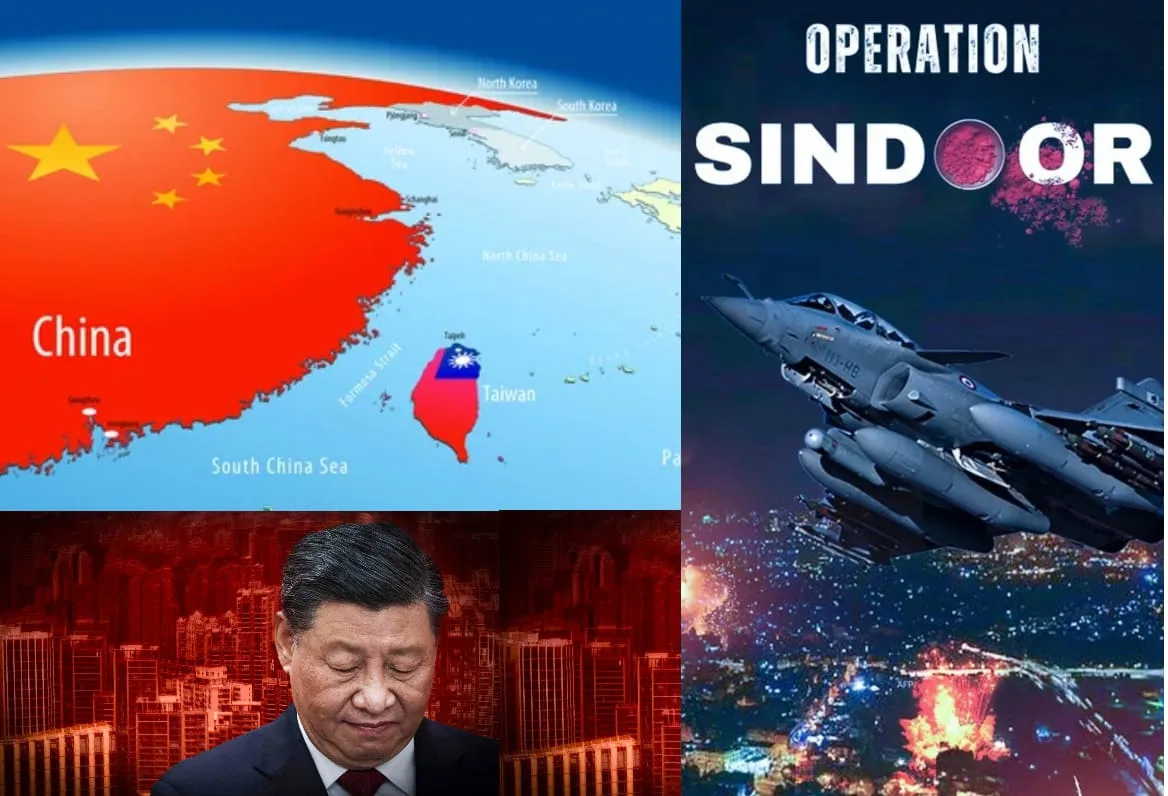
In a span of just four days, from May 7 to May 10, 2025, India’s Operation Sindoor delivered a decisive blow to Pakistan’s terror and military infrastructure in retaliation for a brutal terrorist attack in Pahalgam that left 26 civilians dead. But beyond its immediate regional impact, the operation has triggered shockwaves in global strategic circles, particularly in Beijing, by exposing the glaring weaknesses in Chinese military hardware. As the world’s eyes increasingly turn towards Taiwan and the possibility of a Chinese invasion, the poor performance of Chinese-supplied weapons in Pakistan has called into question the credibility of China’s military capabilities and its ambitions in the Indo-Pacific.
India’s Precision Strikes Rattle Pakistan’s Defences
India’s carefully calibrated operation, launched in response to the terror strike, saw the Indian Air Force (IAF) carry out precision strikes on Pakistani military sites, including terrorist camps and key airbases like Nur Khan near Islamabad. The IAF deployed a mix of Rafale fighter jets equipped with Xgard electronic warfare decoys, BrahMos-A supersonic cruise missiles, Tata’s ALS-250 loitering munitions, and Israeli-made Harop drones. The outcome was devastating for Pakistan. Despite its air defence shield comprising HQ-9P and HQ-16 systems supplied by China, Pakistan failed to intercept incoming missiles.
Pakistan, China’s top arms buyer, deployed its front-line Chinese-supplied assets including J-10C fighters, PL-15E beyond visual range missiles, Wing Loong II drones, and HQ-series air defence systems. Yet, they failed to stop Indian strikes or inflict meaningful damage in response. Pakistan claimed it had downed five Indian aircraft, including three Rafales. However, Indian officials and analysts from Jane’s Defence Weekly suggest these were likely Xgard decoys, not actual fighter jets, an assessment bolstered by the lack of wreckage and the continuation of IAF operations.
China’s Military Technology Under the Spotlight
This outcome was more than a military embarrassment for Pakistan; it was a strategic disaster for China. With over 80 per cent of Pakistan’s arsenal being Chinese-made, the conflict inadvertently became a live testing ground for China’s military technology. The results were sobering. The much-vaunted HQ-9P and HQ-16 air defence systems, modeled in part on Russian and Western designs, were unable to stop Indian missiles like BrahMos and SCALP from striking targets near Lahore and Islamabad. Wing Loong II drones, priced economically at $1–2 million, were overwhelmed by India’s electronic warfare and anti-drone systems.
On social media platform X, the performance of Chinese weapons drew widespread ridicule. Prominent accounts like @FrustIndian dubbed it a ‘humiliating outing’ for Beijing’s defence industry. These sentiments were echoed in NDTV’s analysis, which also pointed out critical limitations in the J-10C jets. Notably, the WS-10B engines of the J-10C lack the thrust, fuel efficiency, and survivability of Rafale’s French-built Snecma M88-2 engines. In head-to-head combat scenarios, India’s Rafales had the edge, a worrying sign for the PLA, which fields similar platforms.
Operation Sindoor’s Lessons for Taiwan Conflict Scenarios
For China, the implications extend far beyond the subcontinent. Beijing has been preparing for a potential invasion of Taiwan by 2027, aiming to establish air and naval superiority over the island before any land-based operations. The Taiwan Strait is already patrolled by PLA Air Force J-10C jets armed with PL-15 missiles, the same systems that failed against India. With Taiwan relying on U.S.-supplied F-16Vs, Patriot air defence systems, and U.S. naval reinforcements, the credibility of the PLA’s capabilities now faces deep scrutiny.
A critical vulnerability exposed in Operation Sindoor was the inadequacy of Chinese electronic warfare (EW) systems. India’s Xgard decoys spoofed Pakistan’s Chinese-built KLJ-7A AESA radars, allowing Rafales and missile platforms to evade detection. Analysts like Brendan Mulvaney from the China Aerospace Studies Institute have noted that such EW gaps would be disastrous in a Taiwan conflict, where the U.S. Navy’s EA-18G Growlers and Taiwan’s E-2K AWACS could severely degrade PLA radar and missile lock-on capabilities.
Further, the failure of the PL-15E missiles to effectively engage targets suggests reliability issues in the design or integration of these long-range systems. If the downgraded export version is any indication, even China’s domestic PL-15s may not effectively counter advanced U.S. AIM-120D AMRAAMs. The PLA Rocket Force, which would play a key role in any Taiwan scenario with missile barrages using systems like the DF-21D, will likely need to reassess its assumptions based on the Sindoor outcome.
Repercussions for China’s Arms Market and India’s Strategic Posture
Even China’s intelligence gathering fell short. Despite reportedly using spy satellites and maritime militia in the Indian Ocean to monitor the operation, it failed to anticipate or mitigate the real-time combat failures of its equipment. This gap in real-world performance versus lab-tested assumptions could push the PLA towards a more sobering reassessment of its force readiness, training protocols, and equipment quality.
Financially, the damage is already visible. The initial media hype around Pakistan’s use of J-10Cs had temporarily boosted shares of AVIC Chengdu Aircraft by 40%. But the exposure of ground realities has dented both credibility and market prospects. Countries like Algeria, Egypt, and Sudan, considered potential buyers of Chinese systems, may now reconsider future procurements. China had already faced past criticisms from clients like Bangladesh and Myanmar over defective or underperforming equipment.
India’s success, meanwhile, underscores the advantages of a diversified and integrated arsenal. Combining French Rafales, Israeli drones, Russian missiles, and indigenous platforms like ALS-250, India showcased the value of strategic autonomy and technological resilience. It also highlighted India’s growing edge in electronic warfare and unmanned systems, areas that will be crucial in any future conflict involving the PLA.
For Taiwan and its partners in the Indo-Pacific, Operation Sindoor offers a valuable case study in how PLA weaponry performs under pressure. While a cross-strait conflict would differ in terrain and scope, the lessons from the IAF’s surgical strikes and the meltdown of Pakistan’s Chinese-built defences cannot be ignored. As Shu Hsiao-Huang of Taiwan’s National Defense and Security Research Institute observed, the PLA’s air combat edge may be overstated and that could fundamentally alter Beijing’s invasion calculus.
Operation Sindoor may have been a short operation in a local theatre, but its strategic consequences for Chinese ambitions in Taiwan and beyond are likely to reverberate far longer.













Comments