





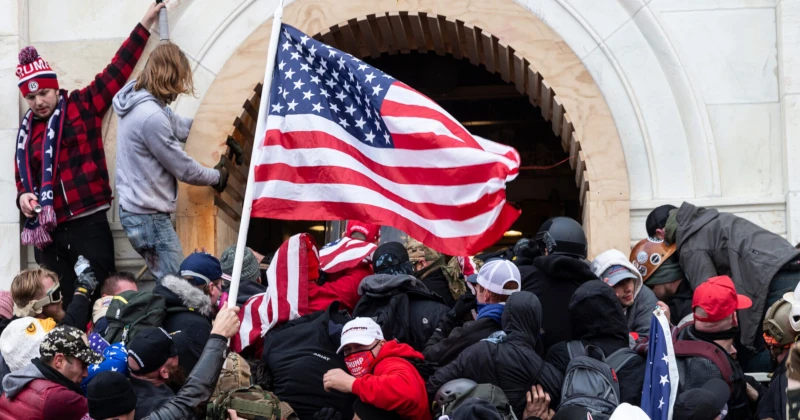
For decades, the world looked to America as an anchor of stability in turbulent times. That very anchor is currently dragging down the interests of global prosperity, security, and progress. The United States has undergone a process of unprecedented upheavals within the border- from mass deportations to dismantling of institutions, from economic disasters to democratic backsliding, the ripple effects of which are so disastrous that, upon assigning them to the global sphere, the sudden felt collapse of leadership places all nations, one way or another, into the force of handling that vacuum.
The most immediate impact is the devastation of the economy, like a contagion, far beyond America’s borders. Canada and Mexico are the closest countries to trade alongside the United States, and they have now entered into impending recessions triggered directly by the US’s aggressive and punitive tariff policies. Imposing 25 per cent tariffs on your most trustworthy allies is a blatant undermining, and it fractures the global trade system, far beyond just bilateral relations, once the world’s largest economy does it.
Supply chains that took decades to optimise are now “tilting sharply away” from established patterns, with overall trade falling 5 per cent while U.S.-China trade is tumbling by an assured 90 per cent. This is not an American issue that necessitates American remedies; rather, it forces businesses located on opposite sides of the world to rebuild their operations at enormous costs. Every European manufacturer sourcing components through disrupted networks, every Asian exporter scrambling for new markets, and every African nation watching commodity prices fluctuate dramatically are paying for America’s malfunctioning infrastructure.
Due to erratic US policies, the sentiment of enterprise executives has plummeted worldwide, while the investment climate has deteriorated everywhere. Not just in America, housing starts and major investments have stalled in the markets for whom US stability might have meant something. When the country whose currency serves as the world’s reserve currency becomes economically unreliable, it weighs down global welfare by a 1.2 per cent margin, with developing nations—the least equipped to absorb such shocks—shouldering this load with a greater burden.
Mass deportation campaigns inflicting humanitarian crises of sorts have to be absorbed by neighbouring countries. These days, large-scale operations by ICE, raiding major urban centres like the Bay Area, Detroit, and Philadelphia, arresting hundreds, some of whom may be US citizens, create flows of refugees, now stretching border communities and the immigration systems from Chihuahua through to Ottawa. These occurrences targeting pro-Palestinian activists and thousands of displaced international students and scholars force the host countries to accommodate the displaced scholars, disturbing the global academic exchange styles and circulation of human capital that have been the carbon that fueled innovation across generations.
This academic exodus is more than just an individual tragedy; it is, at the very least, a dismantling of the international research ecosystem. When the US cuts scientific funding through, say, NIH and groom foreign academics, other countries have to stitch up scientific partnerships that do not include the US, which slows down medical research and technological innovation that benefits humanity at a global level. The fight against cancer, climate change, and emerging diseases in the world becomes increasingly complicated as America draws away some of the brightest minds.
The most worrying development is the fragmentation of global security arrangements. New NATO partners, for example, are not seriously considering independent capabilities because they doubt the US’s ability to lead them. When you multiply all of this duplication of effort across many alliances, you discount the collective effectiveness of those alliances. Moreover, the US is removing the oversight structures that are also directing civil servants to undermine the credibility of US intelligence with its partners and allies. That means the partners must develop their independent intelligence networks entirely. In total, you may see the dismantling of global security structures and the eroding of trusted leadership.
There are regional conflicts that have previously required American mediation, which have now evolved into full NATO interventions, but where there has not been an American diplomatic mediator in the past. There are no multilateral security arrangements that small powers can turn to, and they end up on the cusp of threats they cannot confront. It stresses an already destabilised world with conflicts that fester to broader levels, refugee crises, disruptions to trade and humanitarian catastrophes that create unending cycles of conflict that meet up with states even further afield.
The moment is also very chaotic, and there is nothing further to the left than at the moment when global coordination on climate change was disrupted by the withdrawal from the Paris Agreement and the ramping up of fossil fuel extraction and production, precisely as it was unravelled, unravelling global partnerships and climate initiatives. Not just symbolic, because it creates a leadership vacuum that gives excuses and rationalisations for other countries to back away from guiding climate arrangements.
Cuts to FEMA and NOAA undermine America’s global disaster response capabilities, leaving other countries to tackle climate emergencies with less international collaboration. As extreme weather events worsen and become more frequent, countries face these extreme events alone, without the resources and expertise that US agencies provide. Developing countries are now also increasingly isolated and experiencing vulnerabilities around climate adaptation, with an already challenging headwind.
Much of the world, as a consequence of increasing concern about US fiscal sustainability and a seemingly endless national debt trajectory, is losing confidence in the dollar as the world’s reserve currency. Countries are now seeking alternative arrangements, creating fragmentation of the world monetary system, which means longer transaction times and higher transaction costs, thereby reducing global efficiency and productivity. Central banks around the world now must commit resources to managing currency risks that were once essentially non-existent.
US economic policy now generates unpredictability and market volatility that also impacts pension funds in Europe, sovereign wealth funds in Asia, and individual investors in Africa and Latin America. When the chaos of American domestic politics translates into global financial instability, it is pensioners in Germany or small businesses in Ghana that will ultimately bear the brunt of the consequences.
Multilateral institutions built around American leadership are becoming increasingly reactive, as the United States lacks a reliable partner in the event of a hypothetical breakdown. From the World Health Organisation to climate accords, from trade organisations to security councils, the machinery of global governance is tarnished and going nowhere without a predictable American presence. This creates governance deficiencies in responding to threats such as pandemics and cybersecurity that require coordinated international responses.
The visible failure of American democratic institutions is emboldening authoritarian regimes, powerless to even dream of that level of reckless experiment, while also dissuading any democratic movements. Suppose the oldest democracy in the world can vet and evaluate its elected officials, surveil its academics, and journalists. In that case, it is wholly undermining the universal democracy promotion agenda, while providing marketing material for autocrats on both the right and the left.
A new global reality is emerging, where nations are responding by creating alternative partnerships and institutions that exclude the United States, radically inverting global governance systems. European nations are quickly advancing strategic autonomy initiatives, while Asian nations are rapidly developing regional cooperative mechanisms. Traditional American alliances in Brazil are making partnerships much broader.
This adaptation is costly, messy and duplicative. Resources that would have been productively and holistically adjusted to the common challenges of humanity (poverty, disease and climate change) are instead largely wasted on constructing redundant capabilities and alternative institutions. Data are systematically shared, coordination is less frequent, and opportunities to manage collective challenges are systematically reduced, leading countries to import and adopt fewer common capabilities. All this because America has changed from a global stabiliser to a global disruptor.
The tragedy is the need for international intervention to tackle increasingly urgent problems, yet the American domestic crisis is making this effort both increasingly necessary and increasingly difficult. As the world adapts to the consequences of an increasingly unreliable America, global problems that require everyone’s attention and resources are piling up on one another. The cost of America’s dysfunction is too expensive in comparison to American suffering; it is written in rising poverty, delayed medical innovations, worsened climate impacts, and limitless and enlarging wars and conflicts around the world.
Today, the international community is facing a new challenge: how to make a more stable world order while simultaneously (and actively) disabling the world order that America built.












Comments