US strikes on Iran: Short-term gain, long-term gamble
June 4, 2026
  • Read Ecopy
  • Circulation
  • Advertise
  • Careers
  • About Us
  • Contact Us
Android AppiPhone AppArattai
Organiser
  • ‌
  • Bharat
    • Assam
    • Bihar
    • Chhattisgarh
    • Jharkhand
    • Maharashtra
    • View All States
  • World
    • Asia
    • Europe
    • North America
    • South America
    • Africa
    • Australia
  • Editorial
  • International
  • Opinion
  • RSS @ 100
  • More
    • Op Sindoor
    • Analysis
    • Sports
    • Defence
    • Politics
    • Business
    • Economy
    • Culture
    • Special Report
    • Sci & Tech
    • Entertainment
    • G20
    • Azadi Ka Amrit Mahotsav
    • Vocal4Local
    • Web Stories
    • Education
    • Employment
    • Books
    • Interviews
    • Travel
    • Law
    • Health
    • Obituary
  • Subscribe
    • Subscribe Print Edition
    • Subscribe Ecopy
    • Read Ecopy
  • ‌
  • Bharat
    • Assam
    • Bihar
    • Chhattisgarh
    • Jharkhand
    • Maharashtra
    • View All States
  • World
    • Asia
    • Europe
    • North America
    • South America
    • Africa
    • Australia
  • Editorial
  • International
  • Opinion
  • RSS @ 100
  • More
    • Op Sindoor
    • Analysis
    • Sports
    • Defence
    • Politics
    • Business
    • Economy
    • Culture
    • Special Report
    • Sci & Tech
    • Entertainment
    • G20
    • Azadi Ka Amrit Mahotsav
    • Vocal4Local
    • Web Stories
    • Education
    • Employment
    • Books
    • Interviews
    • Travel
    • Law
    • Health
    • Obituary
  • Subscribe
    • Subscribe Print Edition
    • Subscribe Ecopy
    • Read Ecopy
Organiser
  • Home
  • Bharat
  • World
  • Operation Sindoor
  • Editorial
  • Analysis
  • Opinion
  • Culture
  • Defence
  • International Edition
  • RSS @ 100
  • Magazine
  • Read Ecopy
Home World

Operation Midnight Hammer to Ceasefire: Iran’s nuclear obsession and US’s West Asia gamble

The recent US strikes on Iran’s nuclear sites, following Israel’s Operation Rising Lion, may have caused short-term setbacks but failed to deter Iran’s long-term nuclear ambitions. Rooted in flawed historical policies of containment and strategic gambles, the move risks escalating regional instability rather than securing peace

Srijan SharmaSrijan Sharma
Jun 29, 2025, 02:00 pm IST
in World, West Asia, Opinion, Asia, International Edition
Follow on Google News
FacebookTwitterWhatsAppTelegramEmail

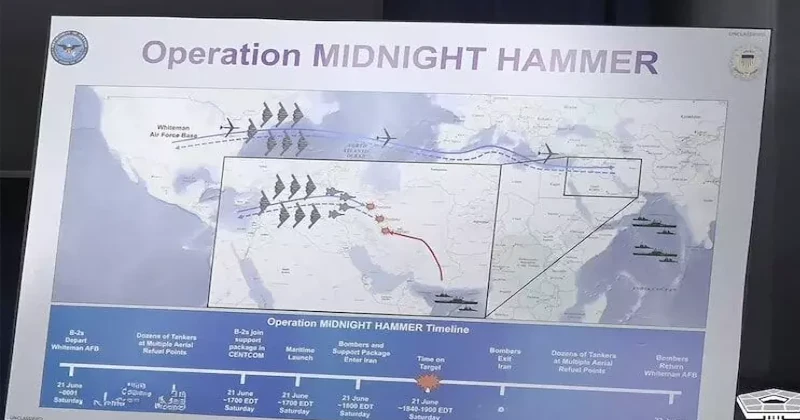
After nine days of Israel’s Operation Rising Lion, the US launched its first strike on Iran’s key nuclear sites, mainly Fordow and Natanz. The strike significantly damaged Iran’s nuclear capabilities. However, it remains controversial, as Iran claims only superficial damage, and many OSINT analysts question the US bombing campaign, suggesting Iran might have shifted uranium. The real question is not about the strike’s effectiveness but whether this risk will force Iran into a corner or lead to a fragile ceasefire and symbolic victories.

US West Asia Policy  

The US adopted a strategic policy of offshore balancing and containment to maintain its influence and prevent any one regional power from becoming too dominant in the oil and gas sector. Its first major operation was organising Iran’s coup d’état in 1953, which overthrew Prime Minister Mohammad Mosaddegh, who was leaning toward the Soviet Union. Five years later, in 1958, the US deployed troops to Lebanon under Operation Blue Bat to protect its interests amid political instability. The Eisenhower Doctrine shaped the US’s strategic approach in the West Asia, stating that any regime threatened by Communism in the region could request military support from the US. Meanwhile, the US prepared the ground for supporting Israel to strengthen its regional presence and influence in the 1960s. Throughout this period, the US continued following a containment and balancing approach in the West Asia. A significant shift occurred during the 1980s and 1990s, when the US became more assertive and involved in West Asia affairs, beginning with the Islamic Revolution in Iran and the hostage crisis and extending to the Lebanon Intervention. A sense of strategic assertiveness—aimed at containment and influence through allies—became central to US policy in the region, focusing on issues from oil security to countering Soviet influence.

The Gamble Period

The Iran-Iraq war was more than a territorial dispute; it was a struggle for dominance in the Gulf. On one side, the Islamic revolution marked the rise of the Shia crescent in the West Asia, while Saddam Hussein feared that Iran’s Islamic ascent would seriously challenge his power in the Gulf. The US viewed Iran’s rise as a threat to its influence and allies in the region. Moreover, the US did not want a single power dominating the Gulf, especially since Iran was strategically exporting the Islamic revolution throughout the region. Consequently, the US supported Saddam to ensure Iran’s defeat, providing military and economic aid to Iraq against Iran.

The US’s gamble and blind eye to Saddam Hussein’s atrocities, human rights violations and usage of chemical weapons led to the beginning of long-term instability in the region. After three years of war, the region witnessed the first Gulf War in 1991, when Iraq invaded Kuwait. Perhaps the first failure of the US’s foreign policy in the West Asia- the US wanted to keep a check on rising powers and contain the Soviets, but the US’s gamble on Saddam backfired, as the US’s quest to contain Iran made Iraq more dangerous and powerful which to some extent weakened US position in the West Asia. However, the US readjusted its policy and adopted a broader containment strategy, known as dual containment, in 1993.

Dual Containment: Another Gamble Failed

The US pushed the Dual containment policy by containing both Iran and Iraq, which was seen as a tactical victory in coercing both countries. Still, in the long term, it proved counterproductive for the US’s strategic interests in the West Asia.  The region became more unstable and gave rise to  Shite groups, and proxy conflicts began to brew. Notably, the dual containment policy weakened Iraq. Still, it allowed Iran to carve a silver lining to take advantage of the weakened regional power of Iraq and push its rise through Shite groups.  Moreover, the threat of terror groups also increased in the region as the US presence in the Gulf significantly increased, especially in Saudi Arabia, which led Al-Qaeda to get into active mode and spread anti-American sentiments—the Riyadh Compound Bombing in 2003, where Westerners were targeted.

The US’s policy of dual containment also employed regime change tactics through the use of sanctions and deterrence, but these measures had no significant impact on either country. US foreign policy, with scattered, faulty geopolitical assessments and a superficial understanding of regional dynamics, contributed to a fractured policy in the West Asia, ultimately making it a power-gambling game. However, US West Asia policy in recent years has undergone necessary adjustments, such as placing greater emphasis on diplomacy and limiting itself to security issues. However, it still hinges on limited strategic gains and more on risks.

Iran’s Nuclear Obsession and US Strikes

US strikes on Iran’s nuclear facilities follow Israel’s strike, serving as a display of containment and deterrence. However, will the US transform this tactical success into strategic gains by pushing Iran to negotiate a new plan or by dropping its nuclear obsession? The answer is no. Iran’s fixation on nuclear weapons is deeply linked to its identity and national pride, which can be reduced through coercion but not entirely abandoned. Trump’s efforts to do so complicate new negotiations, and Iran’s obsession is evident: it did not aim to import a nuclear bomb but to develop its own. Reports indicate that US Vice President JD Vance confirmed that 400kg of uranium is missing after US strikes. Two primary outcomes are possible: first, Iran might directly proceed to develop its nuclear bomb, bypassing nuclear diplomacy and brinkmanship as North Korea did; second, heightened security fears could threaten the fragile ceasefire, especially as the US-Israeli relationship remains far from their goals. Reports suggest the US strike has set Iran’s nuclear program back only a few months. Therefore, it might be seen as a symbolic victory for the US, as it fails to deter Iran or hinder its nuclear ambitions. Instead, the strikes have increased Iran’s threat level, with Iran making serious calls to close the Strait of Hormuz and advancing nuclear ambitions. This indicates that the US’s hurried gamble in the West Asia has once again failed.

Topics: Israel Iran conflictOperation Midnight HammerUS StrikesUSAl Qaeda
ShareTweetSendShareSend
✮ Subscribe Organiser YouTube Channel. ✮
✮ Join Organiser's WhatsApp channel for Nationalist views beyond the news. ✮
Previous News

Bastar reclaimed: Historic firsts mark triumph over Maoism since Independence

Next News

Bangladesh Horror: Hindu woman raped at knifepoint by BNP leader Fazor Ali in Cumilla, Graphic video goes viral

Related News

Rubio’s Kolkata visit revived debate over missionary influence, evangelical politics and America’s religious pressure campaign in India

Revisiting the myth behind Mother Teresa: Inside Rubio’s Missionaries of Charity stop & US’s evangelical push in India

Tata Electronics CEO Randhir Thakur and ASML CEO Christophe Fouquet sign a MoU as PM Modi and Dutch PM Rob Jetten look on, during a two-day visit to the Netherlands in May 16, 2026

Five-Nation Visit: PM Modi advances India’s chip ambitions as Tata and ASML to build semiconductor fab in Gujarat

President Trump shakes hands with China's President Xi Jinping as he leaves after a visit to Zhongnanhai Garden in Beijing on May 15

US President Trump leaves China with praise, promises and optics but no confirmed breakthroughs

(Left) RSS Sarkaryavah Dattatreya Hosabale ji (Right) Sunil Ambekar ji, Akhil Bharatiya Prachar Pramukh, RSS

RSS Sarkaryavah Dattatreya ji’s UK, US & Germany visit highlights Bharat’s civilisational ethos & global responsibility

Donald Trump Jr.’s advisory roles at Polymarket⁠ and Kalshi⁠ have intensified scrutiny over the growing intersection of political power, prediction markets, and speculative trading tied to US government actions.

Democracy for Sale: How prediction markets turned US power into a profitable commodity

POTUS Donald Trump delivering an address to the nation alongside Vice-President JD Vance, US Secretary of State Marco Rubio and US Defence Secretary Pete Hegseth, following US strikes on Iran's nuclear facilities, at the White House

Rift in Trump Camp? US Vice President JD Vance suspects Pete Hegseth; Pentagon misled Trump on Iran war?

Load More

Latest News

MK Stalin with Sonai Gandhi; MK Stalin with Rahul Gandhi (File Photos) (Left to Right)

Tamil Nadu: DMK says no to INDIA Alliance meet in Delhi, blames Congress for political backstabbing

Union Finance Minister Nirmala Sitharaman

Karnataka: All-Women team powers Yadgir’s groundnut revolution; Nirmala Sitharaman inaugurates NABARD Unit

Keralam: Jamaat-e-Islami event features Hamas and Muslim Brotherhood ideologues, raises concerns over Political Islam

Representative Image (This is an AI Generated image)

Uttar Pradesh CM Abhyudaya Scheme: Apply for free civil services, JEE and NEET coaching from June 5

House worth Rs 2 crore of drug peddler bulldozed in J&K

Anti-narcotics campaign in J&K: Police demolish Rs 2 crore residential property linked to drug peddler Sheikh Tasaduq

As fuel shortages rippled across Asia, New Delhi expanded supplies to its neighbours while Beijing sought to turn energy security into strategic influence.

The Hormuz Test: How India’s energy assistance outshines China’s conditional approach

Demographic changes in Bharat’s border districts have raised concerns about migration, security, and social cohesion

Demographic Shift in Border Areas of Bharat: The dangerous design

FIR filed against the Islamists in the Love Jihad case in Bhopal

Love Jihad again in Bhopal: Minor Hindu girl forced to drink beer, trapped and pressured to convert by Islamists

The ₹100 Crore Dhaba: How Amrik Sukhdev Revolutionised Highway Dining in India

The Dhaba Story: The family that changed highway dining

After TCS Controversy, Wipro Faces Fresh 'Corporate Jihad' Allegations as Former Employee Details Harassment, Religious Pressure and Forced Resignation

Exclusive | Corporate Jihad at Wipro? Hindu employee says Shahina told her, ‘Accept Islam, I’ll marry you to a Sheikh’

Load More
  • Privacy
  • Terms
  • Cookie Policy
  • Refund and Cancellation
  • Delivery and Shipping

© Bharat Prakashan (Delhi) Limited.
Tech-enabled by Ananthapuri Technologies

  • Home
  • Search Organiser
  • Bharat
    • Assam
    • Bihar
    • Chhattisgarh
    • Jharkhand
    • Maharashtra
    • View All States
  • World
    • Asia
    • Africa
    • North America
    • South America
    • Europe
    • Australia
  • Editorial
  • Operation Sindoor
  • Opinion
  • Analysis
  • Defence
  • Culture
  • Sports
  • Business
  • RSS @ 100
  • Entertainment
  • More ..
    • Sci & Tech
    • Vocal4Local
    • Special Report
    • Education
    • Employment
    • Books
    • Interviews
    • Travel
    • Health
    • Politics
    • Law
    • Economy
    • Obituary
  • Subscribe Magazine
  • Read Ecopy
  • Advertise
  • Circulation
  • Careers
  • About Us
  • Contact Us
  • Policies & Terms
    • Privacy Policy
    • Cookie Policy
    • Refund and Cancellation
    • Terms of Use

© Bharat Prakashan (Delhi) Limited.
Tech-enabled by Ananthapuri Technologies