From Tehran to Beijing: Hard Reality of autocratic regimes
June 9, 2026
  • Read Ecopy
  • Circulation
  • Advertise
  • Careers
  • About Us
  • Contact Us
Android AppiPhone AppArattai
Organiser
  • ‌
  • Bharat
    • Assam
    • Bihar
    • Chhattisgarh
    • Jharkhand
    • Maharashtra
    • View All States
  • World
    • Asia
    • Europe
    • North America
    • South America
    • Africa
    • Australia
  • Editorial
  • International
  • Opinion
  • RSS @ 100
  • More
    • Op Sindoor
    • Analysis
    • Sports
    • Defence
    • Politics
    • Business
    • Economy
    • Culture
    • Special Report
    • Sci & Tech
    • Entertainment
    • G20
    • Azadi Ka Amrit Mahotsav
    • Vocal4Local
    • Web Stories
    • Education
    • Employment
    • Books
    • Interviews
    • Travel
    • Law
    • Health
    • Obituary
  • Subscribe
    • Subscribe Print Edition
    • Subscribe Ecopy
    • Read Ecopy
  • ‌
  • Bharat
    • Assam
    • Bihar
    • Chhattisgarh
    • Jharkhand
    • Maharashtra
    • View All States
  • World
    • Asia
    • Europe
    • North America
    • South America
    • Africa
    • Australia
  • Editorial
  • International
  • Opinion
  • RSS @ 100
  • More
    • Op Sindoor
    • Analysis
    • Sports
    • Defence
    • Politics
    • Business
    • Economy
    • Culture
    • Special Report
    • Sci & Tech
    • Entertainment
    • G20
    • Azadi Ka Amrit Mahotsav
    • Vocal4Local
    • Web Stories
    • Education
    • Employment
    • Books
    • Interviews
    • Travel
    • Law
    • Health
    • Obituary
  • Subscribe
    • Subscribe Print Edition
    • Subscribe Ecopy
    • Read Ecopy
Organiser
  • Home
  • Bharat
  • World
  • Operation Sindoor
  • Editorial
  • Analysis
  • Opinion
  • Culture
  • Defence
  • International Edition
  • RSS @ 100
  • Magazine
  • Read Ecopy
Home World

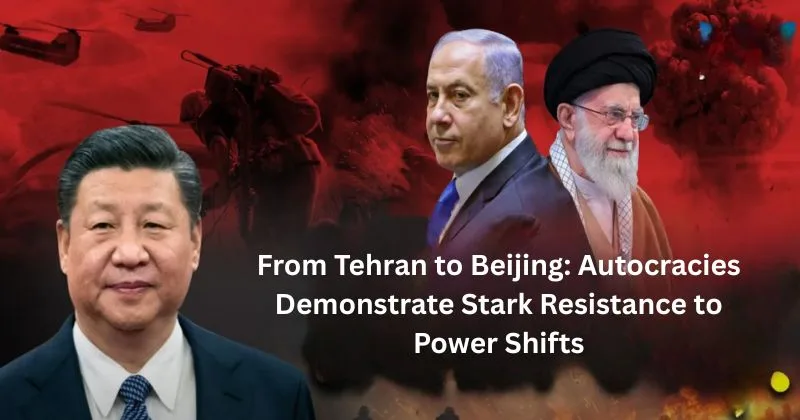
From Tehran to Beijing: Autocracies demonstrate stark resistance to power shifts

The volatile concept of "regime change" has surged to the forefront of global discourse, particularly intensified by the ongoing Israel-Iran conflict where it was initially a stated objective, later softened to a "desirable outcome" by Israel and even briefly entertained by the USA

Lt Gen M K DasLt Gen M K Das
Jun 25, 2025, 06:30 pm IST
in World, West Asia, Opinion, Asia, International Edition
Follow on Google News
FacebookTwitterWhatsAppTelegramEmail

There has been a talk of regime change in Iran in the ongoing Israel-Iran conflict. Initially, Israel stated that change of the existing regime in Iran is one of the main objectives of their military campaign against Iran. After Iran retaliated against Israel and managed to cause sufficient destruction in Israel, particularly in Tel Aviv and Haifa, that Israel changed its stance and said that change of regime is one of the desirable outcomes. Even USA talked of change in the regime in Iran for the good of the Middle East region but later they too retracted their statement.

Iran is an Islamic Republic, established in the year 1979 after the revolution that overthrew the monarchy. It is a theocratic state where Islamic law or Sharia plays a central role in governance. The country is ruled by a Supreme Leader in Ali Khamenei. In essence, Iran is an autocracy where Human Rights are suppressed, women face many restrictions and there is no free media. Any opposition to the ruling regime is met with death penalty or life sentence. The Iranian government has 1,25,000 strong Islamic Revolutionary Guards, which are mandated to crush any rebellion and interference with the regime.

As the events of the last two weeks has proved, the regime change in autocratic nations is never easy. Even though the people are oppressed and have to bear with huge difficulties, not much hope is generated, even when the world opinion may support them. It is similar to the situation in North Korea, where no one is even contemplating a regime change. North Korea is a totalitarian state with absolute dictatorship of the Kim family for the last seven decades. It is one of the poorest countries in the world, where the Army gets major share of revenue. It is a nuclear weapon state and has long range missile capability. So, regime change in autocratic states is never easy.

Read More: “Democracy under arrest”: PM Modi marks 50 years of Emergency, slams Congress for constitutional violations

Nearer home, China is ruled by a single party Chinese Communist Party (CCP) which has total monopoly over power. There is no democracy in a country of 1.4 billion people. When we Indians complain that how China has moved ahead of India economically, we must remember that Chinese dispensation had a free hand in implementing what they wanted, with no regard to Human Rights and freedom of expression. Our western neighbour Pakistan is also a pseudo democracy where the Pakistan Army and the Army Chief rules the country through a proxy Prime Minister. After Army Chief Asim Munir has put Pakistan in an embarrassing situation by towing the American line against Iran, there are murmurs in the country. But any change in the power structure in Pakistan appears bleak as of now. The state of near anarchy in Bangladesh after the ouster of Sheikh Hasina regime is well known. That also shows that our neighbourhood does not have much democracy and India as a nation has to deal with autocratic leadership of these countries.

Are genuine democracies immune to a regime change these days? The evidence suggests that serious attempts are made by the big powers and the Deep State to destabilise the legitimate democratic governments. Foreign Electoral Interventions (FEI) are attempted by backing a preferred party in a targeted country, carrying out disinformation campaign and through polarisation techniques. The two largest democracies of the world, that is India and USA, have been victims of FEI. It is very difficult to prove the direct involvement of such inimical agencies as they rely on the supportive network of the targeted country. Therefore, a democracy is also susceptible to a regime change through indirect means. Therefore, the electorate of a genuine democracy like India have to remain conscious of such false narratives while exercising their franchise.

Indian democracy also faced a bleak future when Emergency was imposed on June 25, 1975. This 21-month period till March 21, 1977 remains the darkest chapter in India’s glorious democracy. The state of emergency empowered Prime Minister Indira Gandhi to rule by decree, cancel elections, suspend civil liberties and censor the press. More than 100, 000 political opponents, journalists and dissenters were imprisoned during this period. A lot of atrocities also took place against the hapless citizens. Thus, emergency in India too can be called a type of regime change by political coercion.

One of the strongest pillars of democracy in India has been its apolitical armed forces. When you compare around our neighbourhood or the region, very few armies have continued to function under the civilian rule. Indian armed forces are a shining example which has executed every constitutional role, under every democratically elected government of India. Therefore, when Prime Minister Modi gave full freedom to the armed forces to avenge Pahalgam terror attack of 22 April, our forces exhibited controlled aggression against Pakistan with precision strikes during Operation Sindoor. Even under provocation, Indian armed forces refrained from targeting the civilian population of Pakistan. Pakistan capitulated within four days and the Indian armed forces further raised the esteem of a democratic India.

More than 65% of India’s population is below 35 years of age. The declaration of Emergency 50 years ago means that at least 75% of Indian population has not experienced the horrors of a full-fledged dictatorship. In this context, it is important for a vast majority of our population to be sensitised on ‘Samvidhan Hatya Diwas’. Today India can boast of most vibrant democracy in the world, from the Panchayat to Parliament level. Today, India is recognised as the beacon of hope for democracy. We Indians are indeed blessed to enjoy the fruits of democracy. On this day, all the citizens should take the pledge to uphold the constitutional values, protect fundamental rights and follow the fundamental duties to Make India Great Again (MAGA). Jai Bharat!

Topics: Iran-IsraelWest AsiaMake India Great Again
ShareTweetSendShareSend
✮ Subscribe Organiser YouTube Channel. ✮
✮ Join Organiser's WhatsApp channel for Nationalist views beyond the news. ✮
Previous News

Sabka Saath, Sabka Vikas in Action: Govt’s Dharti Aaba Janbhagidari Abhiyan touches every corner of Tribal Bharat

Next News

Madras HC issues contempt notices to IAS officers over St Joseph School running on encroached temple land

Related News

Strait of Hormuz Crisis: Why India cannot afford to be a spectator

Iran President Masoud Pezeshkian and Supreme Leader Mojtaba Khamenei

West Asia Conflict: Did Iran President Masoud Pezeshkian offer resignation owing to the iron fist of IRGC & theocracy?

NSA Ajit Doval at International Security Forum, Moscow

NSA Doval reviews security & energy ties with Russia; Reaffirms fight against terrorism & calls for peace in Hormuz

Prime Minister Narendra Modi and United Arab Emirates President Mohamed bin Zayed Al Nahyan

India’s expanding influence across West Asia – From historical ties to strategic alliances!

PM Modi and UAE President Mohamed Nahyan witness the exchange of agreements in Abu Dhabi, including major investment, energy and ship repair cooperation pacts between India and the UAE.

Five-Nation Visit: PM Modi lands $5 billion UAE investment deal, seals Gujarat shipyard expansion MoU

PM Modi is set to meet UAE President Mohamed bin Zayed Al Nahyan, Italian PM Meloni, Norwegian PM Store, Swedish PM Kristersson and Dutch PM Jetten during his five-nation West Asia-Europe tour.

PM Modi sets off on strategic five-nation West Asia-Europe tour amid push for energy and high-tech defence ties

Load More

Latest News

Beyond Alignment: How India is Carving Its Own Strategic Space Amid Global Power Play

Beyond Alignment: How India is Carving Its Own Strategic Space Amid Global Power Play

Chinese President Xi Jinping, Russian President Vladimir Putin and Prime Minister Narendra Modi

China’s New Tone Towards India: Tactical shift or strategic necessity? What Beijing’s push for RIC ties really signals

Keralam’s 2026 Fiscal Health White Paper has unveiled a mounting debt burden of Rs 5.07 lakh crore, exposing deep structural challenges in the state’s economy

Keralam’s Financial Reality Check: White Paper exposes Rs 5.07 lakh crore debt crisis

Tamil Nadu: TVK government arrests YouTuber Maridhas; BJP alleges crackdown on dissent

‘Every grave or dargah is not automatically Waqf property’: Madras High Court’s landmark verdict

US Court strikes down Trump’s $100,000 H-1B fee as executive overreach; Lawmakers & Republicans welcome the verdict

Union Defence Minister Rajnath Singh

Uttar Pradesh: Defence land goes green; Rajnath Singh clears 250 MW solar project in Sitapur

Afghanistan Foreign Minister Amir Khan Muttaqi and External Affairs Minister Dr. S. Jaishankar(File Photo)

India extends gratis long-term business visas to Afghan traders; Slams Pakistan for “trade & transit terrorism”

How Modi's Zero-tolerance doctrine reshaped India's anti-terror policy (This is an AI generated image)

Twelve Years of Modi Government and the rise of India’s zero-tolerance doctrine against terrorism

Press Conference organised by Janjati Suraksha Manch at the Press Club, Ranchi, National Convener Dr Raj Kishore Hansda

Success of Janjati Sanskritik Samagam symbolises unity and cultural pride: Dr Raj Kishore Hansda

Load More
  • Privacy
  • Terms
  • Cookie Policy
  • Refund and Cancellation
  • Delivery and Shipping

© Bharat Prakashan (Delhi) Limited.
Tech-enabled by Ananthapuri Technologies

  • Home
  • Search Organiser
  • Bharat
    • Assam
    • Bihar
    • Chhattisgarh
    • Jharkhand
    • Maharashtra
    • View All States
  • World
    • Asia
    • Africa
    • North America
    • South America
    • Europe
    • Australia
  • Editorial
  • Operation Sindoor
  • Opinion
  • Analysis
  • Defence
  • Culture
  • Sports
  • Business
  • RSS @ 100
  • Entertainment
  • More ..
    • Sci & Tech
    • Vocal4Local
    • Special Report
    • Education
    • Employment
    • Books
    • Interviews
    • Travel
    • Health
    • Politics
    • Law
    • Economy
    • Obituary
  • Subscribe Magazine
  • Read Ecopy
  • Advertise
  • Circulation
  • Careers
  • About Us
  • Contact Us
  • Policies & Terms
    • Privacy Policy
    • Cookie Policy
    • Refund and Cancellation
    • Terms of Use

© Bharat Prakashan (Delhi) Limited.
Tech-enabled by Ananthapuri Technologies