From Barabanki to the Khomein
July 23, 2026
  • Read Ecopy
  • Circulation
  • Advertise
  • Careers
  • About Us
  • Contact Us
Android AppiPhone AppArattai
Organiser
  • ‌
  • Bharat
    • Assam
    • Bihar
    • Chhattisgarh
    • Jharkhand
    • Maharashtra
    • View All States
  • World
    • Asia
    • Europe
    • North America
    • South America
    • Africa
    • Australia
  • Editorial
  • International
  • Opinion
  • RSS @ 100
  • More
    • Op Sindoor
    • Analysis
    • Sports
    • Defence
    • Politics
    • Business
    • Economy
    • Culture
    • Special Report
    • Sci & Tech
    • Entertainment
    • G20
    • Azadi Ka Amrit Mahotsav
    • Vocal4Local
    • Web Stories
    • Education
    • Employment
    • Books
    • Interviews
    • Travel
    • Law
    • Health
    • Obituary
  • Subscribe
    • Subscribe Print Edition
    • Subscribe Ecopy
    • Read Ecopy
  • ‌
  • Bharat
    • Assam
    • Bihar
    • Chhattisgarh
    • Jharkhand
    • Maharashtra
    • View All States
  • World
    • Asia
    • Europe
    • North America
    • South America
    • Africa
    • Australia
  • Editorial
  • International
  • Opinion
  • RSS @ 100
  • More
    • Op Sindoor
    • Analysis
    • Sports
    • Defence
    • Politics
    • Business
    • Economy
    • Culture
    • Special Report
    • Sci & Tech
    • Entertainment
    • G20
    • Azadi Ka Amrit Mahotsav
    • Vocal4Local
    • Web Stories
    • Education
    • Employment
    • Books
    • Interviews
    • Travel
    • Law
    • Health
    • Obituary
  • Subscribe
    • Subscribe Print Edition
    • Subscribe Ecopy
    • Read Ecopy
Organiser
  • Home
  • Bharat
  • World
  • Operation Sindoor
  • Editorial
  • Analysis
  • Opinion
  • Culture
  • Defence
  • International Edition
  • RSS @ 100
  • Magazine
  • Read Ecopy
Home Bharat

From Barabanki to the Khomein: Finding the Indian root of face of Iran’s Islamic revolution

A 19th-century departure of a pilgrim from Barabanki to Persia set in motion a journey that would culminate into Iran’s Islamic Revolution nearly a century later

Kirti PandeyKirti Pandey
Jun 24, 2025, 09:30 pm IST
in Bharat, World, West Asia, Uttar Pradesh
Follow on Google News
From Barabanki to the Khomein: The lost Indian Chapter in Iran’s revolution

From Barabanki to the Khomein: The lost Indian Chapter in Iran’s revolution

FacebookTwitterWhatsAppTelegramEmail

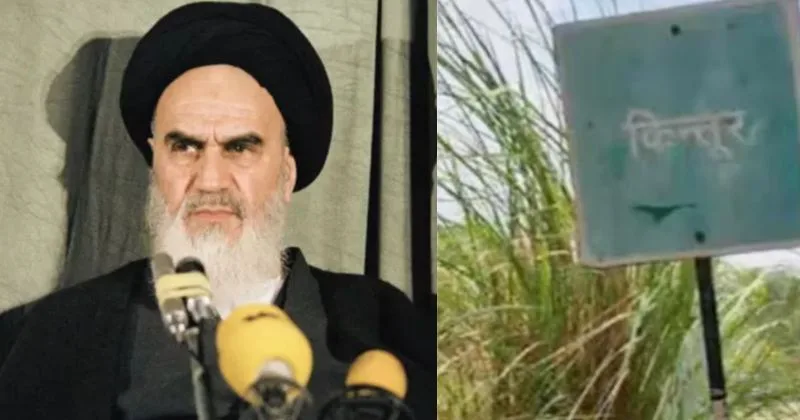
When Ayatollah Rouhollah Mousavi Khomeini (Imam Khomeini) overthrew Iran’s monarch – Mohammad Reza of the Pahlavi monarchy in 1979 and ushered in a new Islamic republic, few paused to consider how the origins of that revolution could be traced back — not to Tehran or Qom — but to a modest village named Kintur or Kintoor, nestled in Barabanki district in the heart of Uttar Pradesh in faraway India.

The Kintoor village came under the Awadh region. Many of the early Sufi preachers who came to North India belonged to Sayyid families, most of whom hailed from Central Asia and Iran — enjoyed powerful positions of ‘taluqdari’ (feudal) nature under the Nawab of Awadh (later anglicised to Oudh by the British colonisers).

Awadh, historically known as Kosala, was the ancient kingdom of Shri Ram and is centred around Ayodhya, his birthplace and capital. Over time, the region became known as Awadh under Persian influence and later flourished under the Mughals and Shia Nawabs as a hub of Islamic culture, literature, and architecture.

Read More: Israel-Iran conflict flares up hours after ceasefire begins; missiles fired from Tehran, Tel Aviv plans heavy reply

As per the historical archival records of the Iran Chamber, the leader of Iran’s Shia revolution descended from a line of scholars who had travelled from Iran to India, and then back again. His grandfather’s journey from Barabanki to Iraq and ultimately Khomein in Iran did more than reconnect a family with its roots—it rewrote the script of modern Middle-Eastern history.

From Nishapur to Awadh

Khomeini’s paternal lineage belonged to the Musavi Sayyids, who trace their ancestry to Imam Musa al-Kazim, the seventh Shia Imam. In the late 18th century, his ancestors migrated from Nishapur, an old Persian city in north-eastern Iran, to Awadh—a region that welcomed Shia scholars and Sufi mystics under the patronage of the Nawabs.

Among them were families who settled in towns like Lucknow, Jaunpur, and what is now in UP’s Barabanki district. Here, amid the Imambaras and theological seminaries of Shia India, Syed Ahmad Musavi Hindi was born. Though Indian by birth, he and his family retained a strong sense of their Iranian roots. The surname “Hindi,” meaning “from India,” stayed with him even as fate pulled him westward.

A Turning Point

In the mid-1800s, Syed Ahmad undertook a pilgrimage to Najaf, Iraq, to visit the shrine of Imam Ali. It was meant to be a religious journey, but it proved pivotal. While in Najaf, he met Yousef Khan, a citizen of Khomein, a small town southwest of Qom in Iran. Invited to settle there and marry Yousef Khan’s daughter, Syed Ahmad agreed. That was the key turning point. Thereafter, Syed Ahmad Musavi Hindi made Iran his home and did not return to India.

By the time of his death, Syed Ahmad had laid down new roots in Iran. His son, Syed Mostafa Hindi, born in 1885, became a scholar trained in Esfahan, Najaf, and Samarra, and later settled in Khomein. There, he married Hajar, and in 1902, their son Rouhollah Khomeini was born.

When a Revolution Is Born

The significance of this migration became clear decades later. Raised in Khomein and educated in Qom, Khomeini emerged as a towering figure in Iran’s Shia clerical hierarchy. After years of opposition to the Shah’s pro-Western regime—and more than a decade in exile in Iraq, Turkey, and France—he returned to Iran in 1979 and led the Islamic Revolution that would transform Iran into a theocratic state.

But had his grandfather not stayed on in Iran—had he returned to Barabanki after pilgrimage—Rouhollah Khomeini may never have been born. Not just as a revolutionary leader, but possibly not at all. The specific circumstances of his lineage, clerical education, and political environment that enabled him to lead Iran’s transformation would not have aligned.

Without Khomeini, there may have been no Islamic Republic, no hostage crisis, no ideological model for Shia Islamist politics in West Asia. In that sense, a decision made quietly in the 19th century by a pilgrim from Barabanki reshaped the fate of a nation—and the region around it.

The Legacy of “Hindi”

Though modern Iran does not foreground Khomeini’s ancestral ties to India, the suffix “Hindi” lingered in family memory for at least a generation. It was a quiet acknowledgement of origins across the subcontinent—an identity woven through Nishapur, Barabanki, Najaf, and Khomein.

And so, the arc of Iran’s modern history may begin not in Tehran or Tabriz, but in a village in Barabanki district, known more today for the 1858 battle fought during India’s First War of Independence. Long before Khomeini’s return from exile, his family’s departure from India had already set the revolution in motion.

 

Topics: Ayatollah Rouhollah Mousavi KhomeiniMohammad Reza
ShareTweetSendShareSend
✮ Subscribe Organiser YouTube Channel. ✮
✮ Join Organiser's WhatsApp channel for Nationalist views beyond the news. ✮
Previous News

Emergency & Contribution of Women: ABVP karyakarta recalls daring acts to shield RSS Pracharaks from arrest

Next News

Inside Operation Rising Lion: How Mossad staged a masterclass in intelligence with precision strikes on Iran

Related News

No Content Available
Load More

Latest News

Chhattisgarh CM Vishnu Deo Sai (Left), Rahul Gandhi During the protest at PM House (Right)

“Exploiting students for cheap politics”: Chhattisgarh CM slams Rahul Gandhi’s regrettable PM house protest

The Muslim couple identified as Twana H.S. and Asia R.A. during the trial on May 19, 2026

Germany convicts ISIS couple for enslaving, raping and forcing two Yazidi girls to convert to Islam

Sonam Wangchuk offers to end hunger strike on three conditions: What are they?

Sonam Wangchuk offers to end hunger strike on three conditions: What are they?

NEET Paper Leak Row: PM Modi announces fast-track courts; “Nothing is more important than our youth’s future”

On Bharatiya Mazdoor Sangh Foundation Day, India celebrates Dattopant Thengadi's vision of nationalism, dignity of labour and nation-building

Bharatiya Mazdoor Sangh Foundation Day: An ideology of nationalism, dignity of labour and nation-building

A representative image

How India is building a future-ready workforce: Govt’s skill development initiatives explained

FCRA

Holding NGOs accountable: Govt tightens FCRA rules to stop unregulated foreign cash & safeguard national security

Radical agitators are using fake narratives and violent protests under the guise of student activism to undermine national institutions

Mask Off: How radical agitators use fake news, street violence and digital deception to undermine India’s rule of law

Former Politburo member Ma Xingrui

China expels Ma Xingrui in fresh politburo purge as Xi Jinping tightens grip amid mounting internal challenges

Caption : The Dakshina Moda ritual of Chariots in Puri Grand Road

Rath Yatra: Dakshina Moda completed; Puri prepares for grand Bahuda Yatra with crowd management measures

Load More
  • Privacy
  • Terms
  • Cookie Policy
  • Refund and Cancellation
  • Delivery and Shipping

© Bharat Prakashan (Delhi) Limited.
Tech-enabled by Ananthapuri Technologies

  • Home
  • Search Organiser
  • Bharat
    • Assam
    • Bihar
    • Chhattisgarh
    • Jharkhand
    • Maharashtra
    • View All States
  • World
    • Asia
    • Africa
    • North America
    • South America
    • Europe
    • Australia
  • Editorial
  • Operation Sindoor
  • Opinion
  • Analysis
  • Defence
  • Culture
  • Sports
  • Business
  • RSS @ 100
  • Entertainment
  • More ..
    • Sci & Tech
    • Vocal4Local
    • Special Report
    • Education
    • Employment
    • Books
    • Interviews
    • Travel
    • Health
    • Politics
    • Law
    • Economy
    • Obituary
  • Subscribe Magazine
  • Read Ecopy
  • Advertise
  • Circulation
  • Careers
  • About Us
  • Contact Us
  • Policies & Terms
    • Privacy Policy
    • Cookie Policy
    • Refund and Cancellation
    • Terms of Use

© Bharat Prakashan (Delhi) Limited.
Tech-enabled by Ananthapuri Technologies