





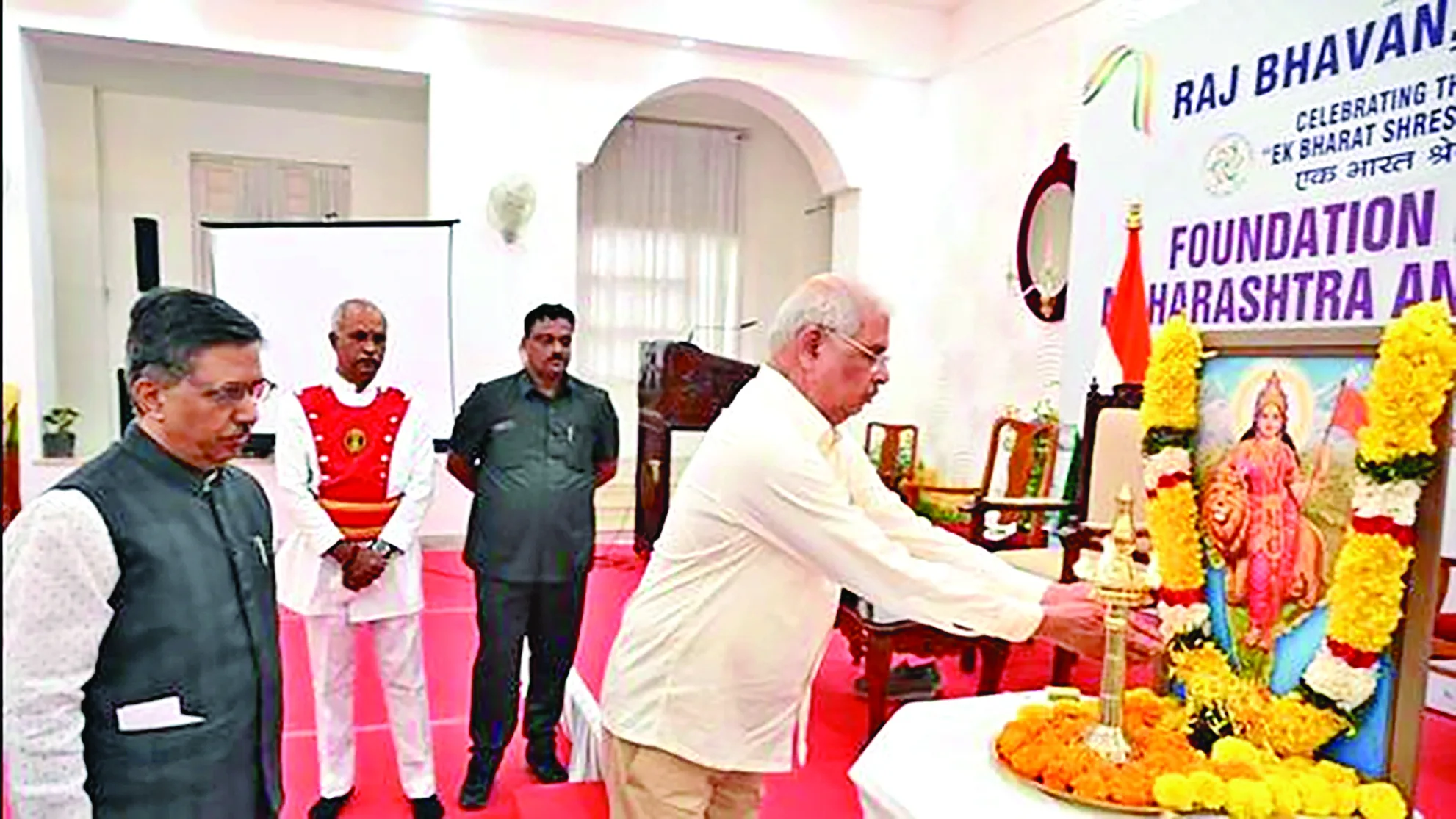
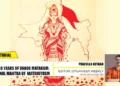
A picture of Bharat Mata, Devi form holding a saffron flag, astride a lion in the backdrop of Akhand Bharat was the picture set on the stage made to celebrate World Environment Day at Raj Bhavan, Thiruvananthapuram. The Agriculture Minister of the State of Kerala, on seeing the portrait of Bharat Mata, refused to participate in the programme. The Minister lamented the installation of a portrait of Bharat Mata as opposed to secularism as it symbolised devotion to Hindu Goddess Durga. He termed the episode ‘unconstitutional’ as it’s not authorised by the Constitution to have the picture of Bharat Mata as symbolism in a Government function. The Minister appears to be oblivious of the constitutional status accorded to Vande Mataram, where in the fourth stanza of the song depicts the picture of Durga Devi in nama roopa (verbal form) as one seated on lotus as divine consort Lakshmi, Saraswathi and Kali Mata.
Constitutional Status of National Flag
The tricolour flag of Indian National Congress was hoisted on the banks of river Ravi in December, 1929, after adoption of resolution for Poorna Swaraj at Lahore Session of Indian National Congress. The tricolour had originally red colour at its top end and charkha (spinning wheel) in the mid white portion. The Constituent Assembly, which came into being even before the Partition of India, had originally 389 members, which after Partition was reduced to 299. The Constituent Assembly, by a resolution adopted on July 22, 1947, gave recognition to the tricolour as our national flag. The red colour in the flag of Indian National Congress was changed to saffron (Kesari) and instead of charkha, the Ashoka Chakra in navy blue colour was inscribed in the middle band. When the red colour in the original flag was sought to be replaced with saffron, curious and interesting discussion on the significations of the saffron colour was witnessed by the Constituent Assembly. Mohamed Sheriff of Mysore State in his inimitable style said, “Sir, the white, the green and the saffron colours signify renunciation, purity and sacrifice. Great spiritual significance is attached to them. These colours are venerated by all persons, whether they are Hindus or Muslims or Christians or Parsis”.
Welcoming Saffron’s Inclusion in Flag
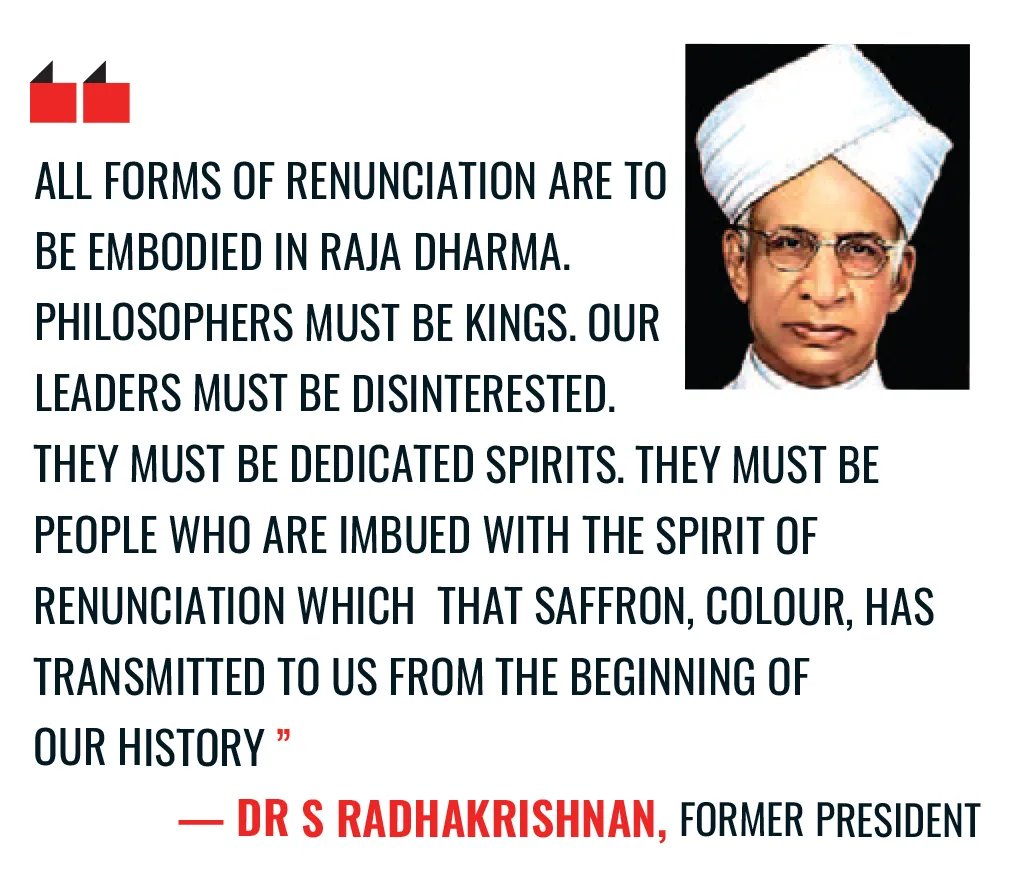
Referring to saffron colour, Dr S Radhakrishnan commented, “All forms of renunciation are to be embodied in Raja Dharma. Philosophers must be kings. Our leaders must be disinterested. They must be dedicated spirits. They must be people imbued with the spirit of renunciation which the saffron colour has transmitted to us from the beginning of our history.”
The significance of saffron colour was more soulfully explained by Sayid Mohammed Saidullah from Assam, a Muslim League member in the Constituent Assembly. Alluding to the spiritual connotations of saffron, he said, “The saffron, as is well known, is the colour of all those people who live the spiritual life not only among Hindus but also among Muslims. Therefore, the saffron colour reminds us that we should keep ourselves on that high plane of renunciation which has been the realm of our sadhus and saints, peers and pundits. Therefore I welcome the inclusion of this colour in the Flag”. (Constituent Assembly Debates, July 22, 1947). But the saffron colour is often denounced by the liberals and pseudo-intelligentsia in Bharat. The colour is dubbed as representing reactionary forces; being cited as symbolism of conservatism.
It was on January 24, 1950, that the Constituent Assembly had its concluding session. The President of the Assembly, Dr Rajendra Prasad, reminded everyone about a lingering subject, that is National Anthem and National song, which was yet to be taken up and decided. Without labouring much on the issue, he made a statement, “The composition consisting of the words and music known as Jana Gana Mana is the National Anthem of India, subject to such alterations in the words as the Government may authorise as occasion arises, and the song Vande Mataram, which has played a historic part in the struggle for Indian freedom, shall be honoured equally with Jana Gana Mana and shall have equal status with it. I hope this will satisfy the members.” Vande Mataram was composed by Bankim Chandra Chatterji and it was part of a novel penned by him. Ravindranatha Tagore has to his credit for singing the song Vande Mataram first in the Calcutta Session of Indian National Congress in 1896. Later, controversy brewed over the song over its contents as its 3rd and 4th stanzas were really the syllable form of Devi Durga, which was unpalatable to people like Jinnah. The objectionable part in its pristine translation in English by Aurobindo is; “Thou art Durga, Lady and Queen, with her hands that strike and her swords of sheen, Thou art Lakshmi lotus throned And the Muse a hundred toed.”
A committee formed by the Congress recommended only singing of the first two stanzas and omission of the rest. But when the Constituent Assembly had its call on the National song, Vande Mataram in its original form, without addition or deletion was accepted. The Durga form depicted and deified in the backdrop of Akhand Bharat is the pictorial representation of Devi found in the verbal form in Vande Mataram. Dimensional personification in pictorial form of Durga depicted in a constitutionally approved ode to Bharat Mata is no doubt in perfect sync with all constitutional ethos and proprieties so far evolved. Then why one takes an exception is not understandable.
Significance of Hindu Gods in Constitution
The calligraphic version of Constitution made by Prem Bihari Raizwada curiously contains pictorial representations of Hindu God incarnations. The triumphant journey of Ram, Sita and Lakshman to Ayodhya is picturised in the Fundamental Rights that is part of the handwritten Constitution. The Directive Principles of State Policy portion is distinctive by the drawings of Bhagavan Krishna delivering Divine instructions to Arjun in the battleground; so also part XII where cosmic dance of Nataraja is depicted. When Hindu pantheons found its pictorial presence in the manuscript of the holy Constitution, none found it as offending secularism in those days. Rather the aesthetic beauty in the hieroglyphics of God Incarnations were sensed by the religious as auguring well for them, while the secularists found it as a deep intertwining of the cultural and literary profoundness of Bharat into the holy document of governance; the Constitution of India.
A Nation has a repertoire of symbols of national importance in its kitty, where its subjects find themselves in ineffable oneness and cultural bondage. A symbolism encapsulating in itself with beautiful drawing lines, giving apparitions of Divinity in female clad, astride a lion holding a holy flag in the backdrop of a United Bharat is really the finest embodiment of Article 1 of the Constitution of India. “India, that is Bharat, shall be a Union of States”.












Comments