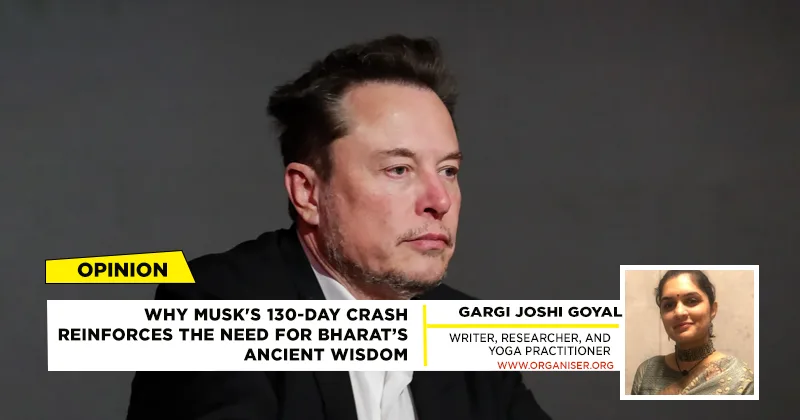
In the grand theater of global governance, few contrasts are as stark, or instructive, as Elon Musk’s hasty departure from Trump’s Department of Government Efficiency (DOGE) and India’s methodical, decade-long transformation under Prime Minister Narendra Modi. Where Silicon Valley’s “move fast and break things” ethos crashed against bureaucratic reality, ancient Indian wisdom quietly orchestrated one of history’s most comprehensive national reforms. The following analysis explains why DOGE failed and why it could have worked if Americans had a sense of Dharma.
The tale of these two approaches isn’t just about policy, it’s about dharma versus drama, patience versus impatience, and why 5,000-year-old Sanskrit verses might hold the key to 21st-century governance challenges. DOGE’s spectacular failure is a case study in Adharmic governance.
The Great DOGE Experiment: When Disruption Meets Democracy
Elon Musk’s DOGE promised to slash $2 trillion from the U.S. federal budget, a number that, tellingly, exceeded the entire discretionary spending. This mathematical impossibility revealed the first dharmic principle DOGE violated: स्वस्थान परिज्ञान (svasthāna parijñāna), understanding one’s actual position and limitations.
Vidur Niti provides the perfect framework for understanding DOGE’s inevitable failure:
“त्वरा राज्ञः सर्वनाशकरी भवेत्।धैर्यं सर्वगुणानां मूलमिति वेदविदो विदुः॥”
“Haste in a ruler leads to total destruction; patience is the root of all virtues, as knowers of the Vedas understand.”
Specific DOGE Failures:
- The 130-Day Constraint Debacle: Musk’s exit after hitting the legal limit for “special government employees” exposed fundamental ignorance of governmental processes. As Vidur warned in the Mahabharata:
“अज्ञानात् कृतकर्माणि न फलं दददते सदा।ज्ञानपूर्वक्रिया यस्य स लोके धर्मपारगः॥”
- “Actions performed in ignorance never yield proper results; one whose actions are preceded by knowledge is truly wise in dharma.”
- The $2 Trillion Mathematical Fantasy: DOGE’s target exceeded total discretionary spending, revealing what Chanakya called मूढ़ता (foolishness) in the Arthashastra:
“सङ्ख्याहीनो गणो नष्टो मन्त्रहीनो द्विजो नष्टः।नष्टो देशः पतिहीनो नष्टा स्त्री चरितत्रिहीना॥”
- “A group without proper calculation is destroyed, a Brahmin without knowledge is lost; a nation without a proper ruler is ruined, and a woman without character is destroyed.”
- Stakeholder Alienation: Musk’s public mockery of federal employees on X demonstrated complete failure in परेङ्गित परिग्रहाण (understanding others’ intentions and motivations).
- Institutional Ignorance: Suggesting the elimination of departments without understanding their constitutional mandates showed absence of नीतिज्ञान (policy wisdom).
- Bharat’s Dharmic Alternative: The Art of क्रमिक परिवर्तन (Gradual Transformation)
Case Study 1: The GST Revolution (2016-2019) vs. DOGE’s Tax Fantasy
While DOGE promised overnight federal restructuring, India executed history’s largest tax reform through समन्वय दृष्टि (harmonious vision):
India’s Dharmic Approach:
- 3 years of constitutional preparation
- Multiple stakeholder consultations across 29 states
- Gradual rate rationalization based on ground feedback
- Technology infrastructure built patiently over years
Result: A unified tax system covering 1.4 billion people, increasing tax compliance from 6.8 million to 14+ million taxpayers.
DOGE’s approach: Mathematical impossibilities announced without stakeholder consultation or constitutional understanding.
Chankya notes: “नीतिः शास्त्रात् प्रवर्तते वृत्तिः शील्तो निवर्तते।वृत्तिकर्मविहीनस्य न राज्यं न च जीवनम्॥”
“Policy emanates from scriptures, conduct from character; one devoid of proper conduct and action can neither rule effectively nor live meaningfully.”
Case Study 2: Digital India (2015-2025) vs. DOGE’s Digital Disruption Dreams
India’s सरसता (Gentleness) in Digital Transformation:
- JAM Trinity (Jan Dhan-Aadhaar-Mobile): 10-year patient integration
- UPI ecosystem: Gradual merchant adoption, now processing 13+ billion transactions monthly
- Digital literacy campaigns reaching rural areas with sensitivity
DOGE’s approach: Proposing elimination of departments managing critical digital infrastructure without understanding interdependencies.
Mahatma Vidur explains the difficulties in implementing technological changes:
“यथा हि एकेन चक्रेण न रथस्य गतिर्भवेत्।एवं पुरुषकारेण विना दैवं न सिध्यति॥”
“Just as a chariot cannot move with only one wheel, divine destiny cannot be fulfilled without human effort.”
Case Study 3: Farm Law Recalibration (2020-2021) vs. DOGE’s Bulldozer Mentality
India’s स्वार्थ नियमन (Self-Interest Management):
- Recognition of farmer concerns despite policy merit
- Complete withdrawal showing विनम्रता (humility)
- Demonstration that governance requires स्वाभिमान (self-respect) balanced with लोकहित (public welfare)
PM Modi’s statement exemplified dharmic leadership: “Maybe something was lacking in our efforts (tapasya) that we could not convince some farmers.”
DOGE’s approach: No mechanism for course correction, no humility in approach, no stakeholder feedback integration.
Arthashastra expounds upon the importance of Policy Flexibility:
“कालदेशौ हि कर्तव्ये विवेकः सम्प्रवर्तते।विवेकहीनः कुर्वाणो नियतं विनशिष्यति॥”
“Wisdom manifests in considering time and place before action; one who acts without discrimination will certainly perish.”
To summarize Bharat has been successful in its reforms because it followed Dharmic principles (while DOGE was not)-
1. स्वस्थान परिज्ञान: Constitutional Consciousness vs. Ego-Driven Overreach
- India’s Success: Understanding federal structure in GST implementation
- DOGE’s Failure: Ignoring separation of powers and constitutional limits
2. परेङ्गित परिग्रहाण: Stakeholder Empathy vs. Silicon Valley Arrogance
- India’s Success: Farmer law withdrawal after understanding genuine concerns
- DOGE’s Failure: Mocking federal employees instead of understanding their roles
3. स्वार्थ नियमन: National Interest vs. Personal Branding
- India’s Success: Vaccine diplomacy balancing global good with national needs
- DOGE’s Failure: Using government position for personal publicity and brand building
4. समन्वय दृष्टि: Cooperative Federalism vs. Centralized Disruption
- India’s Success: NITI Aayog model replacing top-down Planning Commission
- DOGE’s Failure: Attempting federal restructuring without state consultation
5. सरसता: Gentle Implementation vs. Shock Therapy
- India’s Success: Ayushman Bharat’s gradual healthcare expansion
- DOGE’s Failure: Proposing departmental eliminations without transition planning
Ancient Wisdom for Modern Challenges: The Vedantic Leadership Model
Unlike Western leadership theories focused on quarterly results, Vedantic governance emphasizes चिरकालिक हित (long-term welfare). As the Bhagavad Gita teaches:
“कर्मण्येवाधिकारस्ते मा फलेषु कदाचन।मा कर्मफलहेतुर्भूर्मा ते सङ्गोऽस्त्वकर्मणि॥”
“You have the right to perform action, but never to the fruits thereof; do not be motivated by results, nor be attached to inaction.”
This principle, Nishkama Karma, directly contradicts Silicon Valley’s obsession with immediate, measurable outcomes.
Chanakya’s Arthashastra provides a blueprint that makes Harvard Business School case studies look elementary:
“प्रजासुखे सुखं राज्ञः प्रजानां च हिते हितम्।नात्मप्रियं हितं राज्ञः प्रजानां तु प्रियं हितम्॥”
“The ruler’s happiness lies in the happiness of subjects; in their welfare lies his welfare. What pleases the ruler personally is not beneficial; what pleases the subjects is truly beneficial.”
West has an obsession for ‘Need for Speed’. Modern leadership suffers from what ancient texts call राजसिक प्रवृत्ति (rajasic tendencies), excessive activity without wisdom. Vidur Niti warns:
“अत्यधिकगतिर्राजा न शुभाय कल्पते।मध्यमा गतिरुत्तमा गतिः पण्डितमन्यते॥”
“A ruler with excessive speed brings no good; moderate pace is considered the best approach by the wise.”
The Innovation Paradox: Why Ancient Wisdom Enables Modern Progress
India’s post-2014 transformation demonstrates that dharmic principles don’t hinder innovation, they enable sustainable innovation:
- UPI Innovation: Patient ecosystem building created world’s most advanced payment system
- Space Technology: ISRO’s methodical approach achieved Mars mission at lower cost than a Hollywood movie
- Pharmaceutical Leadership: Gradual capacity building made India the “pharmacy of the world”
The Dharmic Governance Toolkit for Global Leaders
For Political Leaders
- Embrace Constitutional Dharma: Understand institutional limits before attempting reform
- Practice Stakeholder Satyagraha: Patient consensus-building over forceful imposition
- Develop Timeline Wisdom: Match reform pace to institutional capacity
For Business Leaders
- Long-term Value Creation: Move beyond quarterly capitalism to sustainable growth
- Stakeholder Harmony: Balance shareholder returns with employee and community welfare
- Cultural Sensitivity: Understand local contexts before global expansion
For Policy Makers
- Evidence-Based Gradualism: Test policies in limited areas before nationwide rollout
- Feedback Integration: Build mechanisms for course correction without ego
- Institutional Respect: Work within existing systems while gradually improving them
The Eternal Relevance of Dharmic Governance
As we witness the spectacular rise of Bharat and the chaotic governance experiments elsewhere, the words of the Mahabharata ring prophetic:
“धर्मेण हीनाः पशुभिः समानाःधर्मेण तुल्याः स्वर्गयाणि कर्माणि।धर्मस्य मूलमिदं सर्वम् जगत्तस्मात् धर्मं न परित्यजेत्॥”
“Without dharma, humans are equal to animals; with dharma, their actions become heavenly. Dharma is the foundation of this entire universe; therefore, dharma should never be abandoned.”
The lesson of Musk’s DOGE exit isn’t just about one man’s governmental failure, it’s about the fundamental choice between तत्काल सफलता (immediate success) and शाश्वत प्रगति (eternal progress).
India’s patient, dharmic approach to governance offers the world a tested alternative to the chaos of disruption-obsessed leadership. In an age of instant gratification, perhaps the most radical innovation is the ancient wisdom of धैर्य (patience), विवेक (discrimination), and लोकसंग्रह (world maintenance).
As global challenges from climate change to economic inequality demand sustained, thoughtful responses, the dharmic governance model becomes not just relevant but essential. The question is not whether the world will adopt these principles, it is whether it will do so before or after learning them the hard way.
Yato dharma, tato jaya, where there is dharma, there is victory. The mathematics of governance, it turns out, are as eternal as they are practical.
(This article is summarised by the writer from her X postings)
(The Author is a Writer, researcher, and Yoga practitioner. Express views on Sanatan Dharma and Bharat’s rich legacy)