





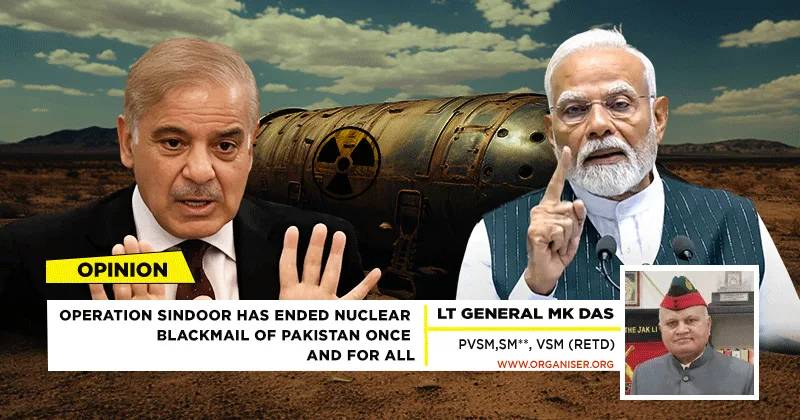
During his address to the nation on May 12 evening, Prime Minister Narendra Modi asserted that India will not tolerate any ‘nuclear blackmail ‘from Pakistan. After the barbaric terror attack in Pahalgam on April 22, which left 26 innocent tourists, mostly Hindus, dead, Pakistan once again raised the nuclear bogey, fearing retaliation from India. But with the first strike on May 7 which led to precise missile and drone strikes on nine terror hubs of Pakistan, resulting in elimination of more than 100 terrorists, India effectively silenced the nuclear bluff of Pakistan. The terror hubs included aerial missile strikes on Bahawalpur and Muridke, deep inside Pakistan mainland. PM Modi described Operation Sindoor as the ‘New Normal’ in India’s policy towards terrorism, in which no country can take refuse by threatening use of nuclear weapons against India. In effect, with such policy stance, India has called the nuclear bluff of Pakistan, for once and all.
Pakistan’s nuclear weapons programme was launched by then Prime Minister in 1972, after defeat from India in the 1971 war that led to loss of East Pakistan and birth of Bangladesh. After India’s nuclear test in Pokhran in 1974, Pakistan gave extra impetus to develop its own nuclear programme. Dr AQ Khan joined the nuclear programme of Pakistan in the end of 1974 and he is believed to have sourced fissile material by clandestine means. It is believed that Pakistan had acquired the capability to detonate a nuclear weapon by the end of 1984. Pakistan has continued with clandestine means to further its nuclear capability and assist some rogue nations too.
Once India tested nuclear weapons in May 1998 (Operation Shakti) under the regime of Prime Minister Vajpayee, Pakistan also carried out nuclear detonations in the last week of May 1998. Thus, Pakistan became an official nuclear weapons nation in the last week of May 1998. It is believed that Pakistan has acquired almost the same number of nuclear warheads as India, mostly with the nexus of China and North Korea. It is also believed that Pakistan has also supplied sensitive nuclear technology to Iran and Libya. From the very beginning, India has followed the ‘No First Use (NFU) Doctrine of nuclear weapons’ which includes a pledge not to use nuclear weapons first. India has strictly upheld this policy of nuclear deterrence as a responsible nuclear power.
Pakistan on the other hand has discarded the NFU Doctrine and in the recent years has talked of a military strategy that promotes deterrence by guaranteeing an immediate ‘massive retaliation’ to an aggressive attack against the state. It means that Pakistan is ready to use nuclear weapons in case of a conventional attack against it. Even during the current conflict with India, Pakistani leadership warned of using any weapon in its arsenal, including nuclear weapons, to defend itself. This nuclear doctrine is essentially of a nuclear blackmail against India, knowing that India would keep the response well below the nuclear threshold.
In order to overcome India’s conventional war superiority, Pakistan developed ‘Tactical Nuclear Weapons (TNWs)’, particularly in more aggressive manner, after defeat in the Kargil War of 1999. Pakistan has developed tactical nuclear weapons, which are short range, battlefield-oriented and relatively low yield nuclear weapons. These weapons are designed for use against military targets closer to the border, as against strategic nuclear weapons which are to be used against targets, located deep inside the Indian territory. Thus, Pakistan was able to give more weight to its nuclear blackmail through the bluff of using TNWs, whenever India attempted a major conventional strike against it.
India was constrained to strike against Pakistan, limiting itself to Pak Occupied Jammu & Kashmir (POJK), as it happened after Uri strike of 2016 and Pulwama of 2019. This time around, India called the nuclear bluff of Pakistan, by striking against known terror hubs in Bahawalpur and Muridke on 7 May. When Pakistan escalated the conflict, India struck eight strategic airfields of Pakistan, right from Sargodha to Sialkot, with precision strikes. India also targeted the radar facilities and air defence infrastructure of Pakistan, effectively neutralising the imminent threat of employing TNWs by Pakistan.
Being a rogue nation that it is, Pakistan has been a major challenge for the international community, particularly the Americans, to ensure that Pakistan fulfills the mandatory obligations regarding nuclear weapons. Unlike India, where the military functions under the civilian control, Pakistan Army virtually controls the civil government in Pakistan. So, essentially the nuclear trigger is in the hands of Pakistan Army Chief. That makes the situation grave, in case of conflict between India and Pakistan. The threat of TNWs adds another dimension to the vulnerability of Pakistan, particularly under a radical Army Chief like Asim Munir. Shri Rajnath Singh, the Raksha Mantri also raised his concern on 15 May stating that Pakistan is a rogue nation with nukes and it must be under International Atomic Energy Agency (IAEA).
Another concern about nuclear weapons programme of Pakistan has been about its capture by the jihadi elements operating actively in the country. In order to take its policy of state sponsor of terrorism, Pakistan has given refuge to a number of Islamist terrorist organisations. These terrorist organisations have been eyeing the TNWs of Pakistan to destroy all those who oppose the Islamic caliphate. Since we have seen some highly qualified engineers and technology-oriented people joining the terror organisations (as evident in 9/11 attacks), such people can hijack the TNWs held with Pakistan. In fact, Pakistan has been able to blackmail the US to obtain huge financial aid with the promise of fighting such terrorists and keeping its nukes safe.
The world at large has now understood the gameplan of Pakistan. After Pahalgam terror attack of 22 April, there was global condemnation of Pakistan. India was able to isolate Pakistan diplomatically and thus it enabled Indian political leadership to direct Indian armed forces against the terror hubs in Pakistan, without bothering about the consequences of nuclear blackmail. When Pakistan escalated the conflict, India used long range missiles including BrahMos to target the strategic targets, deep inside Pakistan. The calibrated response of India, which only targeted the terror pads and military infrastructure of a nation that supports terror made Pakistan buckle and plead ceasefire. India, once again exhibited mature conduct and only paused the operations to give Pakistan another chance to dismantle terror infrastructure. India’s such measured response has thus ended the nuclear blackmail of TNWs from Pakistan.
There are unconfirmed media reports about the presence of nuclear emergency support aircraft B350 AMS of the US in Pakistan. In my opinion, this must be a Standard Operating Procedure (SOP) of the US whenever there is a conflict situation in Pakistan. Massive craters reportedly have been observed near the hills surrounding the Pakistan Nur Khan airbase, which is believed to house Pakistan’s nuclear bombs. Even if these inputs are totally incorrect, then also it assists India in calling the nuclear bluff from Pakistan. India has demonstrated its military ability to strike any part of Pakistan, with precision and lethality. Thus, Pakistan will have to be extra careful with its nukes in the future.
India now has to urge the global community to ensure proper audit of Pakistan’s nuclear arsenal and its safety protocols. India has to force Pakistan through the collective might of global world to revert to its nuclear deterrence to the NFU doctrine like India and become a responsible nuclear weapons state. Even economic and diplomatic sanctions against Pakistan should be imposed. IMF loan to Pakistan has been made conditional and the international agencies should strictly monitor the checks on Pakistan. India has achieved this remarkable feat of settling the nuclear blackmail of Pakistan, for once and all. Now it is up to the global community to make Pakistan a responsible nuclear weapons state, in the interest of universal peace.














Comments