





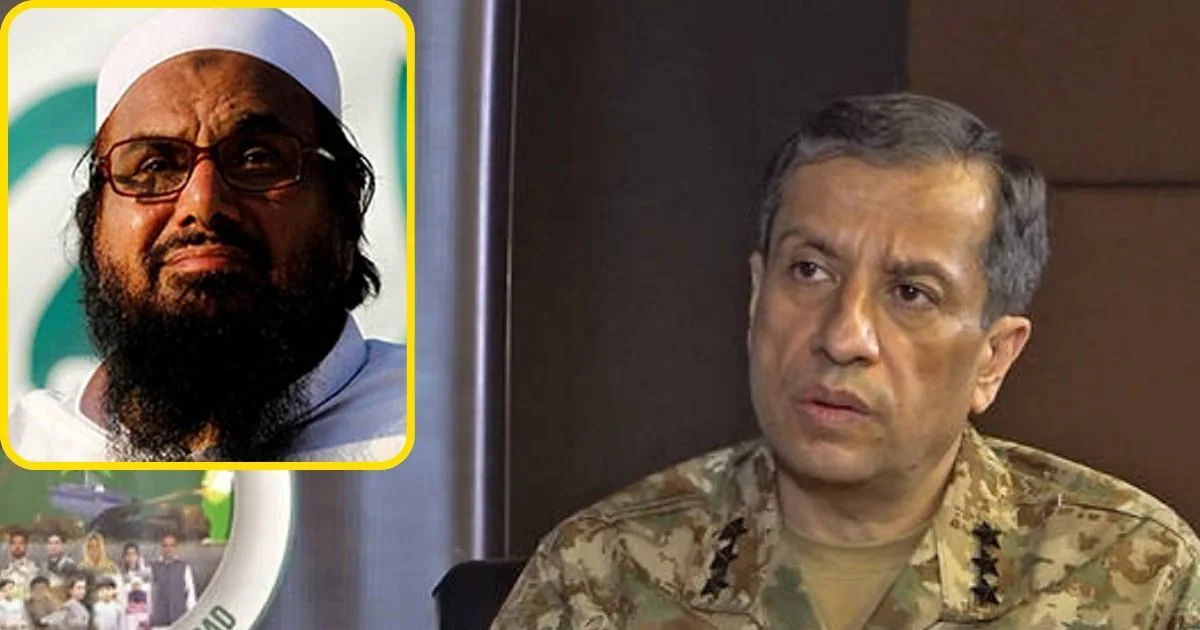
In a controversial and provocative statement, Pakistani military spokesperson Lieutenant General Ahmed Sharif Chaudhry issued a direct threat to India over the suspension of the Indus Waters Treaty (IWT), invoking language that closely mirrors the rhetoric of proscribed terrorist Hafiz Saeed.
Speaking at a university in Pakistan, Lt Gen Chaudhry commented on India’s recent move to suspend key provisions of the IWT following the April 22 terror attack in Pahalgam. Addressing the audience, he remarked: “If you stop our waters, we’ll choke your breath” (translated from Hindi: “Tum humara paani rok doge toh hum tumhara saans band kar denge”).
Here is Hafiz Saeed saying the same thing : pic.twitter.com/SLBV5ODojR
— Taha Siddiqui (@TahaSSiddiqui) May 22, 2025
The statement, laced with open hostility, immediately drew comparisons with past speeches by terrorist Hafiz Saeed, the founder of Lashkar-e-Taiba and alleged mastermind of the 2008 Mumbai terror attacks. Saeed, currently serving a jail sentence in Pakistan, has long been known for his incendiary speeches against India and the United States. His aggressive rhetoric has been a hallmark of his public appearances and propaganda efforts.
Lt Gen Chaudhry’s remarks come at a time of heightened tensions between the two nuclear-armed neighbours, following the brutal terror strike in Pahalgam, Jammu & Kashmir, in which several Indian security personnel were martyred. Holding Pakistan responsible for harbouring and facilitating terrorist infrastructure, India responded with a series of diplomatic and military measures aimed at isolating Islamabad.
On April 23, just a day after the Pahalgam attack, India announced the decision to suspend its cooperation under the Indus Waters Treaty, a landmark 1960 agreement brokered by the World Bank that governs the sharing of the Indus River and its five tributaries — Sutlej, Beas, Ravi, Jhelum, and Chenab — between the two countries. The treaty also mandates regular technical exchanges of hydrological data between India and Pakistan.
Reiterating its long-standing policy, New Delhi maintained that “blood and water cannot flow together”, a phrase often used by Indian leadership to stress that peace and cooperation are incompatible with acts of terror.
In addition to pausing its obligations under the treaty, India shut down operations at the Integrated Check Post (ICP) at Attari border, halting bilateral trade and people-to-people movement. The escalation continued with the launch of Operation Sindoor on May 7, during which the Indian military targeted nine terror-linked sites in Pakistan and Pakistan-Occupied Kashmir (PoK).
The Pakistan military’s institutional mindset has often been linked to a strong religious ideology, particularly since the era of General Zia-ul-Haq, who shifted the army’s motto to “Iman, Taqwa, Jihad fi Sabilillah” (Faith, Piety, Struggle in the Name of God). This ideological orientation is reflected in its use of militant groups to advance foreign policy goals, particularly in Kashmir and Afghanistan, fostering a perception of the military as intertwined with jihadist elements.
This mindset blurs the line between state forces and non-state actors like Lashkar-e-Taiba and Jaish-e-Mohammed, with the military’s rhetoric often emphasising religious struggle over secular objectives. A clear manifestation of this came from Lt Gen Ahmed Sharif Chaudhry, Director General of Inter-Services Public Relations, who stated during a 2025 press briefing, “Islam is part of not only the belief of each one of us but part of our training. It is part of our faith. Iman, taqwa, jihad fi sabilillah—that’s what drives us, that’s our motto.”
















Comments