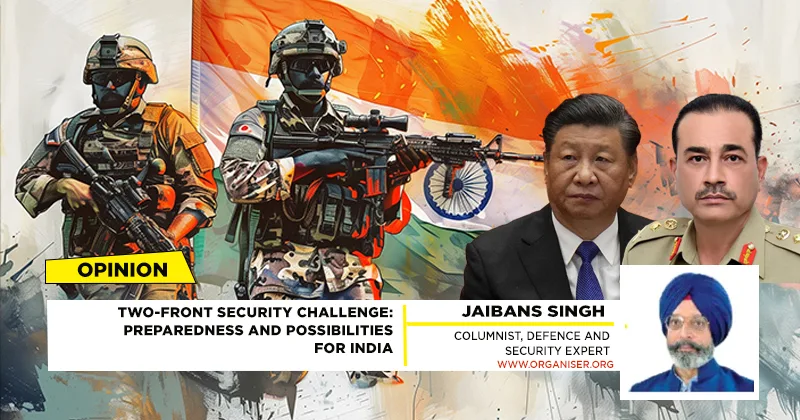
The Indian response to the reprehensible terrorist attack in Pahalgam, Kashmir on April 22, 2025 in the form of Operation Sindoor has created a new strategic red line in the south Asian sub-continent that has been clearly enunciated by Prime Minister Narendra Modi in his assertion that, “every act of terror will be treated as an act of war,” and “equal punishment to terrorists and their sponsors.” The Indian posture based on strong legal and moral grounds and explicit assertion of sovereignty is a blend of strength and restraint.
The assertion made by Prime Minister Modi implies that in the event of a terrorist strike on Indian soil, India will carry out a complete security assessment and keep all options of retaliation open including deep strikes into Pakistani territory. This apart, India has set strong economic and diplomatic caveats including a posture of no trade, no talks and no water sharing agreements if proliferation of terrorism from Pakistan continues.
The best option in the existing situation would be for Pakistan to understand that in attempting to apply its policy of a “thousand cuts to India,” it has brought itself on the brink of extinction and now is the best time to shed the policy and move on. Sadly, there are enough radical and notorious elements in the country who strongly contest abdication of the anti-India policy. India, therefore, needs to remain vigilant and ready at all times.
The recent conflict was essentially new-age stand-off attacks paradigm with the use of drones, missiles and artillery fire. It clearly exhibited weaknesses in Pakistani defences that failed to stall precision missile attacks by India on pre-selected targets over two days. Indian defences, on the other hand, successfully countered drone and missile attacks by Pakistan thus exhibiting India’s growing defence capabilities and advancements in defence technology.
While India predominantly put to use indigenous technology like the Akashteer air defence system, Brahmos cruise missile and Kamikaze drones, Pakistan depended only on foreign equipment, mainly Turkish and Chinese, to launch its attacks.
It also emerged that the two supplier countries firmly stood with Pakistan’s misadventure without any thought to global opinion and principles of sovereignty, justice and righteousness. It can, therefore, be safely assumed that these countries will stand with Pakistan in the future too, not only diplomatically but also with the supply of military wherewithal.
The Two-Front War Challenge
India needs to stay prepared to face a two and a half front challenge in future conflict to include a front against Pakistan and China simultaneously along with internal dissension in the form of proxy war, insurgency and terrorism within India. Such a scenario has been acknowledged by top Indian military commanders and strategists. The Indian Army Chief, General Upendra Dwivedi termed the strategic coordination between China and Pakistan as “near absolute collusivity.” “What it means, as far as I am concerned, is that the two-front threat is a reality,” he warned. The political leadership of the country does not publicly speak of the same but would certainly be alive to the challenge.
Strength of China-Pakistan Nexus
A few numbers are given below to establish a broad understanding of the comparative strength of the three armies.
India has been ranked as the fourth strongest military in the world, just after China. China is the biggest spender on defence in Asia with an allocated budget of $229 Billion in the financial year 2023-2024 as against the Indian allocation of $73.9 Billion (less than half of China). The Pakistan budget was $11 Billion. China being a closed state may have spent much more than what was declared, possibly double the amount.
• In the strength of the armed forces China has 2.03 million active personnel and Pakistan 6.670 lakh against Indian 1.4 million.
• In major equipment China has 5,250 tanks while Pakistan has another 2500 and India 4500. China has 1900 aircraft, Pakistan 350 (mostly Chinese) and India 600.
• All three countries have a viable missile arsenal and nuclear warheads.
• China’s J-20 Chengdu is its fifth-generation stealth fighter. India only has 4.5 generation fighters like Rafale and
Tejas MK1A won’t be a fifth generation
India has 38 divisions, organised under 14 Corps. By simple military calculation the requirement for a two front challenge is minimum 43 divisions just for defence on both the borders, with no capability of launching even a limited offensive. The situation is no better with the Indian Air Force, which is down to 30 squadrons of fighter aircraft when it needs at least 50 squadrons.
The data given above is only an indicator of the relative strength at a macro level designed to prove the point that the combined forces of Pakistan and China would roughly be twice the size of the Indian strength. India will also have to engage in conflict over a combined border stretching to 6800 kms over mountain, jungle, plains and desert terrain.
Indian Strength
Tactically, there are a few aspects that favour India. Large portions of Chinese troops are not stationed at high altitudes. It has limited military personnel in Tibet, while the rest are deployed in the Xinjiang, Sichuan and Chongqing regions. The Chinese Air Force (PLAAF) has fewer fighter jets positioned in Tibet as compared to the IAF in Ladakh. China will therefore have to resort to speedy deployment which in high altitude can cause considerable loss of fighting ability.
India’s biggest advantage is the battle-hardened troops, whose inherent courage, training and professionalism can carry the day against insurmountable odds.
Over the last decade, India is making rapid strides in military indigenisation and production of world class weaponry. India is a leader in electronics and missile systems and will need to extend this proficiency to military use of Artificial Intelligence also.
The government has also paid a lot of attention to the build-up of border roads and infrastructure. This will facilitate rapid movement of troops that is the most urgent need for the war on multiple fronts.
Meeting the Two-Front Challenge
In keeping with the Indian defence policy of no territorial loss, defence experts recommend division of the battle space into a primary front and secondary front. There will be a major deployment on the primary front while the secondary front will only have a deterrent posture. The Indian Army has formations which can quickly be moved from the east to west or vice-versa.
The nuclear threshold will need an unambiguous articulation. Under extreme circumstances created by evil and inimical forces the high pedestal “no first use policy” needs a serious rethink. This would also create a need to go for production of tactical nuclear devices with employment freedom given at the tactical level. Such an approach would severely impact the war fighting capability of the adversary.
The basic requirement has been summed up by General Upendra Dwivedi. “Security is about wholesome capability to wage war and deter war. Healthy military-civil fusion, Aatmnirbhar defence industrial base, dual-use assets at the national level, well-informed and empowered decision-makers of DIME framework, and an inclusive approach for citizen warriors play a pivotal role,” he said. Nothing more needs to be added.
In the event of a two front war, India will need to firmly establish her principled stand. Chinese arbitrary dismissal of any rules-based system needs to be highlighted in order to build a correct picture of the global insecurities that would emerge if the conflict goes in the favour of the twin aggressors.
India will have to forge effective alliances at the global level. The country needs to build an international standing for which an immediate call for reforms to make the United Nations more inclusive and in tune with existing realities. The gross human rights violation that both Pakistan and China are blatantly indulging in needs to be thrust into the collective global psyche aggressively.
The Half-Front Challenge
In the course of operation Sindoor, Pakistan suffered tremendous damage, all of which is recorded. The country did not acknowledge the same, instead, it went into a celebration frenzy for having defeated India. It defined the conflict as a revenge of the 1971 debacle. A list of targets destroyed including five fighter aircraft was presented not only to the people but to the whole world with exemplary media confidence. The Army Chief, General Asim Munir, was promoted to the rank of Field Marshal to draw a parallel with India in 1971 when a similar honour was bestowed upon Field Marshal SHFJ Manekshaw. The nationalism, confidence and of course the ability to turn fake news into an asset was palpable in Pakistan’s media initiative.
Despite securing a decisive victory that set a new benchmark of next generation warfare, India remained muted and unsure. The opposition parties grudgingly extended full support to the government when the operation was underway only to pull out the rug the moment it culminated. Questions were asked about the losses suffered and selling off to foreign powers in the declaration of ceasefire was insinuated. The list of woes and doubts expressed is endless. The doubts were highlighted by a toxic social media campaign. The BJP carried out “Tiranga Yatras” across India while the opposition parties made no effort to honour the Armed Forces.
The Pakistani exuberance, confidence and faith in its cause, its government and its army as compared to Indian cynicism and negativity has the potential of creating a psychological advantage for the enemy which can tilt the tables against India. China is even better than Pakistan in this aspect.
The serious cracks in the national fabric that have will seriously impinge upon Indian war fighting capability. This adds a new, huge and very serious dimension to challenge of internal dissension. It has been established that fake news and social media can play havoc in the country’s war fighting capability. There is an urgent need to curb such divisive tendencies. The requirement is to build a more mature polity that understands its responsibilities in times of military emergency; this process can be augmented with effective legislation.
The two and a half front war is a security challenge that India can neither ignore nor wish away. Even as our defence forces continue to prepare themselves for the same with the active support of the government, it is the whole of nation approach that will ultimately prevail upon the enemy. Nobody can ignore the collective will of 1.5 Billion people.
Our issue with Pakistan is proliferation to terrorism in our country. Terrorism cannot find feet without the support of the local populace. We should, therefore, be looking at building internal strength before pointing fingers at others.
The Pakistan Army and the feudal immoral leadership of the country are the real enemies of India. The people of the country are, in fact, as much victims of this evil nexus as India. The thrust therefore should be towards complete destruction of the Pakistan Army in its existing radical avatar and its replacement with a moderate professional organisation that functions under a legitimate political authority for the sake of national interest.
The nation should re-acquaint itself with the Prithvirtaj Chauhan syndrome. The powerful King defeated Mohammad Ghori conclusively several times but did not destroy him completely. Post-Independence India has also conclusively defeated Pakistan seven times but has remained shy of destroying this enemy completely. This is a fatal error that needs rectification at the earliest opportunity. The cost will have to be paid by the involved generation for the sake of future generations.