IMF warns debt-ridden US: Every American owes 3118, total soars to 36.2 trillion dollars; Nation runs on printing money
June 12, 2026
  • Read Ecopy
  • Circulation
  • Advertise
  • Careers
  • About Us
  • Contact Us
Android AppiPhone AppArattai
Organiser
  • ‌
  • Bharat
    • Assam
    • Bihar
    • Chhattisgarh
    • Jharkhand
    • Maharashtra
    • View All States
  • World
    • Asia
    • Europe
    • North America
    • South America
    • Africa
    • Australia
  • Editorial
  • International
  • Opinion
  • RSS @ 100
  • More
    • Op Sindoor
    • Analysis
    • Sports
    • Defence
    • Politics
    • Business
    • Economy
    • Culture
    • Special Report
    • Sci & Tech
    • Entertainment
    • G20
    • Azadi Ka Amrit Mahotsav
    • Vocal4Local
    • Web Stories
    • Education
    • Employment
    • Books
    • Interviews
    • Travel
    • Law
    • Health
    • Obituary
  • Subscribe
    • Subscribe Print Edition
    • Subscribe Ecopy
    • Read Ecopy
  • ‌
  • Bharat
    • Assam
    • Bihar
    • Chhattisgarh
    • Jharkhand
    • Maharashtra
    • View All States
  • World
    • Asia
    • Europe
    • North America
    • South America
    • Africa
    • Australia
  • Editorial
  • International
  • Opinion
  • RSS @ 100
  • More
    • Op Sindoor
    • Analysis
    • Sports
    • Defence
    • Politics
    • Business
    • Economy
    • Culture
    • Special Report
    • Sci & Tech
    • Entertainment
    • G20
    • Azadi Ka Amrit Mahotsav
    • Vocal4Local
    • Web Stories
    • Education
    • Employment
    • Books
    • Interviews
    • Travel
    • Law
    • Health
    • Obituary
  • Subscribe
    • Subscribe Print Edition
    • Subscribe Ecopy
    • Read Ecopy
Organiser
  • Home
  • Bharat
  • World
  • Operation Sindoor
  • Editorial
  • Analysis
  • Opinion
  • Culture
  • Defence
  • International Edition
  • RSS @ 100
  • Magazine
  • Read Ecopy
Home World North America USA

IMF warns debt-ridden US: Every American owes 3118, total soars to 36.2 trillion dollars; Nation runs on printing money

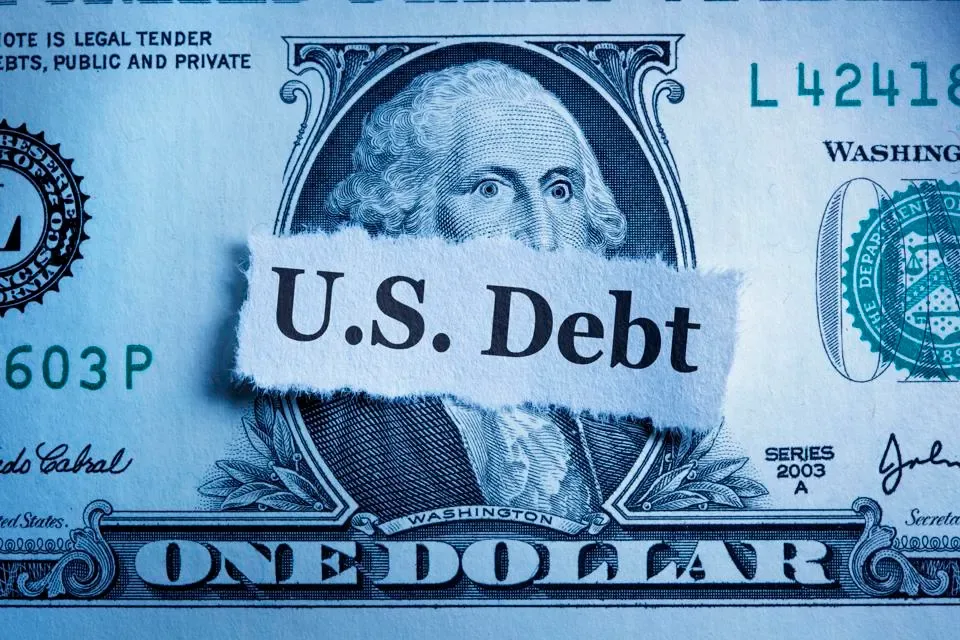
The United States is grappling with an unprecedented fiscal crisis, with its national debt soaring to 36.2 trillion dollars, equating to roughly 3118 dollars per citizen, as the nation increasingly relies on borrowing and monetary expansion

WEBDESKWEBDESK
May 22, 2025, 11:00 am IST
in USA, World
Follow on Google News
U.S. Sustains Itself With Debt and Dollars, but For How Long?

U.S. Sustains Itself With Debt and Dollars, but For How Long?

FacebookTwitterWhatsAppTelegramEmail

The United States is grappling with a fiscal crisis of unprecedented proportions, with its national debt set to surpass historical records in the coming years. At the end of 1945, following the economic strains of the Great Depression and World War II, the U.S. national debt briefly exceeded the size of its entire economy, reaching a debt-to-GDP ratio of approximately 106 per cent. According to projections from the Congressional Budget Office (CBO) released in January 2025, this record is likely to be broken by 2032, with the debt-to-GDP ratio projected to reach 117 per cent by 2034 under current laws.

However, the proposed Republican tax and spending megabill could accelerate this timeline, pushing the debt to 129 per cent of GDP by 2034, according to estimates from the Committee for a Responsible Federal Budget (CRFB).

Historical Context and Current Trajectory of U.S. National Debt

Historically, high U.S. debt levels have been associated with major crises such as wars, recessions, or pandemics. The post-World War II debt peak was a direct result of massive wartime spending. Similarly, debt surged during the 2008 financial crisis, the wars in Iraq and Afghanistan under President George W. Bush, and the COVID-19 pandemic under Presidents Donald Trump and Joe Biden.

However, the current escalation in debt is occurring during a period of relative economic stability, with low unemployment and no major wars or recessions. This anomaly is driven by persistent federal deficits, as government spending has consistently outpaced tax revenues over the past two decades.

As of January 2025, the U.S. national debt stands at over 36.2 trillion dollars, with a debt-to-GDP ratio of approximately 122.5 per cent, making it the eighth highest globally, according to the International Monetary Fund (IMF).

The CBO projects that without changes to current fiscal policies, the federal debt will climb to 49.6 trillion dollars by 2034, equivalent to 118 per cent of GDP, surpassing the 1945 record. The Republican megabill, which includes extending the 2017 Tax Cuts and Jobs Act, expanding tax cuts, and increasing military spending, could exacerbate this trend. The CRFB estimates that if the bill’s temporary tax provisions are made permanent, the debt could reach 129 per cent of GDP by 2034. Even if some tax cuts expire as written, the debt is still projected to hit 125 per cent of GDP.

More alarmingly, the Centre for American Progress, a liberal research group, forecasts that if all provisions are extended permanently, the debt could balloon to nearly 200 per cent of GDP by 2055, compared to 156 per cent under current law.

The rising cost of servicing this debt is a significant concern. In 2024, net interest payments on the federal debt reached 870 billion dollars, surpassing expenditures on both the military and Medicare. Elevated interest rates, which have risen from 1.1 per cent on 10-year Treasury securities in 2021 to a high of 5.0 per cent under the Biden administration, have increased borrowing costs. This trend, coupled with higher deficits, has prompted Moody’s to downgrade its assessment of U.S. government debt in 2025, citing the growing debt burden and increased risk of default.

U.S. Tariffs on India and India’s Reciprocal Response

Amid these fiscal challenges, the U.S. has implemented trade policies that could further complicate its economic landscape, including reciprocal tariffs introduced on April 2, 2025, targeting over 50 countries, including India. Reciprocal tariffs are designed to match the tax rates imposed by other countries on U.S. goods, aiming to protect domestic industries and pressure trading partners to lower their tariffs.

For India, which accounts for approximately 18 per cent of its 437 billion dollars in merchandise exports to the U.S. (valued at 78.66 billion dollars in FY 2023-24), these tariffs primarily affect sectors such as automobiles and electronics. The U.S. argues that these tariffs address perceived trade imbalances, but they risk escalating into trade wars, as seen in previous U.S.-China trade disputes.

India, in response, has imposed retaliatory tariffs on U.S. goods, mirroring the U.S. approach to ensure fairness in trade. These reciprocal tariffs target American products such as agricultural goods, chemicals, and machinery, aiming to offset the impact of U.S. tariffs on Indian exports. India’s economy, which is projected to grow at 6.7–6.8 per cent over the next two years, is less reliant on exports compared to other nations, with domestic demand driving much of its growth. S&P Global Ratings notes that India’s domestically oriented economy mitigates the impact of U.S. tariffs, estimating minimal disruption to its GDP growth.

The Irony of U.S. Economic Lectures to India

Despite its mounting debt crisis, the U.S. has often positioned itself as a global economic arbiter, offering critiques and policy recommendations to nations like India. U.S. officials and institutions, including the IMF and World Bank, have historically advised India on fiscal discipline, structural reforms, and economic liberalisation.

For instance, IMF Article IV consultations with India in 2023 emphasised fiscal consolidation and debt management, even as India’s economy demonstrated resilience with a government debt-to-GDP ratio of 89.26 per cent in 2023, significantly lower than the U.S.’s 122.5 per cent. India’s external debt stood at 629.1 billion dollars in 2023, a manageable figure relative to its 3.4 trillion dollars GDP, and its fiscal deficit targets of 4.8 per cent for FY 2024-25 and 4.4 per cent for FY 2025-26 are on track, supported by strong domestic demand and central bank dividends.

This contrast is stark. While the U.S. faces a debt-to-GDP ratio projected to exceed its historical peak, India’s economy is projected to grow robustly, with S&P Global Ratings affirming its ‘BBB-’ rating and positive outlook in May 2024. India’s fiscal metrics, including a tax revenue-to-GDP ratio of 12 per cent, reflect a stable economic trajectory, despite challenges like income tax cuts and global trade tensions. The U.S., with its debt projected to reach 129 per cent of GDP under the Republican bill, is in a precarious position to lecture India, particularly when its own fiscal policies—such as extending tax cuts without sufficient spending offsets—exacerbate its debt burden.

The U.S. national debt, projected to surpass its 1945 record in the coming years, poses significant risks to its economic stability and global standing. The proposed Republican tax and spending bill could accelerate this trajectory, pushing the debt-to-GDP ratio to unprecedented levels.

While the U.S. lectures India on economic management, India’s robust growth and relatively stable fiscal metrics contrast sharply with the U.S.’s challenges.


Topics: Tariff warsIMFTrump AdministrationUS Debts
ShareTweetSendShareSend
✮ Subscribe Organiser YouTube Channel. ✮
✮ Join Organiser's WhatsApp channel for Nationalist views beyond the news. ✮
Previous News

Gujarat: Teen Jasim Shahnawaz Ansari arrested for launching 50+ cyber attacks during Operation Sindoor

Next News

Why did India choose these 32 countries for Operation Sindoor’s diplomatic outreach?

Related News

As India recalibrates its river strategy after Pahalgam, Pakistan grapples with shrinking policy space, rising debt, and demographic pressure.

Operation Sindoor intensifies as India set to stop Ravi River flow to Pakistan, deepening Islamabad’s economic crisis

Prime Minister Narendra Modi and New Zealand Prime Minister Christopher Luxon

India seals 3rd 2025 trade pact with New Zealand as GCC, EU, Canada, Israel, Peru & Chile line up amid Trump tariff war

Pakistan PM Shehbaz Sharif had directed Federal Board of Revenue to approach the IMF seeking approval to immediately remove the 18 per cent GST on contraceptives.

Islamabad Ashamed Globally: Saudi deports 56000 Pakistani beggars & IMF blocks govt plea to cut condom tax

A carpool photo of PM Modi and President Putin surfaced in Congress as Rep. Kamlager-Dove warned that Trump’s coercive policies are straining a crucial US–India partnership

US lawmakers warn Trump risks losing India as tariff and visa fees push a crucial strategic partner toward mistrust

IMF-linked privatisation pushes Pakistan’s national airline toward a takeover by an army-associated enterprise.

Pakistan sells PIA under IMF pressure as Asim Munir military-linked group leads takeover bid

US President Donald Trump and Venezuelan President Nicolas Maduro brace for heightened tensions as regional pressure mounts

US prepares military strike on Venezuela’s drug cartels while criticising India for targeting terror hubs in Pakistan

Load More

Latest News

US: Anshul Kuncha’s death exposes anti-India racist racket; Assaulting the community that powers American economy!

Security forces undertake anti-Maoist campaign in Odisha in Kandhamal and Malkangiri and seize huge cache of arms

Odisha: Security forces recover caches of weapons of Maoists in Kandhamal and Malkangiri in last three days

Kashmiri Pandits at Kheer Bhawani Temple(File Photo)

J&K: Exiled Kashmiri Pandits throng temples amid enhanced security; Crowd peaks on Jyestha Ashtami at Kheer Bhawani

Global Peace Index Farce: Does the GPI penalise democracies fighting terrorism? India’s case explained

Five Ayush hospitals cum medical colleges to come up in Uttar Pradesh (This is an AI generated image)

Uttar Pradesh plans five integrated AYUSH Colleges and Hospitals to expand traditional healthcare and medical education

(Left) Site of the protest (Right) NIA team in JNIMS hospital

Manipur: NIA starts forensic probe of abduction and killings of 6 Naga civilians by Kuki militants

Prime Minister Narendra Modi

The MODI Era: Legacy of 4399 days of Transformation

Late Laxmananda Saraswati (File Photo)

Missing Swami Laxmananda murder judicial inquiry report triggers FIR in Odisha; BJP targets Naveen Patnaik

4,399 days of Prime Minister Narendra Modi

The Meaning of 4,399 Days: Why Even the Opposition Must Now Play by the New Rules Set in the Modi Era

Keralam: Audit finds gold and silver ornaments missing from nearly 20 temples under Neyyattinkara Devaswom sub group

Load More
  • Privacy
  • Terms
  • Cookie Policy
  • Refund and Cancellation
  • Delivery and Shipping

© Bharat Prakashan (Delhi) Limited.
Tech-enabled by Ananthapuri Technologies

  • Home
  • Search Organiser
  • Bharat
    • Assam
    • Bihar
    • Chhattisgarh
    • Jharkhand
    • Maharashtra
    • View All States
  • World
    • Asia
    • Africa
    • North America
    • South America
    • Europe
    • Australia
  • Editorial
  • Operation Sindoor
  • Opinion
  • Analysis
  • Defence
  • Culture
  • Sports
  • Business
  • RSS @ 100
  • Entertainment
  • More ..
    • Sci & Tech
    • Vocal4Local
    • Special Report
    • Education
    • Employment
    • Books
    • Interviews
    • Travel
    • Health
    • Politics
    • Law
    • Economy
    • Obituary
  • Subscribe Magazine
  • Read Ecopy
  • Advertise
  • Circulation
  • Careers
  • About Us
  • Contact Us
  • Policies & Terms
    • Privacy Policy
    • Cookie Policy
    • Refund and Cancellation
    • Terms of Use

© Bharat Prakashan (Delhi) Limited.
Tech-enabled by Ananthapuri Technologies