





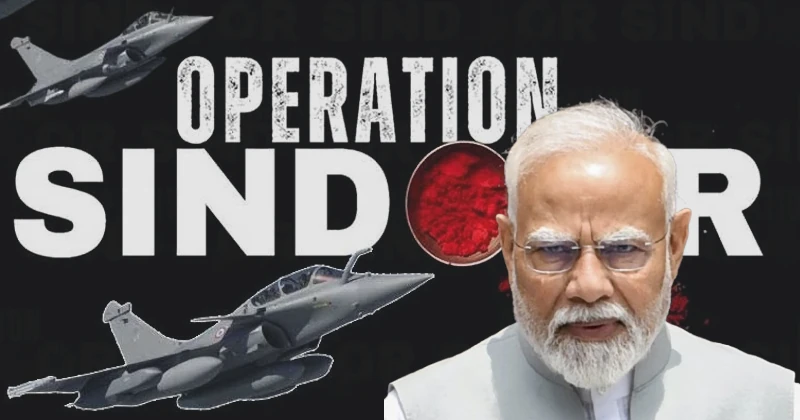
Bharat launched Operation Sindoor, a preemptive and devastating strike that demolished nine terror camps inside Pakistan—sending shockwaves across Islamabad’s military establishment and Beijing’s shadow defence partners.
In a desperate bid to retaliate, Pakistan launched a full-scale missile strike, targeting Indian military installations across J&K, Punjab, Rajasthan, and Gujarat. The response? A clinical shutdown. Not one missile breached Indian defences. Every single one was intercepted or neutralised mid-air. Pakistan’s attempted escalation crumbled against a decade-long wall of Indian preparation, resilience, and innovation.
As the Pakistani missiles hurtled across the border, Bharat’s multi-tiered air defence ecosystem, activated with near-zero latency. The country’s Integrated Counter-Unmanned Aerial System (UAS) Grid, S-400 Triumf squadrons, Barak-8 MR-SAMs, Akash Surface-to-Air Missiles, and DRDO’s counter-drone technologies worked in tandem, forming an impervious aerial shield.
The effectiveness of this shield exposed a telling contrast: while Pakistan’s retaliatory capability remained outdated and reactionary, Bharat’s systems were proactive, deeply integrated, and battle-tested. Electronic warfare suites jammed guidance systems. Counter-drone grids disabled smaller UAVs. Missile defence units intercepted larger projectiles at safe distances. Pakistan’s missiles didn’t stand a chance.
Bharat didn’t merely defend—it counterpunched with calibrated fury. Operation Sindoor wasn’t a symbolic retaliation—it was a strategic incursion, aimed at dismantling not just terror camps, but Pakistan’s defence ecosystem at its core.
In a landmark move, Indian forces struck and destroyed a Chinese-supplied HQ-9 air defence unit stationed near Lahore—a key cog in Pakistan’s radar defence web. Satellite imagery and electronic intercepts confirmed significant damage to radar and communications infrastructure, crippling Pakistan’s early warning network.
The use of loitering munitions—autonomous kamikaze drones manufactured indigenously since 2021—added a lethal dimension. These stealthy, suicidal drones bypassed conventional radar systems and executed precise strikes on enemy strongholds, bunkers, and communication hubs.
Meanwhile, Harop drones, previously imported from Israel but now built under ‘Make in India’, struck with precision in Karachi and Lahore, obliterating ground-to-air defence setups. Rafale fighter jets, deployed with SCALP and HAMMER air-to-ground missiles, delivered finishing blows with pinpoint accuracy.
This overwhelming military superiority is no accident. It is the result of an 11-year-long transformation of Bharat’s defence architecture, spearheaded by Prime Minister Narendra Modi since 2014. His administration has systematically prioritised self-reliance, technological integration, and strategic deterrence.
- S-400 Triumf Deal: In 2018, Bharat signed a Rs 35,000 crore agreement with Russia for five S-400 squadrons. Three of these are now fully operational along the northern and western borders.
- Barak-8 MR-SAM Systems: Bharat inked a $2.5 billion deal with Israel in 2017. These systems, like the ones deployed in Bhatinda, played a central role in intercepting Pakistani missiles.
- Indigenous Systems: DRDO-developed Akash missile batteries, counter-drone technologies, and newly installed Man Portable Counter Drone Systems (MPCDS) in 2024 have turned Bharat into a formidable player in modern airspace warfare.
Each acquisition was not just a procurement—it was a layer in the evolving architecture of a self-sustaining and technology-driven defence grid.
India’s evolved doctrine doesn’t stop at safeguarding its territory. It now encompasses airspace domination, rapid deployment, seamless interoperability between ground, air, and cyber units, and real-time threat neutralisation. The ability to detect, disable, and destroy threats—whether from drones, missiles, or aircraft—is now an Indian strength backed by artificial intelligence, satellite integration, and domestic R&D.















Comments