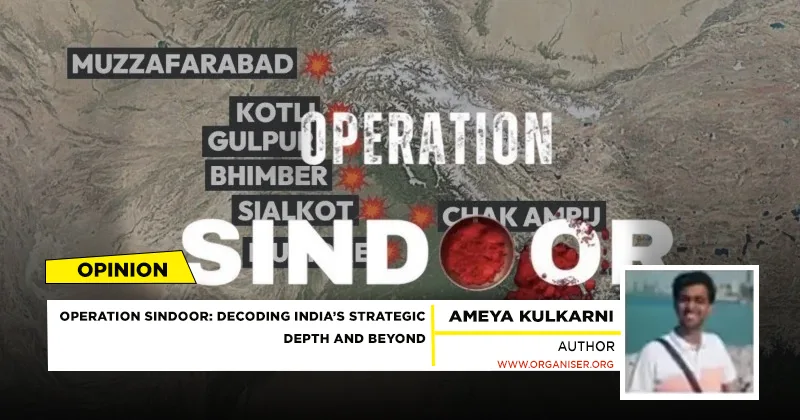
As a direct response to the April 22 terror attack in Pahalgam, which claimed the lives of 26 civilians, India launched its most extensive cross-border strikes since Balakot, targeting nine terrorist facilities in Pakistan and Pakistan-occupied Kashmir (POJK). Codenamed’ Operation Sindoor’, the rapid and coordinated 25-minute operation eliminated over 80 terrorists affiliated with the banned groups Jaish-e-Mohammed (JeM), Lashkar-e-Taiba (LeT), and Hizbul Mujahideen in precision strikes. Following the strikes, India underscored the non-escalatory nature of the action even as it made it clear that it remains ready to retaliate resolutely should Pakistan decide to escalate. The ball is now in Pakistan’s court regarding how far it wants to climb the escalation ladder.
The unfolding crisis has once again forced the Indian leadership to confront a recurring strategic nightmare: How should India respond to Pakistan’s continued support for terrorism in Kashmir? And how can India establish deterrence against Pakistan’s proxy war?
Deterrence is difficult even in the best times, as it hinges on the adversary’s cost-benefit calculations. Despite asymmetries in power, a determined opponent may still use force. Whether through proxy means or conventional war, with or without nuclear weapons, Pakistan’s revisionist goals, ideological mindset, high-risk tolerance, and the dominant role of its military make it especially hard to deter. Pakistan is not a normal state it does not perceive the consequences of using force in the manner that other states do.
Second, deterrence is inherently hard to prove, as it relies on hostile action’s absence, not the presence. Consequently, occasional breakdowns are inevitable. While the impulse to punish Pakistan is understandable, New Delhi must also recognise that such failures have become less frequent than in the past. Pakistan-backed terrorism is now largely limited to Kashmir, where major attacks are sporadic. The region is more securely under Indian control than ever, and the widespread condemnation of the Pahalgam killings marks a significant inflection point in local sentiment.
Third, proxy wars make deterrence harder, as plausible deniability blurs accountability and weakens targeting. Given the Pakistan Army’s history of similar offences, it is not unreasonable to consider it a suspect reflecting a pattern that cannot be ignored. Yet, one of India’s greatest strategic successes has been in shaping a narrative around Pakistan’s complicity in global and regional jihad. Sustaining this narrative, however, will be tougher amid US uncertainty and China’s rise. American leadership and the India-US partnership have been crucial in isolating and pressuring Pakistan, something harder to achieve now.
Lastly, deterrence is costly, and any military action must be weighed against the objective assessment of the harm incurred and the attendant risks of escalation. India has every right to impose costs on Pakistan and must show greater risk tolerance to counter Pakistan’s resolve. Penalising the Pakistani Army is preferable to letting it sponsor terrorism with impunity. However, in strategy, the adversary always has a say Pakistan is not a pushover state, and each crisis-response cycle raises the stakes for future escalation.
Since the mid-1980s, successive Indian leaders have faced this dilemma with no easy solutions. In the 1990s, India chose strategic restraint, quietly absorbing the costs. Overt nuclearisation of the subcontinent deepened challenges, making India cautious while emboldening Pakistan. Although large-scale conventional military responses like Operation Parakram were planned and troops mobilised, they were never executed. As terrorism became a global menace, India shifted to isolating Pakistan diplomatically and economically, aided by stronger ties with the US. The 2008 Mumbai attack was the last major terrorist strike on civilians in mainland India.
Pakistan remained relevant for its ability and commitment to promoting violence in Indian Kashmir under the shadow of nuclear weapons, both to force India to the negotiating table and internationalise the Kashmir dispute. Making it irrelevant required, as External Affairs Minister S Jaishankar put it, “not to play the game—but also to change it.” India had to embrace risk and pursue calculated escalation instead of strategic restraint, signalling to the Pakistan Army that it could no longer support terrorism without consequences. India’s calculated escalation began with its special forces targeting terrorist hideouts across the Line of Control (LoC) in Pakistan-occupied Kashmir after 19 Indian soldiers were killed in September 2016. These surgical strikes marked a significant shift in India’s counter-terrorism strategy. This covert, shallow infiltration provided Pakistan an off-ramp, allowing it to deny that the operations ever occurred. Military action stirs public sentiment but also carries audience costs. Even before Prime Minister Narendra Modi took office, India, long a victim of Pakistan-backed terrorism, was primed for retribution. PM Modi intensified this sentiment, setting a precedent that ensured each escalation would only rise in magnitude.
India’s response to the 2019 paramilitary convoy bombing marked a further escalation, with the Indian Air Force targeting alleged terrorist camps in Pakistan its first air strikes in undisputed Pakistani territory since 1971. However, the use of force in international relations is never one-sided. Given India’s public actions, Pakistan retaliated with air strikes on an Indian Army base. In the resulting dogfight, India lost a fighter jet, and the pilot was captured. The crisis de-escalated through intense US backchannel diplomacy, leading to the pilot’s safe return and both sides claiming victory.
Prime Minister Modi has reshaped India’s approach to combating Pakistani-sponsored terrorism in two key ways.
First, instead of merely accepting Pakistan’s risk-driven strategies, India manipulates risk through escalation. However, each failure of deterrence forces India higher up the escalation ladder. Second, PM Modi has created significant audience costs for India’s political class, making inaction against Pakistani provocations politically costly.
In democracies, such costs signal resolve but also create traps of commitment, pushing leaders toward suboptimal decisions. India’s challenge is to foment deterrence, avoid unnecessary escalation, and impose costs on Pakistan, all within a domestic and global political landscape significantly different from that of 2019, when the Balakot airstrikes were ordered.
PM Modi can withstand the audience costs that many believe could push him into a commitment trap. His popularity has proven remarkably resilient, and on national security, his perceived credentials far exceed those of his political opponents, further strengthening his ability to navigate the crisis.
While escalation carries its momentum, the fear of nuclear exchange remains overstated.
While Pakistan leverages nuclear rhetoric to test India’s resolve and draw international attention, its nuclear redlines are implausibly low to be credible. For example, it has threatened full-spectrum retaliation, including deploying nuclear weapons, for any restriction on water flow under the Indus Water Treaty (IWT). This extreme stance only serves to undermine its credibility.
In the current crisis, while Pakistan’s civilian and military leadership have both repeatedly raised the spectre of a nuclear flashpoint, their actual behaviour suggests otherwise. When the Indian fighter pilot was captured in 2019, PM Modi’s government threatened missile strikes if harm came to him. The Research and Analysis Wing (R&AW), India’s external spy agency, relayed the warning to its counterpart in Pakistan’s Inter-Services Intelligence (ISI) on February 27, 2019. This was later confirmed by India’s National Security Advisor Ajit Doval to then US Secretary of State Mike Pompeo and National Security Advisor John Bolton. India deployed Brahmos missiles in Rajasthan, and Pakistan’s counter-threat was conventional, not nuclear. If India planned to launch nine missiles, Pakistan prepared for thirteen. Islamabad’s response was not nuclear brinkmanship but a calculated quid pro quo plus.
This time, escalation could unfold differently due to two key factors: Pakistan’s internal turmoil. General Asim Munir faces multiple challenges, and the crisis has triggered a rally-around-the-Army effect.
Pakistan witnessed one of its worst civil-military conflicts in April 2022 when then Prime Minister Imran Khan was ousted via a no-confidence vote by a coalition led by Shehbaz Sharif—an effort orchestrated by the Army establishment. Not since the loss of Bangladesh during the 1971 war has the military faced such a crisis of legitimacy. Munir’s appointment as Chief of Army Staff was fiercely opposed by Khan, who sought to install a loyalist, deepening divisions within the Army. These tensions culminated in the widespread rigging of the 2024 elections by the military in favour of the Sharif coalition. In this volatile landscape, any Indian action would likely be seized upon by Munir and the Pakistani establishment to suppress dissent within both the Army and broader society, further consolidating their grip on power.
Second, American disengagement and China’s growing influence shape the current geopolitical landscape. US support has played a crucial role in India’s Pakistan policy in the last two decades. Since the Kargil war, successive American administrations have backed New Delhi’s stance on terrorism in Kashmir. While the present US leadership acknowledges India’s grievances and right to retaliate, internal struggles and a limited attention span weaken its ability to pressure Islamabad. Unlike in 2019, American rhetoric now seems both muted and disengaged.
Conversely, China has emerged as a more assertive ally for Pakistan. Beijing has pledged to protect Pakistan’s sovereignty and supported Islamabad’s demand for a “neutral investigation” into the terrorist attack. Chinese patronage is reinforced by deepening Sino-Pak military ties and significant Chinese investments in Pakistan, including PoJK.
At the same time, India remains heavily occupied along its volatile northern border. A critical lesson for Indian leadership is that, despite recent diplomatic overtures, China will not alter its long-standing policy of backing Pakistan and constraining India in the region. As China’s influence expands, New Delhi must leverage American power and purpose more effectively.