





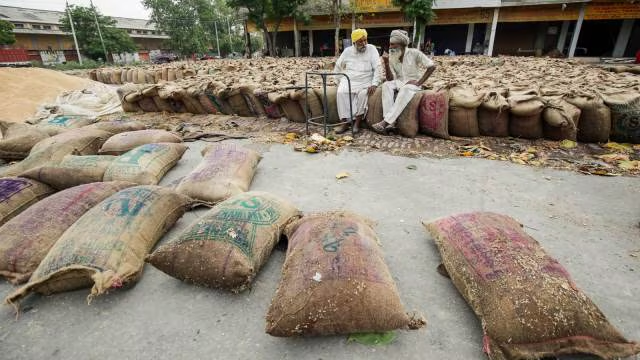
With India facing heightened terror threats along its northern borders and Punjab’s sensitive districts like Amritsar and Gurdaspur on high security alert, the decision by the Kisan Mazdoor Sangharsh Committee (KMSC) to launch a statewide “Rail Roko” protest on May 7 has triggered serious concerns about timing, intent, and political backing behind the agitation.
The protest, set to begin at Devidas Pura railway station along the Amritsar–Delhi rail line, comes at a time when mock drills and blackouts are being carried out in border areas due to increased terror activity. Security agencies are already stretched thin. Yet, farmer leaders, including Sarwan Singh Pandher, Sukhwinder Singh Sabhra, and Rana Ranbir Singh, announced during a Sunday evening meeting that if the government does not resolve their issues by May 8, more protest points will be activated, including in Ferozepur.
The KMSC has warned that if the Punjab government does not address their concerns by May 8, more protest sites will be activated, including Basti Tenka Wali in Ferozepur, escalating the agitation across the state. According to the leadership, preparations are already underway on a “war footing.”
While the KMSC alleges “illegal and forceful acquisition” of farmland without fair compensation under central infrastructure projects like Bharatmala, political observers are questioning whether the protest is truly farmer-driven—or politically motivated. The committee has previously led agitations for three years, and many of their demands—including MSP assurances—have already been addressed by the Centre.
The farm leaders accused the Punjab government, under Chief Minister Bhagwant Mann, of turning the state into a “police state” where land is being acquired under Bharatmala and other central projects across districts including Gurdaspur, Amritsar, and Tarn Taran without following due legal and compensation processes.
“For the past three years, we have led protests at several locations where hundreds of farmers have been denied their fundamental rights. Lands have been seized without fair or timely compensation,” said Pandher. “In many cases, landowners have not yet received awards, yet authorities are moving in to forcibly acquire their land.”
“Our lands, worth crores, are being taken away for free or at throwaway prices. People are willing to lay down their lives rather than give up their land without justice,” the KMSC leaders stated.
Critics, however, are pointing fingers at the Congress party, questioning its role in allegedly instigating unrest at a time when the nation is dealing with terror attacks that have left Hindus dead in Jammu and Kashmir. While Congress leaders publicly claim solidarity with the Centre in matters of national security, their social media campaigns like the “Gayab Hai” post on X and criticism of defense assets like Rafale jets suggest a different narrative playing out in the background.
Observers also highlight the recent approval of the caste census by the Centre, a long-standing demand of the Congress, as a potential trigger for such agitations. Having lost control of the caste narrative, the party now appears to be reigniting farmer protests, a tool it previously used to build momentum during the anti-farm law movement.
Adding to the intrigue is the timing of debates around reforms in the Waqf Act. With increasing scrutiny over arbitrary land acquisitions under Waqf boards, some suggest that ongoing land-related protests might also be an attempt to divert attention from the government’s actions against illegal land holdings.
Heavy police deployment has already been reported in Amritsar’s Saiduke village, where authorities moved to occupy farmland over the weekend. KMSC leaders have warned that the agitation will intensify if the administration does not respond, even as they acknowledge the inconvenience caused to the public.
As India grapples with external threats and internal political games, this new wave of protest raises crucial questions: Is this a genuine farmer movement, or part of a larger, orchestrated attempt to destabilise Punjab during a time of national vulnerability?
Who is really behind these protests and to what end?













Comments