





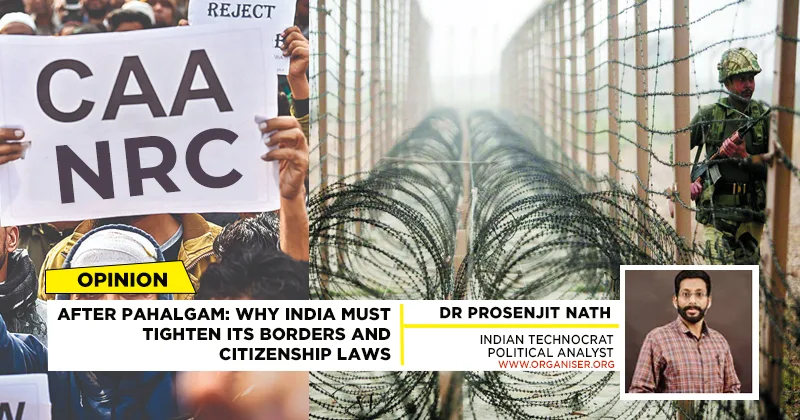
The last has not been heard of the Pahalgam attack. When 26 unsuspecting, innocent civilians were executed in cold blood on the Baisaran meadow on April 22, 2025, the shock reverberated across the nation. As reports began to surface indicating that Hindu men had been singled out, deep, justifiable anger rippled across the country. The brutality, the targeting, and the sheer audacity of the attackers turned the pristine beauty of Pahalgam into a symbol of bloodshed and religious persecution.
Eventually, intelligence inputs confirmed that many feared the attackers were regulars from the Pakistani army, operating in military fatigues, not merely a band of jihadists. A Lashkar-e-Tayyaba affiliate briefly claimed the attack as a triumph in their continued campaign toward Ghazwa-e-Hind, a term dripping in Islamist supremacism, only to retract the statement later under international pressure. But the damage was done. The government of Bharat vowed a two-pronged response diplomatic isolation of Pakistan and a calibrated kinetic retaliation. Pahalgam had to be avenged.
Yet amid the raging national discourse on terror, one seemingly minor but deeply consequential detail emerged one that might have gone unnoticed if not for the frenzied discussions on social media. That detail was the abrupt cancellation of all visas granted to Pakistani nationals in India. What followed was a deluge of law-and-order challenges that exposed a troubling loophole in the issue of Indian women, bearing Indian passports and citizenship, married to Pakistani men.
This issue exploded when reports began emerging of numerous Indian women, legally Indian by birth and documentation, having married Pakistani nationals and subsequently living in India with their children NRCwho, by paternal descent, were also Pakistani nationals. Unconfirmed social media accounts placed the number of such women between 83,000 and over a lakh, with large clusters reported from Punjab, Kashmir, and the National Capital Region. Even more concerning were claims that many of their children were enrolled in Indian schools and may have acquired benefits meant for Indian citizens.
The implications of these numbers are alarming and demand introspection. How is it that these women continue to hold Indian passports, possess Aadhar cards, and enjoy full access to Indian welfare systems while being married to citizens of a nation that actively funds and trains terror outfits operating against India? How were these marital relationships being facilitated across borders with such ease? Were these women being used, knowingly or unknowingly, as conduits for fostering and sustaining India’s internal terror infrastructure?
While these questions demand urgent answers, one thing is clear the chaos and security concerns thrown up by these revelations make a resounding case for the implementation of a nationwide National Register of Citizens (NRC).
The NRC, mandated by the 2003 amendment to the Citizenship Act of 1955, is intended to be a comprehensive registry of all legal Indian citizens. Its primary function is to identify and facilitate the deportation of illegal immigrants. Though implemented in Assam between 2013–2014, the process has not yet been extended nationwide. Under the Citizenship Rules, 2003, the central government can initiate the creation of an NPR (National Population Register) and subsequently, the NRC allowing officials to scrutinize claims for Indian citizenship.
Against the backdrop of the Pahalgam attack and the growing awareness of loopholes being exploited by foreign nationals, the NRC is not just a bureaucratic measure; it is a national security imperative.
Consider the influx of illegal Bangladeshi migrants into India. In 2004, Sriprakash Jaiswal, then Minister of State for Home Affairs, told Parliament that an estimated 12 million illegal Bangladeshis were residing in India, with West Bengal alone hosting 5.7 million. In recent years, that number has swelled, with official estimates under the current government touching 20 million. These migrants cross over using the porous, poorly guarded Indo-Bangladesh border and, through a well-oiled network, acquire fake documentation Aadhar cards, ration cards, and voter IDs within days of entering.
Crackdowns in Maharashtra and Delhi-NCR have unearthed hundreds of such illegal migrants. Beyond economic threats, they pose a tangible risk to national cohesion, often participating in rioting, stone pelting, and anti-national activities. The same holds for illegal Pakistani nationals scattered across Gujarat, Rajasthan, Delhi, and even Madhya Pradesh a fact corroborated by recent law enforcement reports.
Even more dangerous is the unchecked rise of Rohingya infiltration, particularly in Jammu, Delhi, and Hyderabad. Intelligence inputs have repeatedly warned of some Rohingya elements being radicalized by extremist ideologies and maintaining links with militant outfits. In 2015, official figures pegged the number of Rohingya families in India at 10,565. Today, extrapolations suggest the number could well exceed a million.
When these elements are viewed in the same frame as the Indian women–Pakistani man’s marital pattern, a chilling reality emerges. This is not merely a humanitarian issue or a case of misused immigration laws. This is a security threat hiding in plain sight a quiet facilitation of demographic sabotage.
The modus operandi is straightforward: Indian women are married off to Pakistani nationals, after which they return to India to raise families. Children are often born in Indian hospitals, educated in Indian schools, and even receive Indian identity documentation. The entire process circumvents national laws and, in several cases, provides cover for anti-national activities. This may not yet constitute evidence of a full-fledged conspiracy but the possibility of these cross-border marital alliances forming a part of a broader terror or espionage network cannot be ruled out. The term “marital jihad”, while controversial, begins to gain relevance in such a context.
In such a scenario, the NRC becomes the need of the hour. Not only will it identify illegal Pakistani, Bangladeshi, and Rohingya immigrants residing in India, but it will also map out the illegal routes, false documentation networks, and support systems aiding them. Crucially, in the case of cross-border marriages, it will help the state determine the exact number of cases, assess them from a national security lens, and take appropriate action including deportation or cancellation of citizenship claims.
Further, the Citizenship Amendment Act (CAA) must be seen as a complementary measure. By fast-tracking the citizenship process for persecuted minorities from Pakistan, Bangladesh, and Afghanistan namely Hindus, Christians, Sikhs, Buddhists, and Jains the state can protect those who have genuinely fled persecution. These are individuals with no “home” to return to and who wish to become constructive parts of Indian society. The CAA, along with the NRC, will ensure the differentiation between genuine refugees and security threats.
The policy establishment must take heed. The Pahalgam attack, while horrific, has laid bare deep, systemic vulnerabilities. Allowing unchecked cross-border marital alliances, fake documentation, and illegal settlements to thrive is not just dangerous it is a form of slow, unacknowledged invasion. The scale of the racket should scare every lawmaker and citizen alike.
Therefore, the path ahead is clear. The NRC must be implemented nationwide not with haste, but with precision and political will. The state must declare that any Indian woman marrying a Pakistani national will forfeit her Indian citizenship. A mechanism must be created to monitor and restrict the reentry of such individuals, with specific protocols laid out for children born of such marriages. Marital jihad must be recognized as a potential national security threat.
India cannot afford to swim blindly in the murky waters of unverified citizenship any longer. National security is not merely a military or diplomatic concern it is embedded in the laws, documents, and demographic integrity of the country. A clean, updated, and verified NRC is not just desirable; it is non-negotiable.
As Hans Morgenthau observed, national power includes not only military strength but also the health and resilience of the internal system. India’s national power and its future depend on how seriously it treats these internal vulnerabilities. The rot must be cleaned, and it must be done now.
















Comments