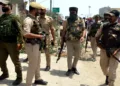
Dependents of former Kashmiri terrorists stay in valley, pose threat
June 9, 2026
  • Read Ecopy
  • Circulation
  • Advertise
  • Careers
  • About Us
  • Contact Us
Android AppiPhone AppArattai
Organiser
  • ‌
  • Bharat
    • Assam
    • Bihar
    • Chhattisgarh
    • Jharkhand
    • Maharashtra
    • View All States
  • World
    • Asia
    • Europe
    • North America
    • South America
    • Africa
    • Australia
  • Editorial
  • International
  • Opinion
  • RSS @ 100
  • More
    • Op Sindoor
    • Analysis
    • Sports
    • Defence
    • Politics
    • Business
    • Economy
    • Culture
    • Special Report
    • Sci & Tech
    • Entertainment
    • G20
    • Azadi Ka Amrit Mahotsav
    • Vocal4Local
    • Web Stories
    • Education
    • Employment
    • Books
    • Interviews
    • Travel
    • Law
    • Health
    • Obituary
  • Subscribe
    • Subscribe Print Edition
    • Subscribe Ecopy
    • Read Ecopy
  • ‌
  • Bharat
    • Assam
    • Bihar
    • Chhattisgarh
    • Jharkhand
    • Maharashtra
    • View All States
  • World
    • Asia
    • Europe
    • North America
    • South America
    • Africa
    • Australia
  • Editorial
  • International
  • Opinion
  • RSS @ 100
  • More
    • Op Sindoor
    • Analysis
    • Sports
    • Defence
    • Politics
    • Business
    • Economy
    • Culture
    • Special Report
    • Sci & Tech
    • Entertainment
    • G20
    • Azadi Ka Amrit Mahotsav
    • Vocal4Local
    • Web Stories
    • Education
    • Employment
    • Books
    • Interviews
    • Travel
    • Law
    • Health
    • Obituary
  • Subscribe
    • Subscribe Print Edition
    • Subscribe Ecopy
    • Read Ecopy
Organiser
  • Home
  • Bharat
  • World
  • Operation Sindoor
  • Editorial
  • Analysis
  • Opinion
  • Culture
  • Defence
  • International Edition
  • RSS @ 100
  • Magazine
  • Read Ecopy
Home World

Security threat in J&K: Dependents of former Kashmiri terrorists, 100s of Pakistani women & children continue to stay

It can perhaps be considered a legacy issue as hundreds of Pakistani women and children, who entered India illegally, via Nepal, continue to stay all over Kashmir. They came here from Pakistan and Pakistan Occupied Jammu Kashmir (POJK) as dependents of terrorists who surrendered their weapons. Not one terrorist, or his dependents, came back to Kashmir using any of the four official routes prescribed under the rehabilitation policy

Sant Kumar SharmaSant Kumar Sharma
May 6, 2025, 12:00 pm IST
in World, India, Asia, Jammu and Kashmir, International Edition
Follow on Google News
Women at the Attari Border

Women at the Attari Border

FacebookTwitterWhatsAppTelegramEmail

The Union government’s decision to deport all Pakistani nationals staying in India in the aftermath of the Pahalgam terror attack has been welcomed by most people. This was the right thing to do given the dangers they posed to the security of the nation.

According to spokesman of the BJP unit in J&K Sunil Sethi: “They have no right to stay in the country even if they are married to Indian citizens.” Such individuals might act as “sleeper cells” for their country. It is possible that Pakistani spy agency Inter-Services Intelligence (ISI) may be behind planting some of these individuals here.

Also Read: Delhi Police bust Bangladeshi infiltration network; Mastermind Chand Miyan among 52 arrested

His statement was made in the context of the news breaking out last week that a CRPF man had married a Pakistani woman, who he claimed was his cousin. Last week, CRPF acted swiftly and dismissed him from service. His case came to the spotlight as Pakistanis overstaying their visas, illegally in India, were called out.

Cross Border Marriages

In the Union Territory (UT) of J&K, marriages across the border are a common practice. These marriages were often between cousins separated by a border, with one brother or sister opting for India and the other going over to Pakistan. These marriages thus became a way of keeping familial ties running down the generations.

Growing antipathy, turning into animosity, between the two nations over the past three decades or more, first turned this trend into a trickle and it would not be wrong to say that this is about to end altogether. Barring very few alliances being solemnised even in these trying times.

In the Kashmir province, however, hundreds of Pakistanis, both women and children, are still living virtually undisturbed. Despite the Central government’s ordering all Pakistani citizens to go away. Perhaps there are practical difficulties which have prevented the security and intelligence agencies from taking any action against such Pakistani women and children.

Who are these Pakistani women and children living in Kashmir? Who facilitated their settling in different parts of the Valley?

Pakistani women, children

Both the state government of J&K (when it was a state before abrogation of Article 370 and 35-A) and the Central government are responsible. These Pakistanis living in Kashmir are dependents of terrorists who renounced the gun and returned to India. Either from Pakistan or Pakistan Occupied Jammu Kashmir (POJK) where they trained and spent time waging war against India.

The state government under Dr Farooq Abdullah brought in a rehabilitation policy in 1997 to give a chance to terrorists to give up weapons. Each AK 47, each hand grenade, each bullet then fetched the terrorists some money when they forsook them. The price of each item was set under this rehabilitation policy of 1997 meant to encourage terrorists, particularly Kashmiri youth, to join mainstream.

Over a decade later, in 2010, Omar Abdullah as Chief Minister (in his first term) improved upon the rehabilitation policy his father had pioneered in 1997. Under this policy, four routes were defined through which terrorists could return to J&K after renouncing violence. These routes were Wagah-Attari border, Indira Gandhi International Airport in Delhi, Muzaffarabad-Srinagar bus route and Rawalakote-Poonch bus route. If one of these four routes was used, terrorists giving up their guns were to get monetary benefits also by way of rehabilitation measures.

Surrender Policy

Under the rehabilitation policy then worked out, those terrorists who did not have reports of committing heinous crimes, were given amnesty. They were to be paid a monthly stipend for some time to start their life anew after eschewing violence. Skill centres were also opened to train these terrorists who surrendered their weapons and their violent ways.

Hundreds of Kashmiri terrorists availed of this rehabilitation policy but none brought back their dependents through any of the four official routes. Most of these former terrorists got in touch with their family members, used their links and staged “surrenders’’ before the local police. These women and their children are now a part of the Kashmir society. But they are neither here nor there as their legal status is not clearly defined.

All these years, the local police did not act against them as most of the political parties of the Kashmir valley support their continued living here. Be it the ruling National Conference (NC), PDP of Mehbooba Mufti, or People’s Conference (PC) of Sajjad Lone, all of them have been in favour of allowing them to stay here, and demand conferring of Indian citizenship on them.

The 2010 surrender policy in J&K aimed to facilitate the return of ex-militants who had crossed over to Pakistan-occupied Kashmir (PoJK) or Pakistan for training, but later chose to return to J&K. This policy was worked out during Omar Abdullah’s stewardship of the state, with Governor N.N. Vohra, being involved at every step of the way in formulation of this policy.

Policy Period

The rehabilitation policy was to applicable to such Kashmiri youth who had travelled to Pakistan Occupied Jammu Kashmir (POJK) or Pakistan between January 1, 1989, and December 31, 2009. Both dates were included and it extended to dependents of those returning, including wives and children who were offered counselling and documentation assistance.

The stated aim of the policy was to facilitate the reintegration of ex-terrorists into mainstream society. Imparting them vocational training in different trades was also envisaged so that these “misguided youth’’ could become self-employed and earn their livelihood.

This is a 20-page document dated September 3, 2010. This policy was a continuation of the Rehabilitation Policy of June 1997 which Farooq Abdullah had brought in. It needs to be mentioned here that he had resigned in January 1990 and till October 1996, for a long time, there was no democratic government chosen through elections in J&K. He came back to power in elections the results of which were declared in early October 1996.

The rehabilitation policy of 1997 was one of the first steps taken by him, in consultation with the Central government, to try to lure away Kashmiri youth who had picked up guns. A good number of these youths had felt disillusioned with the manner in which they were treated by their Pakistani handlers. These youth had initially joined terrorism and picked up guns in the belief that Pakistan will help them get “azadi’’.

Topics: Sunil SethiKashmir ValleyterroristsKashmiri terrorists
ShareTweetSendShareSend
✮ Subscribe Organiser YouTube Channel. ✮
✮ Join Organiser's WhatsApp channel for Nationalist views beyond the news. ✮
Previous News

$1,000 to Leave US: New Trump policy aims to lower deportation costs and encourage undocumented migrants to self-deport

Next News

NFRS’s new milestone, as Mizoram’s capital Aizawl, is now connected to the railway network

Related News

Lieutenant Governor Joins Mega Padyatra in Budgam

Anti-Drug Rally in J&K: “Our neighbour is involved in pumping drugs to destroy our youth,” says LG Manoj Sinha

Representtive Image

J&K: 4 OGWs, including a women arrested in Srinagar for conspiring terror attack; Grenade, AK-47 rounds, mobiles seized

Israeli national security minister Itamar Ben-Gvir (far right) at the Knesset, Israel's parliament, after the vote in Jerusalem, March 30, 2026

Israel parliament approves death penalty for terrorists, marking a historic shift in security policy

Dhurandhar: The Revenge; Not Propaganda, but mirror

J&K: Govt keen to liberate the UT from separatists & terrorists working at Pakistan’s behest: LG Manoj Sinha

New Delhi on high alert as intelligence sources warn about possible Let terror attack in the vicinity of Red Fort

Intelligence Alert: Pakistan based LeT plots terror attack on temples near Red Fort; Security tightened across Delhi

Load More

Latest News

J&K: Zojila tunnel clears key hurdle; Signals new era of connectivity for Ladakh

How Cockroach politics is hollowing out Bharatiya democratic culture

RSS centenary year is a time for renewed resolve and greater commitment to nation-building: Dr Mohan Bhagwat

Ex-DMK Minister Senthil Balaji (Right Side-File Photo)

Tamil Nadu: CBI books Rs 397 cr transformer tender scam from ex-DMK Minister Senthil Balaji’s tenure (2021-2023)

Border Security Force (BSF) officials inspect the Single Row Fencing (SRF) at a Border Out Post area (India-Bangladesh border)

Infiltration and Border Management: Saving the Siliguri corridor

External Affairs Ministry spokesperson Randhir Jaiswal, slams Pakistan over the recent killings in POJK

‘Hope Pakistan is held accountable’: India reacts after 20 killed in Pakistan Occupied Jammu & Kashmir

China’s anti-BLA offensive hits snag as UN members demand proof

UN Setback for China and Pakistan: US and allies stall move to ban Baloch Liberation Army

West Asia Conflict: Collective response to energy crisis

Atul Limaye Ji Sah Sarkaryavah, Rashtriya Swayamsevak Sangh while addressing a Pramukh Jan Gosthi Rashtriya at Raipur, Chhattisgarh

Chhattisgarh: Society must lead its own transformation through collective initiative: Atul Limaye

New York anti-Hindu Bill fails to advance: How the bill fueled bias & espoused caste discrimination

Load More
  • Privacy
  • Terms
  • Cookie Policy
  • Refund and Cancellation
  • Delivery and Shipping

© Bharat Prakashan (Delhi) Limited.
Tech-enabled by Ananthapuri Technologies

  • Home
  • Search Organiser
  • Bharat
    • Assam
    • Bihar
    • Chhattisgarh
    • Jharkhand
    • Maharashtra
    • View All States
  • World
    • Asia
    • Africa
    • North America
    • South America
    • Europe
    • Australia
  • Editorial
  • Operation Sindoor
  • Opinion
  • Analysis
  • Defence
  • Culture
  • Sports
  • Business
  • RSS @ 100
  • Entertainment
  • More ..
    • Sci & Tech
    • Vocal4Local
    • Special Report
    • Education
    • Employment
    • Books
    • Interviews
    • Travel
    • Health
    • Politics
    • Law
    • Economy
    • Obituary
  • Subscribe Magazine
  • Read Ecopy
  • Advertise
  • Circulation
  • Careers
  • About Us
  • Contact Us
  • Policies & Terms
    • Privacy Policy
    • Cookie Policy
    • Refund and Cancellation
    • Terms of Use

© Bharat Prakashan (Delhi) Limited.
Tech-enabled by Ananthapuri Technologies