





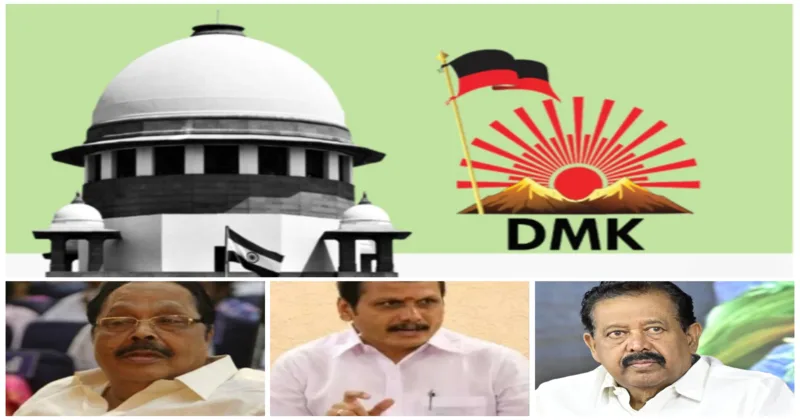
Chennai: In an extraordinary turn of events that has rocked Tamil Nadu politics, the DMK government faced a flurry of legal setbacks over the past week, signalling deepening trouble for several of its top ministers. In a single day alone — April 23 — the Madras High Court and the Supreme Court of India delivered a series of adverse rulings, reviving corruption and disproportionate assets (DA) cases, sanctioning Enforcement Directorate (ED) probes, and reprimanding ministers for misconduct, marking a critical moment for the ruling party just a year ahead of the 2026 state elections.
Legal experts predict a tumultuous road ahead for the DMK, with the possibility of more ministers facing trial, disqualification, and even jail terms by the end of this year.
SC Ultimatum Forces Senthil Balaji to Resign
The most high-profile development involved Tamil Nadu Electricity, Excise, and Prohibition Minister V. Senthil Balaji, currently out on bail in the PMLA-linked cash-for-job scam. On April 24, a Supreme Court bench comprising Justices Abhay S Oka and Augustine George Masih sternly told Balaji to either resign from his ministerial post or face the cancellation of his bail and return to jail.
“You have to make a choice between the post and your freedom,” the bench remarked bluntly. The court noted that it had granted bail assuming Balaji was no longer a minister — an assumption Balaji later upended by reassuming his ministerial role just days after securing bail. “You are playing with the process of law. You have made a mockery of the law,” Justice Oka lashed out, making clear that such conduct would not be tolerated.
Under mounting pressure and facing the risk of re-incarceration, Balaji tendered his resignation on April 27 evening. The Supreme Court formally closed the matter, but with a firm condition — Balaji is barred from holding any ministerial post until the trial is concluded.
The sharp rebuke from the nation’s highest court has sent shockwaves through the DMK’s political establishment, laying bare the judiciary’s hardening stance against political impunity.
Ponmudi Faces Suo Motu Action Over Hate Speech
Meanwhile, K. Ponmudi, Forest Minister and a senior DMK leader, found himself embroiled in fresh legal trouble for making derogatory remarks against religious communities and women.
On April 23, Justice N. Anand Venkatesh of the Madras High Court ordered the registry to take up a suo motu writ petition against Ponmudi for his inflammatory speech. The court observed that Ponmudi had misused the liberty granted by the Supreme Court — which had earlier stayed his conviction in a separate corruption case — by continuing in public office and using it to spread religious hatred.
The court was especially critical of the state police’s inaction despite receiving multiple complaints against the minister. “As a constitutional court, this court is under an obligation to ensure that the TN police do not pay lip service to the directions of the Supreme Court by flouting them in practice,” the order said.
Facing mounting legal heat, Ponmudi too resigned from the Cabinet on April 27.
Duraimurugan and Family Ordered to Stand Trial
In another major setback, the Madras High Court revived a 22-year-old disproportionate assets case against DMK General Secretary and Water Resources Minister Duraimurugan and his family.
Justice P. Velmurugan overturned the 2007 discharge order granted by a Vellore court and directed that the trial must proceed expeditiously. The case, dating back to the 1996–2001 DMK regime, accuses Duraimurugan, his wife D. Santhakumari, son D.M. Kathir Anand (DMK MP from Vellore), and others of amassing wealth disproportionate to their known income.
With ED raids earlier this year on Duraimurugan and his son’s properties in connection to the 2019 “cash for votes” scandal, the family’s legal troubles are far from over.
The High Court has ordered daily hearings, aiming to complete the trial within six months.
Other Major Legal Setbacks for DMK Ministers
On April 25, the Madras High Court revived two disproportionate assets cases against Agriculture Minister M.R.K. Panneerselvam, his wife, and son. Justice Velmurugan set aside the Cuddalore district court’s discharge orders and directed the trial court to frame charges immediately and complete proceedings within six months.
Similarly, on April 28, Justice Velmurugan directed the Dindigul Special Court to frame charges against Tamil Nadu Minister I. Periyasamy and his family. Periyasamy stands accused of accumulating ₹2.1 crore worth of assets beyond known sources of income during his earlier ministerial tenure (2006–2010).
Adding to the list, Health Minister Ma. Subramanian and his wife were summoned by the MPS, MLAs Special Court in a separate land-grab case involving alleged fraudulent acquisition of SIDCO plots in Guindy. Charges are expected to be formally framed on May 6.
TASMAC Scam and ED Probe Approved
Another blow came with the Madras High Court’s greenlight to the Enforcement Directorate’s investigation into the TASMAC (Tamil Nadu State Marketing Corporation) liquor distribution scam, where allegations of large-scale corruption and kickbacks are being examined. Multiple ministers and political appointees are reportedly under the scanner.
With multiple high-profile resignations, court-ordered prosecutions, and pending investigations, the DMK government is facing one of its gravest internal crises since it came to power in 2021.
Legal sources predict that several more ministers — including “very, very important ones” — could soon face fresh corruption and DA charges. Some could even be jailed before the year ends, further destabilizing the ruling dispensation.
Opposition BJP’s Tamil Nadu unit, led by K. Annamalai, has long forecasted a “Cabinet meeting in jail” scenario for the DMK — a prophecy that seems closer to fulfillment now. Speaking to reporters, Annamalai quipped, “This is just the beginning. Accountability is catching up. 2026 will see a new government in Tamil Nadu.”
The High Court and Supreme Court interventions mark a critical moment for judicial accountability in Tamil Nadu, where critics have long accused the political class of operating with impunity.
Justice Oka’s stinging observations during Senthil Balaji’s case underscore the judiciary’s renewed willingness to pierce political privilege: “You are sending the wrong signal. You are making a mockery of the law.”
Moreover, Justice Velmurugan’s rulings reflect an intent to not just revive dead cases but also ensure that trials are fast-tracked, and convictions, if any, are secured during the ministers’ tenure — sending a powerful deterrent signal.
















Comments