





The brutal terrorist attack in Pahalgam, J&K, has jolted India into immediate and uncompromising action. The Narendra Modi government has launched a full-scale crackdown on Pakistani nationals living across India, cancelling their visas en masse and ordering them to leave the country without delay.
This swift and sweeping decision is part of the Centre’s sharpened strategy to dismantle cross-border terrorist attack networks, eliminate potential sleeper cells, and protect India’s internal security at any cost.
Sources within the Home Ministry describe the current operation as “one of the most aggressive security responses to foreign threats in India’s recent history.” Maharashtra has emerged as the state with the highest concentration of Pakistani nationals—a staggering 5,023 individuals residing across its cities under various visa categories, including:
- Long-Term Visas (LTVs)
- Yearly visa renewals
- Pending citizenship applications
- Marriage-based visas
The numbers themselves are unsettling. The probe uncovered that 250 Pakistani nationals are currently living in Maharashtra on short-term visas—individuals who have no long-term legal status in the country. The Home Ministry has ordered immediate deportation proceedings against them, instructing state police forces to act swiftly and without leniency.
Far more chilling, however, is the revelation that 107 Pakistani nationals are missing —their whereabouts unknown. These individuals entered India legally but have since gone off the radar, either living under assumed identities, merging into local populations, or perhaps worse, linking up with anti-national elements.
A senior intelligence officer, speaking on condition of anonymity, minced no words: “Each missing Pakistani is a potential security time bomb. Their disappearance is not accidental—it is deliberate, and in the current environment, it cannot be ignored.”
The security apparatus believes that these missing individuals may have created or reinforced underground networks, which could be activated at a moment’s notice to carry out sabotage or terrorist strikes.
In parallel, investigations have uncovered 34 Pakistani nationals residing illegally in Maharashtra without valid documentation.
Many of them had initially entered on temporary visas but overstayed by months or even years, taking advantage of earlier administrative loopholes and poor monitoring.
India’s internal security, economic hubs, and urban landscapes have been unknowingly hosting foreign nationals without any regulatory oversight. Security experts warn that unchecked illegal residence is not just a legal problem—it is a national security vulnerability waiting to be exploited.
A detailed city-wise breakdown reveals the scale of the challenge:
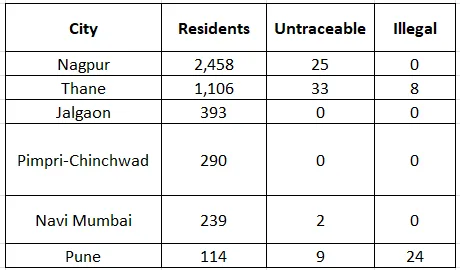
Other districts such as Amravati, Ahmednagar, Solapur, and Nashik also house smaller numbers, prompting statewide surveillance operations.
Nagpur and Thane, with high numbers of untraceable Pakistanis, have been designated high-risk zones.
Pune’s shockingly high number of illegal Pakistanis (24) raises serious red flags, given its proximity to critical military installations and sensitive research hubs.
The cancellation of visas is not an isolated administrative step—it’s a loud and deliberate message to Pakistan, its terror proxies, and sympathizers: “India will no longer tolerate any foreign national—especially from a hostile state—using its land as a staging ground, sanctuary, or hideout for terrorism.”
The move has massive diplomatic implications as well, further isolating Pakistan internationally as a breeding ground for terror. Domestically, the government’s action reflects a seismic shift: national security comes first, even if it means radical measures.
Uttar Pradesh Chief Minister Yogi Adityanath captured the prevailing sentiment when he thundered: “The new India does not provoke, but if provoked, it does not spare.” This message resonates deeply with a nation still mourning its dead and demanding accountability after Pahalgam.
State and central security agencies have swung into high-alert mode:
- Surveillance Teams: Special units have been deployed across Maharashtra’s sensitive cities to trace the missing nationals.
- Deportation Cells: Emergency cells have been set up to expedite deportation processes, cutting red tape.
- Intelligence Grid Activation: Internal movement of Pakistani nationals is being monitored via an enhanced intelligence-sharing grid between states.
The Home Ministry has ordered that no Pakistani national with a visa discrepancy or illegal status be allowed to remain on Indian soil beyond the month of May 2025.
Notably, the Intelligence Bureau (IB) has also handed over the list of around 5000 Pakistani nationals living in the national capital to the Delhi police to ensure these people return home. The visas of Pakistan nationals have been revoked in the wake of the recent directive of the centre, prompted by a recent terrorist attack on tourists in the Pahalgam district of J&K.
The Foreign Regional Registration Office (FRRO) has shared the list with a special branch of the Delhi police, and it was further shared with the district concerned for further verification and identification.
The list includes the names of Hindu Pakistan nationals who have Long Term Visas (LTVs) and are exempted.
“The list has been handed over to the district concerned for verification, and asked the Pak nationals to return to their homeland. Central and North East districts have a high number of Pakistani nationals living in the area,” said a senior official.
The official added that a meeting was called over the matter and Delhi police has been instructed to take immediate action on the matter. Senior officers are monitoring the situation.
The officers of the special branch of the Delhi police and the Intelligence Bureau have been entrusted to collect information about these Pakistani nationals residing in Delhi and ask them to leave India at the earliest.
Another officer confirmed that they have two lists of 3000 and 2000 Pakistan nationals staying in Delhi. There are certain names that overlap, and it is subject to verification of their stay as many Pakistan nationals have already left.
According to estimates, around 900 people are living near Majnu Ka Tila and 600-700 near Signature Bridge.















Comments