





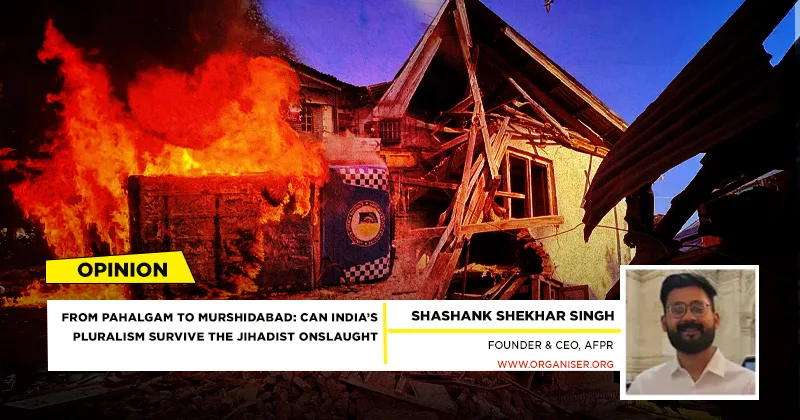
The terror attack in Pahalgam, J&K, on April 22, 2025, which killed 26 people, including 25 Indian tourists, and the communal violence in Murshidabad, West Bengal, on April 11, 2025, which claimed three lives and displaced 300 Hindu families, are chilling manifestations of radical Islamist ideology targeting Hindus. These incidents, marked by explicit religious profiling, expose the systemic threat radical Islam poses to India’s pluralistic ethos, internal stability, and external security. As Hindu society grapples with questions about its reliance on state protection and the need for community resilience, the Indian state faces a critical juncture: it must deliver robust law and order to protect law-abiding Hindu citizens or risk communal flare-ups and eroded trust. Recognising radical Islam as a global and domestic challenge is essential for India and the world to safeguard pluralism and prevent further destabilization.
In Pahalgam, militants from The Resistance Front, an offshoot of Lashkar-e-Taiba, systematically targeted Hindus, sparing Muslims after identity checks, as survivors recounted. A survivor described gunmen accusing her family of supporting Prime Minister Narendra Modi before killing her male relatives, while Surse noted a Muslim tourist was spared after verification. Similarly, in Murshidabad, sparked by protests against the Waqf (Amendment) Act, Hindu families faced orchestrated attacks—homes marked with ink and torched, and individuals forced to chant Islamic slogans. The violence, killing a father and son in Jafrabad among others, left a “pervasive sense of fear” among Hindus, particularly Dalits. BJP leaders alleged local Muslims aided attackers in identifying Hindu properties, while VHP activists claimed a broader conspiracy. X posts linked the attacks as acts of “Islamic Jihad,” amplifying fears of a coordinated threat. Both incidents, occurring within weeks, underscore radical Islam’s intent to fracture India’s pluralistic fabric, with Pahalgam tied to Pakistan-backed militancy and Murshidabad reflecting local radicalization with alleged foreign involvement.
These attacks are not isolated but part of a historical continuum of violence against Hindus, from medieval temple destructions and Partition massacres to the 1990s exodus of over 300,000 Kashmiri Pandits and recent incidents like the 2020 Delhi riots and 2022 Udaipur beheading. Despite Hindus constituting 79.8 per cent of India’s population (2011 Census), this pattern fuels a sense of vulnerability, driven by the asymmetry of organized violence. Radical Islamist groups, often supported by Pakistan’s military-jihadi complex, operate with clear religious objectives, exploiting communal fault lines to sow division. In Pahalgam, the attack aligns with the “Idea of Pakistan,” which views Kashmir as an unfinished project of Partition, backed by declassified 1990s evidence of ISI funding. In Murshidabad, a Muslim-majority district (66 per cent Muslim), alleged Bangladeshi terror links suggest external influence, highlighting the multifaceted nature of the threat.
The impact on India’s internal security is profound. The Pahalgam attack devastated Kashmir’s tourism sector, which saw 35 lakh visitors in 2024, with cancellations from West Bengal and Assam threatening livelihoods of hoteliers, pony wallahs, and guides. Murshidabad’s violence displaced families, destroyed properties, and fueled protests, with NCW reports of molestation underscoring the human toll. These incidents erode trust in state institutions, as seen in X posts demanding justice and protests in Kolkata and Srinagar. Communal polarization risks escalating, with hashtags like #HinduLivesMatter reflecting Hindu frustration. Externally, the threat undermines India’s sovereignty. Pakistan’s support for militancy, evident in algam, and alleged Bangladeshi links in Murshidabad, challenge India’s western and eastern borders. A weak response could embolden jihadist networks, weakening India’s global stance against terrorism.
India’s response to Pahalgam—downgrading ties with Pakistan, suspending the Indus Waters Treaty, closing the Attari-Wagah border, and launching a security operation—demonstrates resolve. In Murshidabad, West Bengal police arrested 276 suspects and registered over 30 FIRs. However, the recurring nature of these attacks, rooted in radical Islam’s centuries-old challenge to pluralism, demands a comprehensive counter-strategy. The state must prioritize intelligence-driven operations to disrupt domestic and cross-border terror networks, coupled with de-radicalization programs to counter extremist propaganda targeting youth. Interfaith dialogue, emphasizing India’s syncretic principle that truth has many paths, can distinguish radical Islam from mainstream Islam, mitigating polarization. A neoliberal approach—rooted in resilience, rule of law, and democratic values—frames decisive action as essential to pluralism, countering narratives that misrepresent such measures as excessive.
Hindu society is now confronting critical questions: Must Hindus build community resilience through local vigilance, legal self-defense training, and civic organizations promoting pluralistic values? This shift reflects a growing realization that over-dependence on the state has been costly. The Kashmiri Pandit exodus, where state failures left communities defenseless, and Murshidabad’s delayed response highlight this vulnerability. Educational initiatives promoting pluralism can counter exclusivist narratives, ensuring Hindus in Muslim-majority areas feel secure. Community-led efforts, supported by local governance, can deter communal flare-ups, addressing failures like those in Murshidabad. These questions signal a demand for the state to deliver on its core mandate: ensuring law and order for law-abiding Hindu citizens. Failure risks communal unrest, as frustration over targeted attacks could fuel counter-violence, undermining India’s pluralistic ethos.
The global community must also recognize radical Islam as a systemic threat. From Al-Qaeda to ISIS, these movements destabilize pluralistic societies worldwide, requiring cooperation to curb terror funding and propaganda. India’s experience—facing radicalization within and across its borders—mirrors global challenges, underscoring the need for a unified response. India’s internal and external security are intertwined with its handling of radical Islam. Internally, radicalized elements exploit communal fault lines, as seen in Murshidabad and Pahalgam. Externally, Pakistan’s militancy and alleged Bangladeshi links demand robust border security and diplomatic pressure. A lax approach risks destabilizing regions like Kashmir and West Bengal, weakening India’s global position. A resilient strategy—integrating security, de-radicalization, and societal unity—deters threats, restores confidence in tourism and local economies, and reinforces India’s pluralistic identity.
Philosophically, a society’s survival depends on a cohesive cultural foundation, vulnerable to corrosive influences. India’s pluralistic bedrock, rooted in its syncretic ethos, fosters resilience against radical Islam’s negation. The struggle for cultural recognition requires asserting identity against existential threats, as both attacks aimed to erase Hindu presence. Decisive measures, rooted in societal welfare, preserve space for compassion and coexistence. By blending proactive security, interfaith dialogue, and economic support for affected regions, India can ensure that Kashmir’s beauty and Murshidabad’s diversity symbolize unity, safeguarding the compassionate heart of the “Idea of India.” The state’s ability to meet Hindu citizens’ expectations for security will determine whether it can uphold pluralism or face a fractured future.















Comments