





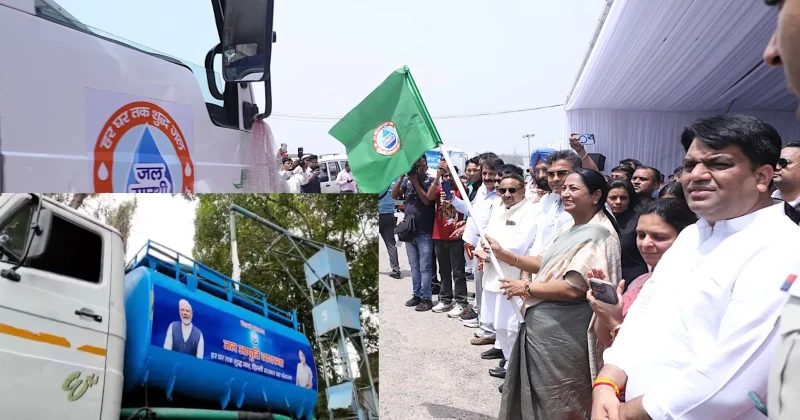
On April 20, Chief Minister Rekha Gupta flagged off 1,111 GPS-enabled water tankers from the Nirankari Ground in Burari, signalling the beginning of a new era of transparent, corruption-free water distribution in the capital.
This massive deployment—executed within just 10 weeks of the BJP government taking charge—is being hailed as a watershed moment for Delhiites who have long suffered under the grip of the tanker mafia, a shadowy network that thrived under the previous regime, exploiting residents during summer shortages.
“Every drop is now traceable. This is accountability in action. This is not headline politics. This is real governance,” said CM Rekha Gupta, as tankers rolled out with fanfare but firm purpose.
For years, Delhi’s residents—particularly in outer colonies, unauthorized settlements, and low-income localities—faced an uncertain summer every year. Water would often vanish without explanation, tankers were hijacked or rerouted, and those who could not afford to buy black-market water simply went without.
Under the previous Aam Aadmi Party (AAP) government, complaints about tanker mafia activities were routinely ignored or downplayed. There was no reliable tracking system, no citizen interface, and no transparency in distribution. “What was needed was political will—and that’s exactly what CM Rekha Gupta has shown,” said Water Minister Parvesh Verma. “The tanker mafia has looted Delhi for a decade. Today, we’re putting an end to it.”
Each of the 1,111 tankers launched is fitted with state-of-the-art GPS tracking, allowing the Delhi Jal Board (DJB) command center to monitor their real-time location, speed, stops, and delivery times. But the innovation doesn’t stop there:
- Mobile App Access: Citizens can now track tanker movements on their phones, eliminating dependency on intermediaries.
- Sensor-Based Monitoring: Sensors on tankers will verify delivery at designated spots, ensuring quantity and location compliance.
- Command Centre Dashboard: A dedicated war room at DJB HQ provides a live feed of the entire tanker fleet, increasing response time to complaints and tampering.
- Citizen Redressal: The mobile app includes a complaint portal, allowing residents to report diversions, delays, or mismanagement.
Chief Minister Rekha Gupta made it clear that the GPS tanker fleet is a transitional step, not a permanent solution. “Our ultimate goal is to provide 100 per cent piped water connectivity to every household in Delhi. No one should need a water tanker. But until that goal is achieved, we will ensure that even one drop of water doesn’t go unaccounted for,” she said.
A new town planning initiative is already underway to map unconnected zones, prioritize infrastructure upgrades, and ensure that budget allocations are spent on improving pipelines and treatment facilities. The Delhi government has earmarked Rs 9,000 crore in the 2025–26 budget for water sector reform—arguably the largest ever allocation to Delhi’s water infrastructure in a single financial year.
While the AAP attempted to brush aside the initiative as “repainting old tankers,” citing GPS features allegedly installed years ago, their claims were swiftly dismissed by both government officials and Delhi residents.
“If AAP had GPS-enabled tankers since 2015, then why didn’t they stop the tanker mafia? Why did people still have to bribe drivers for water?” asked Virendra Sachdeva, President of Delhi BJP.
Many in the public echoed this sentiment, calling the new initiative a “breath of fresh air” in the face of the usual summer despair. Sunita Devi, a resident of Sangam Vihar, one of Delhi’s worst-hit water-scarce colonies, said, “This is the first time in years we know where the tanker is, when it will come, and how much water we will get. Earlier, it was guesswork and begging.”
Minister Kapil Mishra didn’t mince words when addressing Delhi’s systemic water corruption. “This is not just a water crisis—it’s a governance crisis that was deliberately allowed to grow under AAP. In just 10 weeks, we’ve done what AAP didn’t do in 10 years: stand up to the mafia, put citizens first, and restore order.”
Mishra reiterated that this is part of PM Narendra Modi’s ‘Har Ghar Jal’ vision—a commitment to ensure safe, accessible, and affordable drinking water for all citizens.
This initiative is part of a multi-tiered water management strategy that includes:
- Crackdown on illegal borewells and water theft
- Reform of Delhi Jal Board’s billing and pipeline maintenance
- Upgrading water treatment plants and increasing supply from Yamuna and Ganga basin allocations.
In a city of nearly 2 crore residents, this technological intervention—if sustained and expanded—could redefine urban water management for the entire country.
















Comments